
these farmers protect drinking water
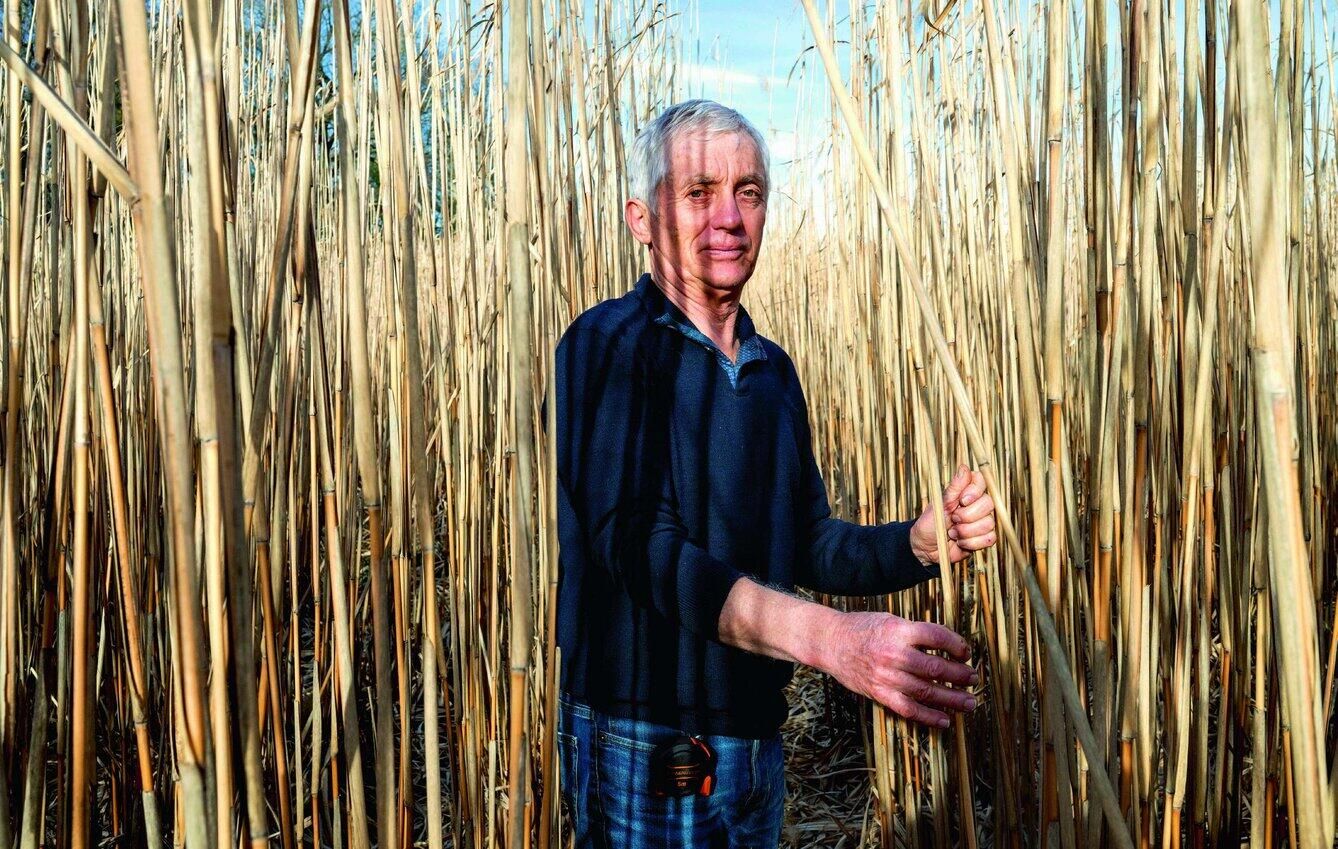
Between Saintes and Rochefort (Charente-Maritime), the Charente plain of agricultural Saintonge unfurls its fields of arable crops as far as the eye can see. Here, wheat, barley and even corn are mainly intended for export via the nearby port of La Rochelle. At the bend of a road, a few meters from the Arnoult river, the dry and tight canes of the Miscanthus emerge in the middle of this flat landscape: they stretch almost two meters above the ground.
Daniel Séguin slips in then leans admiringly towards the ground littered with large blond locks. “Look how clean it is!” Fallen leaves prevent weeds from growing. And they enrich the soil as they decompose. No need for fertilizers or phytosanitary products. That’s what’s interesting here,” explains the farmer, who grew corn on this same plot until 2021. But the plant with golden grains, greedy in chemistry, posed a problem near the La Roche catchment.
Not far from the edge of the field, in fact, a building hides the pumps which fetch water intended for human consumption underground. Next to it, a concrete cube houses the activated carbons which filter the pollutants so that it is “ready to drink”, and sent to the La Clisse water tower. This priority catchment is one of four in the rural Arnoult-Lucérat watershed, a vast catchment supply area of 32,000 ha, strategic in the supply of drinking water to the Charentais coast.
“Here, the water tables are shallow, therefore very sensitive to diffuse pollution caused by nitrogen fertilizers and phytosanitary products,” explains Hortense Bret, director of the water and sanitation union Eau 17, to which 432 municipalities in Charente-Maritime belong. Since 2010, we have been carrying out an action plan with volunteer farmers to regain the quality of raw water used for the production of drinking water. »
The issues? Maintain, or even reopen, these vital points where groundwater is taken. In France, for forty years, a third of catchments have had to be abandoned due to poor water quality. Sometimes due to pollution of industrial or even historical origin (residues of explosives from wars), but mainly due to excessive levels of nitrates and pesticides.
Since the Grenelle de l’environnement (2007) which aimed to regain water quality, the situation has deteriorated instead of improving. In 2023, nearly 17 million French people had consumed tap water at least once that did not meet quality limits, according to the Ministry of Health.
PFAS, these “eternal pollutants” which have long-term consequences on health, are increasingly better detected thanks to progress in science, and they have entered the public debate on water. A subject of concern for three quarters of French people according to the latest Water barometer.
Hortense Bret fully shares this concern: “Will in five years, given the new molecules that we will identify in groundwater, we will still be able to make drinking water? And if so, at what cost? The safest solution for future generations is to avoid pollution at the source. »
Prevention rather than cure, therefore. Carried out in conjunction with the Chamber of Agriculture of Charente-Maritime and Deux-Sèvres, the Re-Sources d’Eau 17 program consists of a “toolbox” tailor-made for this territory in order to involve the farmers concerned in more protective practices.
The safest solution for future generations is to avoid pollution at the source.
Hortense Bret
“Produce, produce, produce”
First key to debunking pollutants in priority catchments: financial aid. This year, 252,000 euros (partly financed by the region and the water agency) are planned to see miscanthus, alfalfa, hemp, etc. grow. In Saint-Romain-de-Benet, Denis and Stella Faucheraud joined the process in 2023. “We are from a generation where we had to produce, produce, produce. But we feel the wind turning. And we see the planet is doing badly,” confides the cereal grower, who conventionally cultivates 120 ha of wheat, corn, barley and sunflowers.
Today, he diversifies his crop rotation by adding soya. “The advantage is that it requires almost no fertilizer or herbicide. It takes nitrogen from the air and returns it to the soil. The wheat growing behind is beautiful. » This legume, more virtuous but less profitable than wheat or corn, is supported at the rate of 300 euros per hectare, with a three-year commitment.
Unlike cereals which are subject to market fluctuations, the farmer is also guaranteed to sell soya at a minimum price. In partnership with several cooperatives and the Chamber of Agriculture of Charente-Maritime and Deux-Sèvres, Eau 17 has coordinated the creation of a sector to provide this local protein to the laying hens of the Loué group. A way to secure the farmer’s income and commitment, once the aid has ended.
Put cows in the meadow: the water union also acts by purchasing land located within the immediate perimeter of the catchment. Priority is then given to the installation of meadows or organic crops, recognized as best protecting the resource.
Thus, after signing an environmental rural lease, Samuel Caillon, an organic farmer with 50 dairy cows, was able to access a plot of land sloping gently towards the priority catchment of Tout Vent, in Landrais. “This hayfield allows me to harvest the stock of hay that I lacked to get through the winters,” he rejoices today.
Volunteering that struggles
So many tools which therefore rely on the voluntary work of farmers working in these strategic areas. 26% of them use it in the Arnoult-Lucérat catchment area. A figure which may seem low… but which is nevertheless above the average of other programs of this type existing in France, from Paris to the Alsace plain via Brittany and Isère.
The national body Chambers of Agriculture France highlighted, in a document, 17 territories which carry out actions with the agricultural world. “Since the Grenelle de l’environnement, local authorities have had the obligation to define an action plan on catchments recognized as priorities by the State. But in the majority of cases, it is difficult to mobilize more than 15 to 20% of farmers, explains Régis Taisne, head of the water cycle department at the National Federation of Granting and Governed Communities (FNCCR), which represents the majority of communities managing drinking water and sanitation. Thanks to substantial resources, Eau de Paris has managed to reach significantly more in certain areas but, nationally, this remains very insufficient to have a real reversal of pollution trends. We should reach at least 80% of them. »
How can we get more farmers involved in becoming guardians of drinking water? “As soon as we have a commitment from communities, the State and associated funding, it works,” believes Arnaud Delestre, cereal grower in Yonne and first vice-president of Chambers of Agriculture France. But we see real territorial inequalities, because not all water services, especially in rural areas, have the means to structure sectors or help farmers change their practices. »
An inequality which also concerns municipal and community elected officials, who are legally responsible for the quality of tap water. The FNCCR has therefore been asking for a real commitment from the State for several years: it alone has the means to go through the regulatory process when the incentive measures prove insufficient.
“The prefects can decide on a whole series of mandatory measures for the protection of the catchment, if voluntary action is not enough to return to acceptable pollution thresholds,” explains Régis Taisne. But it is very rare that these constraints are put in place because it generally ends with manure in the prefecture’s courtyard. »
Health and public finances
Another lever for improving water quality: the common agricultural policy, which is in the process of being renegotiated for 2028. France has the possibility of directing European aid (9 billion per year currently) towards more virtuous practices. In a report which caused a stir in 2024, an interministerial mission therefore pleaded for much greater support for organic farming.
Making what preserves drinking water more attractive seems to come naturally. But in many minds there is still the idea that technologies will be able to overcome the pollution threatening our health. However, the current cost of curative treatments was assessed as three times higher than preventive actions by a Senate mission. And that’s without counting future investments to eliminate new molecules like PFAS.
According to Martial Koney, president of UFC-Que Choisir 17, there is an urgent need to act not only for human health… but also for that of public finances. “Treating a single molecule can result in considerable investments,” he worries. To remove atrazine (herbicide banned in France since 2003 but still present in waters, editor’s note) it was necessary to invest 750,000 euros in a unit in Sainte-Lheurine, in 2025. The more we advance, the more toxic metabolites we discover in the raw water. This will represent a considerable cost for society, and therefore the consumer. » Guardians of a vital resource, farmers are also the best defenses against the explosion of our water bills.
Water, a flammable political subject
How can we better protect catchments? In February 2026, a bill proposed by the environmentalist MP Jean-Claude Raux aimed to ban, by 2030, phytosanitary products on the most fragile catchments, and to establish a national list of metabolites to monitor. But the debate in session met opposition from the right, the National Rally and part of the Macronist group, in the name of the priority given to agricultural productivity.
The hot topic of water protection should return at the beginning of April 2026 with the presentation to the Council of Ministers of the so-called “agricultural emergency” bill, a political response to the demonstrations in winter 2025. According to a version of the text distributed in the press, it would reduce certain environmental rules and local consultations in order to facilitate storage projects for irrigation, including the famous “basins”.
What proportion of agricultural land is located in drinking water catchment areas?
8% of the French useful agricultural area is located in a so-called “priority” catchment supply area.
Source: Chambers of Agriculture France.
What is a catchment feeding area used for?
Catchment supply area: area whose water (table water, river, etc.) is intended to produce drinking water.


