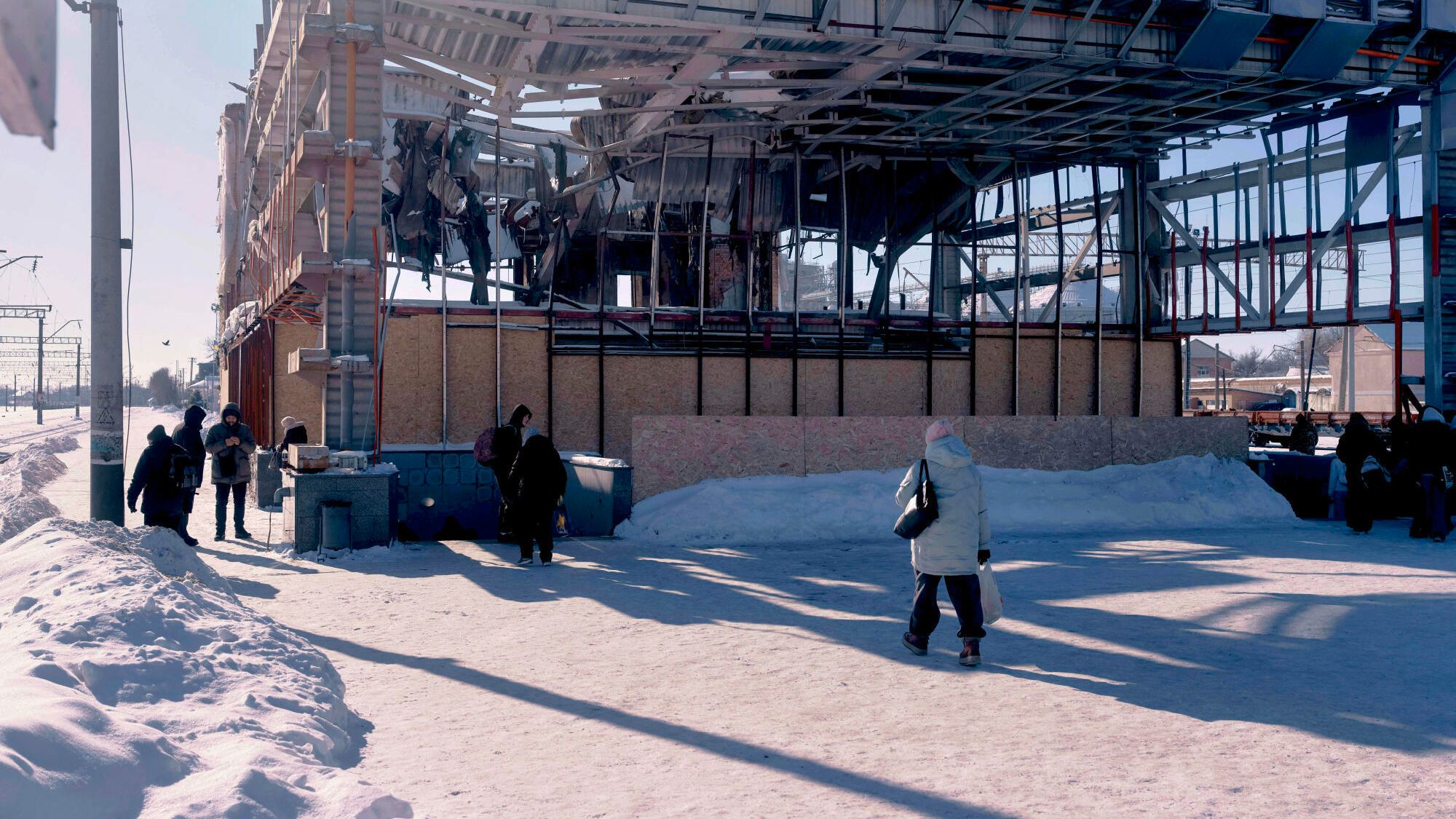
in Fastiv, bombings, electricity shortages and daily life under conflict
“It’s very strange, daily life continues in Fastiv. Despite residents leaving the city and the arrival of displaced people who came to take refuge with us because of the fighting or the Russian occupation, our population remains stable, at around 52,000 inhabitants. But this normality is only a facade: the war hits with full force. What a life! How could anyone get used to Russian bombing?
Last December alone, we suffered 70 drone attacks. Our station was completely destroyed. However, it is vital for our city and allows us to connect with kyiv, the capital, located a little less than 100 km from here. We are truly at a crossroads in Ukraine. Foreign heads of state have visited us, like Emmanuel Macron or Joe Biden. We were not able to completely repair it, but it is working again thanks to the means at hand. There is no longer any automatic signaling. An agent raises a flag to regulate train traffic, as in the 19th century.
War does not only destroy our infrastructure.
In 2025, the number of births in Fastiv was halved compared to 2021. As women experience their pregnancy under constant stress, we pay great attention to the health of newborns. We have set up numerous centers to provide medical monitoring. We note, with great concern, an increase in the number of children with disabilities since the start of the war.
In particular, we observe numerous developmental delays. For older children, the consequences are sometimes extremely serious. We see cases of cardiac arrest in adolescents. Last year, in shock after a bombing, a 13-year-old boy’s heart stopped. He was able to be resuscitated. Recently, another 11 year old did not survive…
In these conditions, surviving on a daily basis becomes a constant battle. We are also experiencing electricity shortages, always due to Russian strikes. Dwellings that rely on an individual electrical system have on average one hour of electricity, followed by twelve hours of outage. Nearly 5,000 homes can no longer heat themselves. At the moment, the thermometer drops to minus twenty degrees outside. Residents risk dying from the cold. We have made emergency beds available in hospitals and schools, with priority given to women with young children.
School, which should be a refuge, has become a place of fear. Children must hide in a shelter at each alert. However, we are seriously lacking underground refuges. It takes 2,000 euros per inhabitant to build a suitable shelter, that is to say capable of withstanding a missile attack. We would need bunkers protecting hundreds, if not thousands, of people. Budget that we don’t have. So, a large number of our schoolchildren leave their establishment. They have to run outside to reach the rustic basement of a neighboring building. It is even more dangerous for our children in kindergarten. The siren sometimes sounds during their nap. You have to wake them up, then get them dressed in a hurry. Impossible to let them go out without coats in these freezing temperatures. And yet, Fastiv is far from the front line. In Kharkiv or Zaporizhia, closer in the east of the country, the alarm sometimes sounds too late. For our part, it’s often a matter of minutes. In these circumstances, classes are frequently interrupted. There can be around five to six alerts per day.
And then we have our soldiers sent to the front
The pain of seeing them return in a coffin is unbearable… Fastiv is a small town, everyone knows each other. With each procession, residents reach the entrance to the town and line up to wait for the hearse to pass. Then they kneel as the vehicle passes in front of them. We then gather in the central square, where a memorial has been erected in memory of the fallen soldiers. On this large wall in the colors of Ukraine, 225 portraits are hung. Faces we will never forget. The conflict enters its fifth year, but the people of Fastiv hold on. As long as Russia does not let go of Ukraine, no one here can envisage an end to the war.”