our last visit before it closes
The countdown is on. On March 31, 2026, the Montparnasse Tower, with its 210 m and its half-century of verticality, will close its doors for a major renovation. Its reopening is planned for the end of 2030.
Since its inauguration in 1973, a space called L’Observatoire has welcomed visitors at the top of the Parisian skyscraper. Before closing, it was time to go up there one last time. This Wednesday, February 25, 2026 offered ideal conditions: the azure sky and the mildness of spring promised a beautiful moment at the top of the City of Lights.
Go to the foot of the dark monolith. After passing the control gate at reception, everything accelerates: 38 seconds are enough to reach the 56th floor. My neighbor holds his breath in the elevator which vibrates slightly. Then the doors open… and immediately, Paris shrinks.
Before us, bathed in light, the emblematic monuments of the capital draw a legible map that we can take in at a single glance: the Luxembourg gardens, the Notre-Dame cathedral sailing on the Île de la Cité, the golden dome of the Invalides, the Center Pompidou, the Montmartre hill dominated by the Sacré-Cœur, the Arc de Triomphe and of course… the Eiffel Tower. “It looks like a giant model,” notes an astonished mother who came with her children.
A panorama to understand Paris
The 56th floor not only shows Paris: it explains it. “It’s a unique point of view for understanding the architecture, the urban grid and the evolution of the city,” underlines Laurence Le Gouic-Parot, member of the L’Observatoire team. Floor plans help with orientation. Since 2023, virtual reality terminals have offered 2.5 minute capsules retracing the great eras: Lutetia in the 3rd century, medieval Paris, the Universal Exhibition of 1889… “We wanted to provide a historical building block to understand the layers that are superimposed before our eyes,” she explains.
For many tourists, The Observatory constitutes an ideal first stop in their stay: a way to choose which neighborhoods to explore. Others prefer to go up there last, to locate the places they have visited. “Foreign school groups love this moment of synthesis: they connect what they discovered on the ground to the entire Parisian landscape,” she observes.
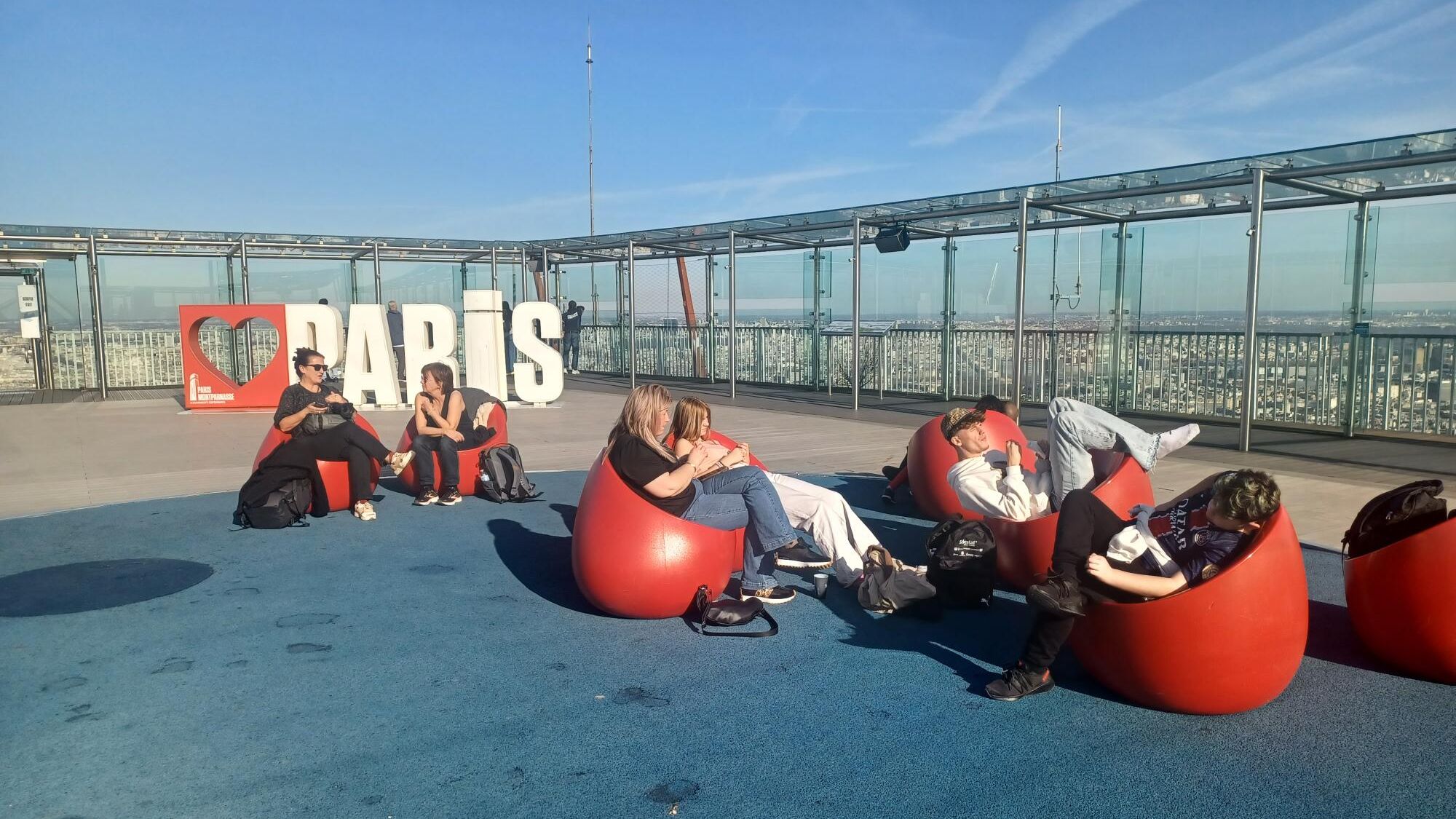
It’s time to take the exterior staircase which leads to the 800 m² terrace on the 59th floor. At this height, on a clear day, the view extends up to 40 km. And at dusk, a unique spectacle plays out: “Our slots are taken by storm for the sunsets,” confides our guide. Even gray days offer a suspended moment: “Sometimes we are above a sea of clouds,” she continues.
Expertise born at the Montparnasse Tower and exported around the world
On a daily basis, around thirty people run this place, open seven days a week, which has welcomed around 30 million visitors in fifty years. For them too, the March 31 closure is a pivotal moment. “The Montparnasse Tower really needs renovation work. It’s an opportunity to think about renewal… So we were prepared, but it always does something,” confides Claire Delaire, operations director of the site, who recalls in passing that L’Observatoire has been a family adventure from the beginning, made possible thanks to an agreement signed with the co-ownership, and which has never ceased to innovate and be a source of inspiration.
Since 1973, L’Observatoire has in fact developed a unique expertise which has been exported, supported by the company Magnificity: that of creating immersive experiences at height. They are now deployed at the Euromast in Rotterdam (Netherlands), at 875 North Michigan Avenue in Chicago (United States), at the Berlin Television Tower (Germany), and recently at the Varso Tower in Warsaw (Poland).
Everywhere, these places have become important tourist stops. By thus connecting metropolises at their highest points, this French know-how which originated at the Montparnasse Tower, offers a world seen from above, where each panorama becomes a story to tell.