The Angel in the Cemetery — How One Figure Came to Watch Over American Graves
Stand at the gates of any large nineteenth-century American cemetery — Green-Wood in Brooklyn, Laurel Hill in Philadelphia, Spring Grove in Cincinnati — and the figures are everywhere. Wings folded over family plots. Heads bowed above obelisks. A hand pointing skyward, a trumpet raised, a wreath held out over a name. The angel is the most reproduced figure in American funerary art by an enormous margin, and the reasons it earned that position explain why it still dominates the category today.
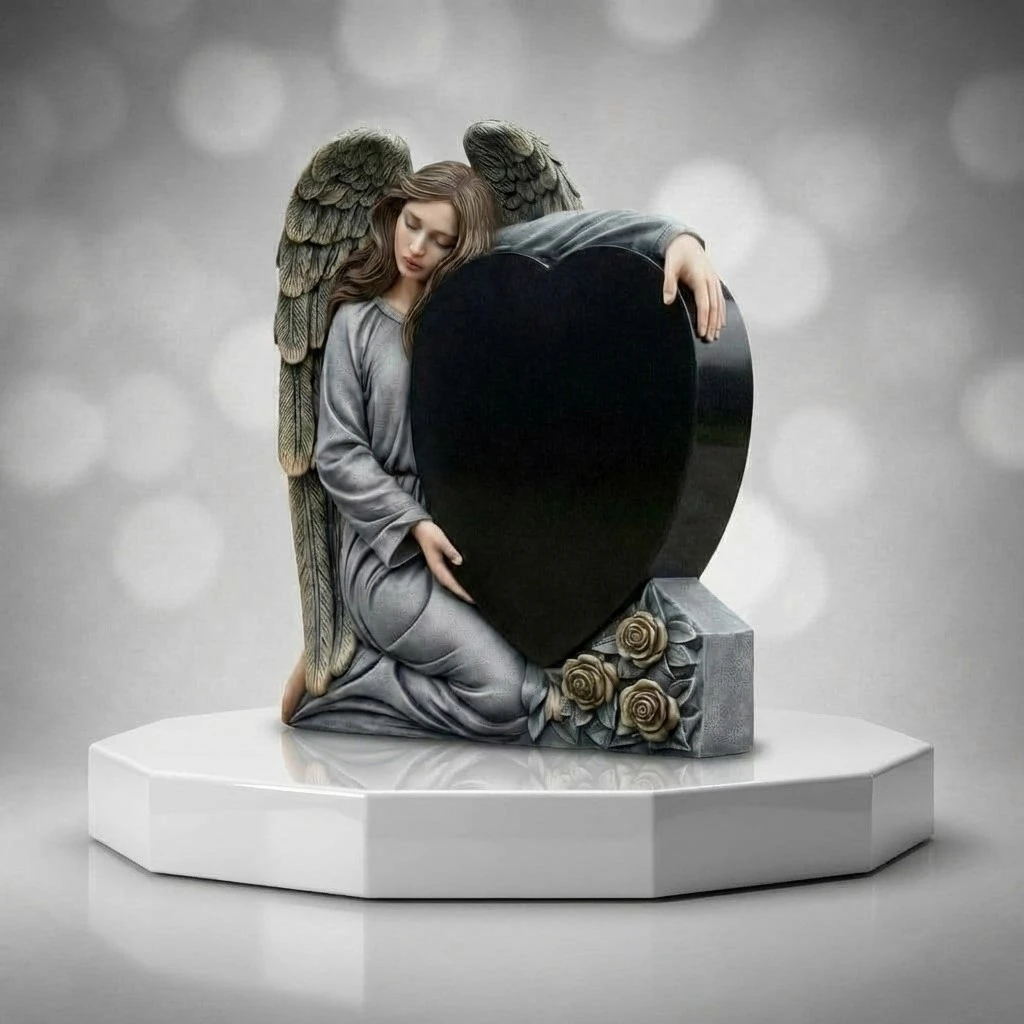
The figure arrived with the rural cemetery movement of the 1830s and 1840s, when American burial moved out of crowded churchyards into landscaped grounds designed as much for the living as the dead. Those new cemeteries were public sculpture gardens in practice, and families who could commission marble wanted figures that communicated across denominational lines to every visitor walking the paths. The angel did exactly that. A cross declared a specific faith. A weeping willow declared sorrow. The angel declared something broader and more useful — a guardian present at the grave, a messenger between the living and whatever comes next — legible to Catholic, Protestant, and unchurched visitors alike. Victorian iconography sorted the figure into recognizable types that monument catalogs still echo: the guardian with sheltering wings, the recording angel with book or scroll, the mourning angel bowed in grief, the messenger pointing upward, the child’s angel watching over the smallest graves.
Marble was the medium of that first golden age, and marble was also its undoing. The soft stone that let Victorian carvers render feathers and drapery weathered badly; a century of acid rain and freeze-thaw has melted detail off thousands of those original figures. The category’s modern revival rests on a harder material and a different toolset. Dense granite resists everything that destroyed the marble angels, and CNC relief carving followed by hand finishing now produces figures with genuine sculptural depth at a price ordinary families can reach — which the Victorian versions, hand-carved in marble, never were.
The contemporary category that families browse under headstones with angels divides along one fundamental line: the carved figure versus the etched image. They are different objects with different presences, and the choice between them shapes everything else.
The relief-carved angel is sculpture. The figure rises physically from the stone face — a bowed praying form, folded wings framing an inscription panel, a full standing guardian — and because it has actual depth, it interacts with light the way sculpture does. Morning sun puts shadows into the wing recesses. Late afternoon rakes across the drapery folds. The stone changes through the day, which is something no flat image can do, and visitors respond to it; relief figures are the pieces people touch. Designs like the Angel Prayer Relief Upright carry this tradition directly: the praying figure raised from polished granite, the carving deep enough to read from the path.
The etched angel is illustration, and on the right stone it is extraordinary. Laser etching on polished black granite renders an angel in photographic tonal detail — every feather gradation, faces with genuine expression, compositions too fine for any chisel. Indian Black and Shanxi Black give the technique its full range; the image emerges in silvery tones against the dark polish. Families wanting a specific devotional image, a Raphael-style figure, or an angel composed with a portrait of the person tend toward etching for exactly this precision.
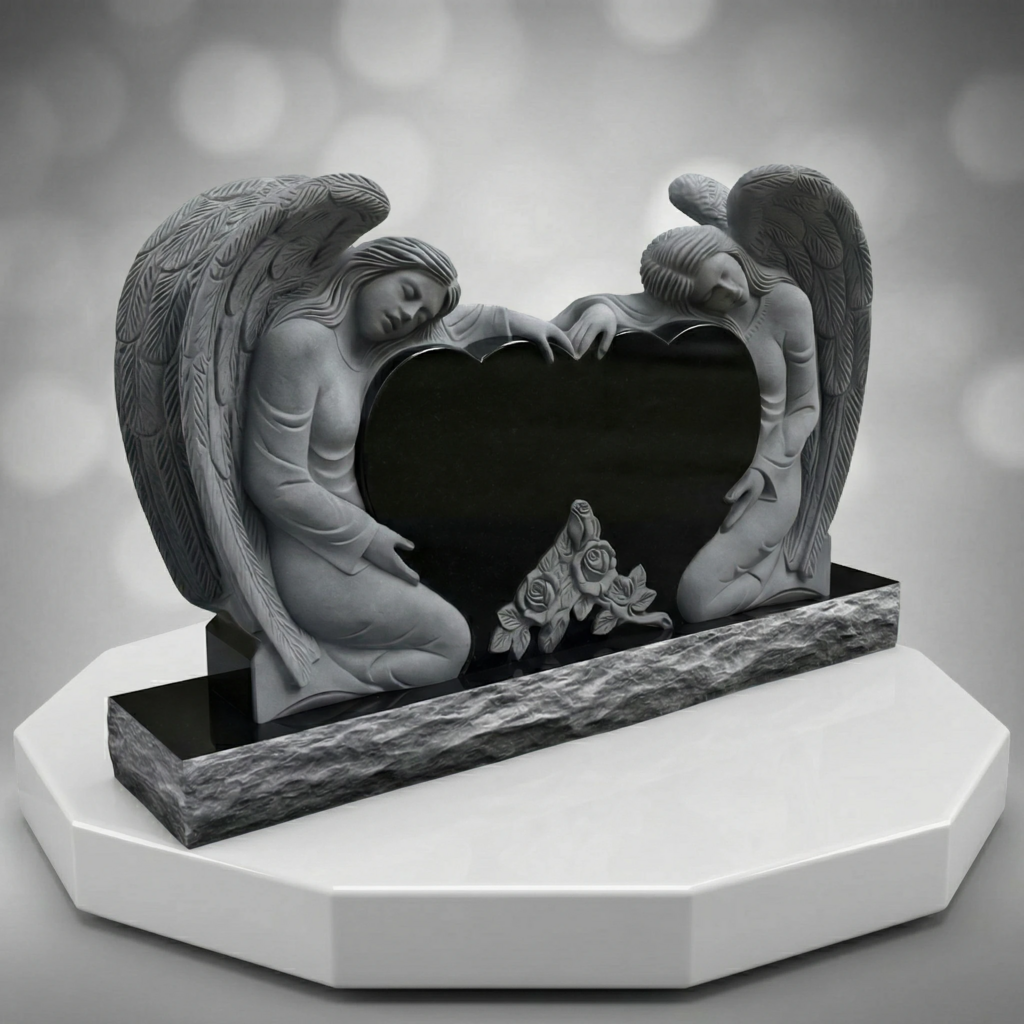
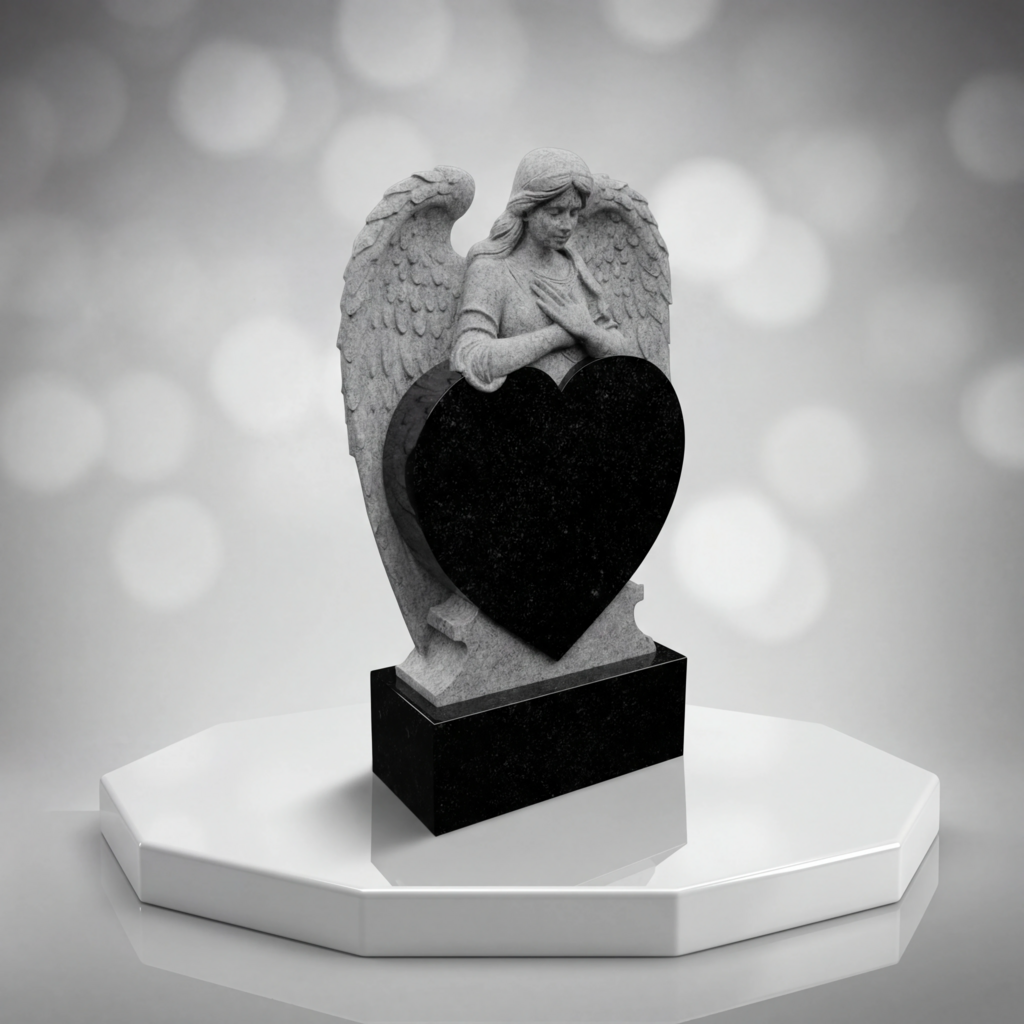
Between the two sit the hybrid forms that define much of the current catalog. The Angel Wings Cross Memorial integrates carved wings with the cross silhouette into a single architectural shape — the monument itself becomes the figure. Angel-and-heart designs place a small carved or etched figure against a heart silhouette, a configuration requested most often for children and young adults. Wing-shaped companion stones spread a pair of carved wings across two inscription panels, the figure sheltering both names at once.
Granite choice sets the register of the figure as much as the carving style does. The same praying angel reads formal and eternal in Indian Black, soft and consoling in Morning Rose, luminous in Carrara White — the pale stones carry an association with the original marble angels that many families respond to without knowing why. Bahama Blue and Blue Pearl bring depth and a faint sky association that suits the subject. Balmoral Red warms the figure into something more intimate than monumental.
The practical considerations are the standard upright checklist with one addition. Relief carving adds projection, and a few cemetery sections measure maximum monument depth in ways that include it; section rules on height and base dimensions apply as they do to any standing stone. A producer who contacts the cemetery before production — confirming dimensions, foundation specification, and section rules — removes the risk entirely. The 3D design proof matters more in this category than almost anywhere else, because a carved figure’s proportions are nearly impossible to judge from a flat photograph; the proof renders the relief depth on the actual selected granite, and the AR view places the finished monument at true scale through a phone camera before anything is cut.
Demand for the figure has never really receded, and the geography of it is wide. Catholic sections in Chicago, Philadelphia, and northern New Jersey order the traditional bowed figures in volume. Non-denominational memorial parks in California, Texas, and Florida take the contemporary hybrids. The children’s sections everywhere take the small guardians, as they have since the Victorians. A hundred and eighty years after the first marble wings went up over American graves, the angel remains what it was at the start: the one figure that promises, to anyone passing at any distance, that someone is watching over this place.
H Stones produces the full angel category — relief-carved uprights, laser-etched figures, wing crosses, angel hearts, and companion designs — in more than 40 granite types with six-stage quality inspection, complete cemetery coordination, and nationwide installation from fourteen showrooms across eight states. Veterans receive 30% off with full payment; police officers and first responders, 25%. The catalog, transparent pricing, and the 3D and AR design tools are at hstones.com.