
the dikes of discord
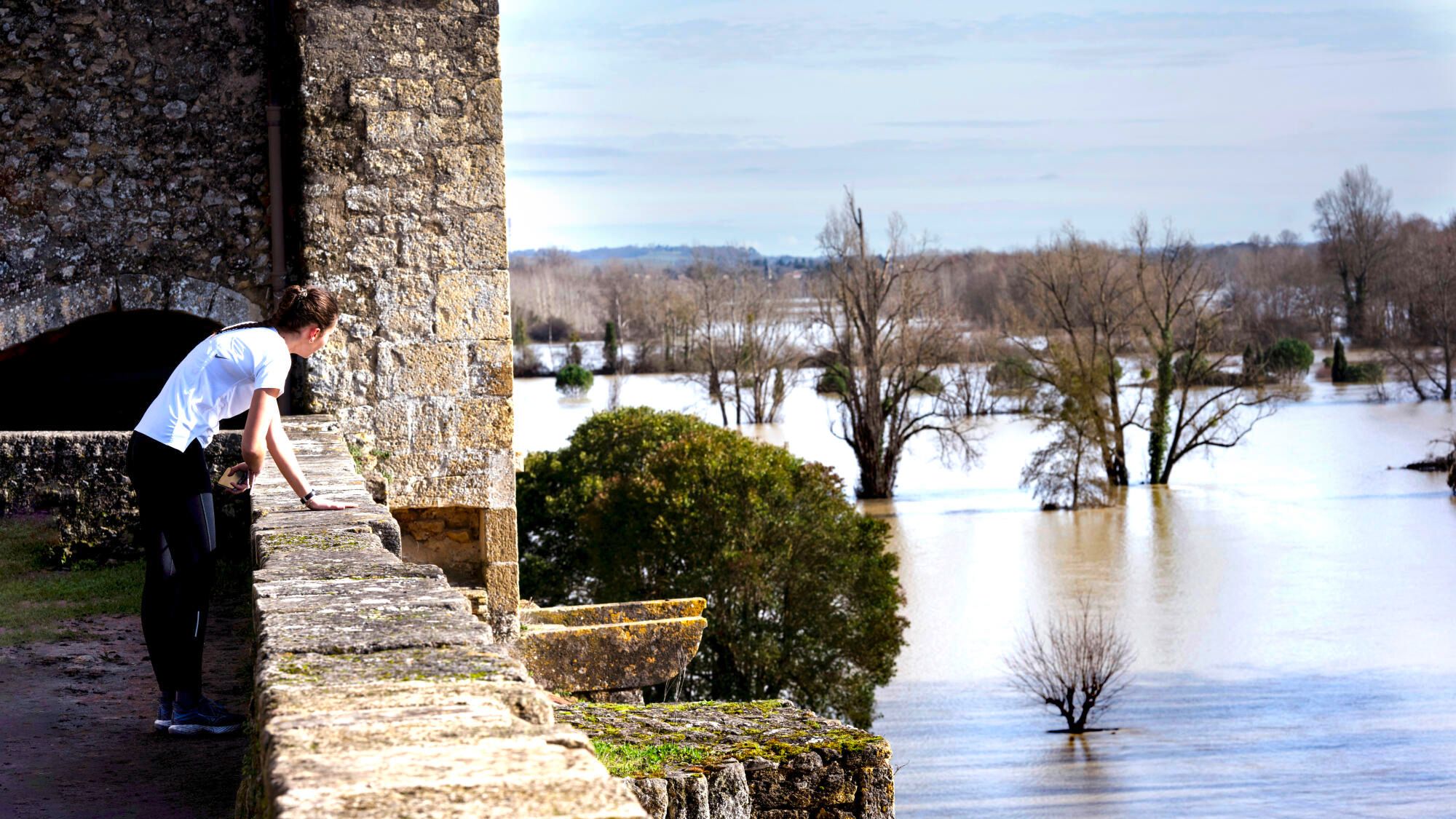
The tops of the pines and plane trees emerge with difficulty from the water. From the medieval ramparts of Saint-Macaire, in Gironde, passers-by observe the flood of the Garonne, which reached 10.45 m at its peak, Sunday February 15, and flooded the entire lower part of the village. “It’s very impressive, the power of this nature,” sighs Catherine, nodding her head. She, who walks daily along the banks of the river, had to find another path.
“Luckily for me, I live on sloping land, only the bottom of my garden is flooded,” confides this resident. “I have lived here for ten years, we had the same thing in 2021.” Catherine can thank the dike which protects the right bank of the Garonne for seven kilometers: with a height of 9.30 m, it largely contributed to protecting the homes, even if the water ended up passing over it.
Around twenty residents were directly affected, out of the 2,000 in the town. The work made it possible to contain the overflow for five days, precious time used to warn the population and organize themselves. However, this dike “should in principle be razed”, explains the mayor of Saint-Macaire, Cédric Gerbeau. “For two years, I have been engaged in citizen resistance by illegally maintaining it with municipal funds, to the tune of 20,000 euros per year, because I have no legal authority over it. »
Responsibility for dike maintenance previously fell to the State, which transferred it in January 2024 to the intercommunal authorities. The problem is that the community of communes of South Gironde voted against the resumption of this management. “The elected officials were afraid of the possibility that the dike would break because, in that case, it would be very, very expensive,” specifies the mayor. The one who is preparing to leave his chair in March criticizes his colleagues for “a lack of perspective”.
The anger of the mayors
From the peak, the decline reveals the damage caused to the asphalt of departmental road 113, the bridge of which allows you to span the river and reach Langon. A major axis of the territory used every day by at least 20,000 people. The mayor meets his constituents who have started crossing the bridge on foot again, while waiting for road traffic to be restored.
Fabrice Daulon comes to show his support. “We agree that it is useful to maintain the dikes, especially since bad weather of this type is likely to be more and more frequent,” confides the man who was once a municipal councilor in a neighboring town. However at the time, he had voted for the abandonment of competence, and he justifies it: “Small municipalities do not have the means. The State gets rid of too many things,” he laments.
Annie and Daniel, a Macarian couple aged around 70 – “we have two meters of water in the cellar, but the house is well above” – are also forgiving: “The mayor is right to be angry, but we understand the others, everyone has financial problems. » 15 km away, La Réole also has the feel of a seaside resort. From the terrace adjoining the town hall, Christophe Gardner observes the flooded landscape, “both beautiful but dramatic”.
The culture assistant, yellow vest on his back and boots on his feet, is preparing to take water level readings. “We are all on deck in this period of crisis, we take turns,” he confides. Unlike that of South-Gironde, the community of communes of Réolais has agreed to inherit the management of the dikes. To raise the 400,000 euros per year necessary for their maintenance, the intercommunality levies a tax of 16 euros per inhabitant.
Necessary work
During a visit to Gironde on February 16, the Minister of Ecological Transition, Monique Barbut, affirmed that “today, many communities are not using this resource to the maximum”. Comments poorly received on the ground, according to Christophe Gardner. “In any case, this tax is not enough,” he says, citing several surrounding places where the dikes have broken. “Everyone is furious. The answer is always: get over it, tax people. »
In 2023, the National Center for the Evaluation of Standards (Cnen) already regretted in an opinion that “the legislator was not concerned with the costs generated by the provisions of the law (from 2014 leading to the transfer of skills after a period of ten years, editor’s note) and the financial consequences which, in any case, were not sufficiently anticipated”. The institution predicts that the work necessary to adapt the dikes could reach 15 billion euros in the years to come. The water is going down but the bill remains.