The reasons that push the Society of Saint Pius X into schism with Rome
It was a last chance offer. To follow up on the announcement made on February 2 by the leaders of the Priestly Fraternity of Saint Pius The exercise was to be carried out in the coming months and postponed the ordination of bishops until later. Because, in the absence of the agreement of the Roman authorities, it would canonically constitute an act of rupture of communion. In other words, the confirmation of the Lefebvrist schism.
The meeting in Rome took place on February 12 in the presence of Cardinal Victor Manuel Fernandez, prefect of the dicastery for the Doctrine of the Faith. But six days later, the fundamentalist movement gave its official response, once again refusing the outstretched hand. According to them, the dialogue could no more succeed than the previous ones because the Society will continue to refuse the conclusions and the implementation of the Second Vatican Council.
Added to this observation of theological impasse is a technical emergency for the survival of the Fraternity itself, whose mother house is in Écône (Switzerland). Because, the death, in 2024, of the French Bernard Tissier de Mallerais (1945-2024) then in 2025 of the British Richard Williamson (1940-2025) reduces to two the number of bishops in office within the Fraternity, who can in particular continue to ordain priests. In this case, the Argentinian Alfonso de Galaterra (born in 1957) assistant to the current superior general and the Swiss Bernard Fellay (born in 1958). The latter, who had responsibility for the Fraternity during two mandates, attempted rapprochement with Rome on various occasions. But the test having not been conclusive, it is now the pride of place for the most intransigent members of the movement that is given. The announcement of February 2 and the refusal of Rome’s proposal bear witness to this.
Thus, in half a century, what was at the beginning only a movement of contestation of the orientations resulting from the Second Vatican Council by the Spiritan bishop Marcel Lefebvre, has now transformed into an increasingly frontal opposition of certain conservative Catholic circles to everything that the Catholic Church deploys pastorally and theologically. Going so far as to want to “bring Rome back to Écône”, as one of the deceased bishops said publicly. Let us not be afraid of words: the schism is complete. A painful thorn for the current pope who has made it his ambition to work for the unity of the ecclesial body.
Half a century of opposition
Founded in 1970 by Mgr Lefebvre (1905-1991), a Spiritan missionary who became archbishop of Dakar, the Society lost its canonical recognition five years later, after the founder ordained priests without the authorization of Pope Paul VI. In those years, the bronca of these virulent Catholics was also manifested by the irregular occupation in 1977 (to the present day) of the Parisian church of Saint-Nicolas-du-Chardonnet. In 1988, the crisis came to light when Bishop Lefebvre also ordained four bishops for his movement, without the agreement of Pope John Paul II: the breakdown in communion was clear.
A wound that Pope Benedict XVI certainly tried to heal by lifting, in 2009, the excommunication of these bishops, while maintaining an official body of dialogue between Rome and Écône. Even Pope Francis has given several signs of pastoral appeasement, for example authorizing marriages (2017) then confessions (2025) by priests of the Society.
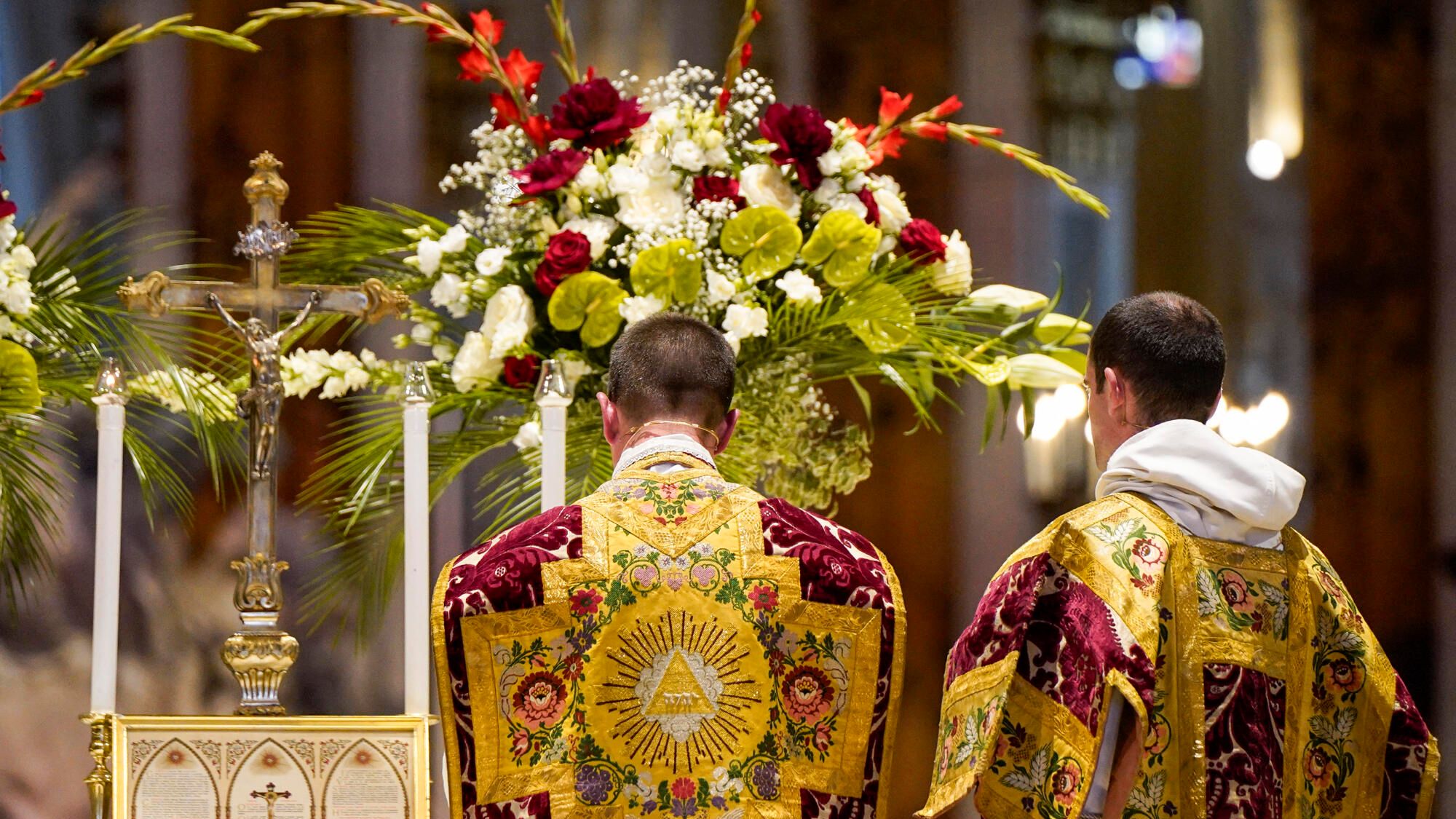
But the question of the form of the celebration of the Catholic rite has continued to fester over the years. To put an end to the confusion thus maintained, the Argentine pope publishes in 2021 the motu proprio Traditions custodes recalling that there is only one form of Roman rite for celebrating the Mass and which is based on the liturgical books promulgated by Paul VI and John Paul II. The celebration of the rite of the Society of Saint Pius
Why such restrictions? Contrary to what some defenders of the Tridentine rite suggest, the issue is not only liturgical or aesthetic. Above all, within the dioceses, it is a question of maintaining the unity of the faith proclaimed and celebrated. An ambition often contested by groups using ancient catechetical, liturgical and theological references to call into question the very legitimacy of what local Catholic communities proclaim and celebrate.
Pope Francis’ decision also demonstrated the fascination that the Society exercises in certain conservative circles of the Catholic Church. In fact, the Fraternity, which has good financial relays and good networks of influence, has increased, over the past years, its establishments in France, Germany and the United States. With very different realities, the movement announces that it is present in more than seventy countries, in churches, chapels, chaplaincies served by more than 700 priests. Those who demand a stricter relationship with Catholic Tradition now come together in an associative nebula that also feeds several small religious communities (Fanjeaux, Avrillé, Morgon, Bellaigue, Trévoux). With also its share of difficulties and scandals, often quickly hushed up.
Schism, excommunication: what do these words cover?
The law of the Catholic Church – “canon law” – defines the schism as the refusal to submit to the authority of the Pope and to be in communion with the members of the Catholic Church united under this authority.
Schism is distinguished fromheresy which is, on the part of a baptized Catholic, the obstinacy to deny or to doubt a truth of the faith of the Church.
Excommunication is the maximum punishment of Church justice: it is pronounced against people on the basis of their actions. A person who commits schism incurs excommunication. The purpose of this sentence is to call him to repentance and a return to unity. If the excommunicated person shows a change in his behavior and actions, the sentence is intended to be lifted.


