
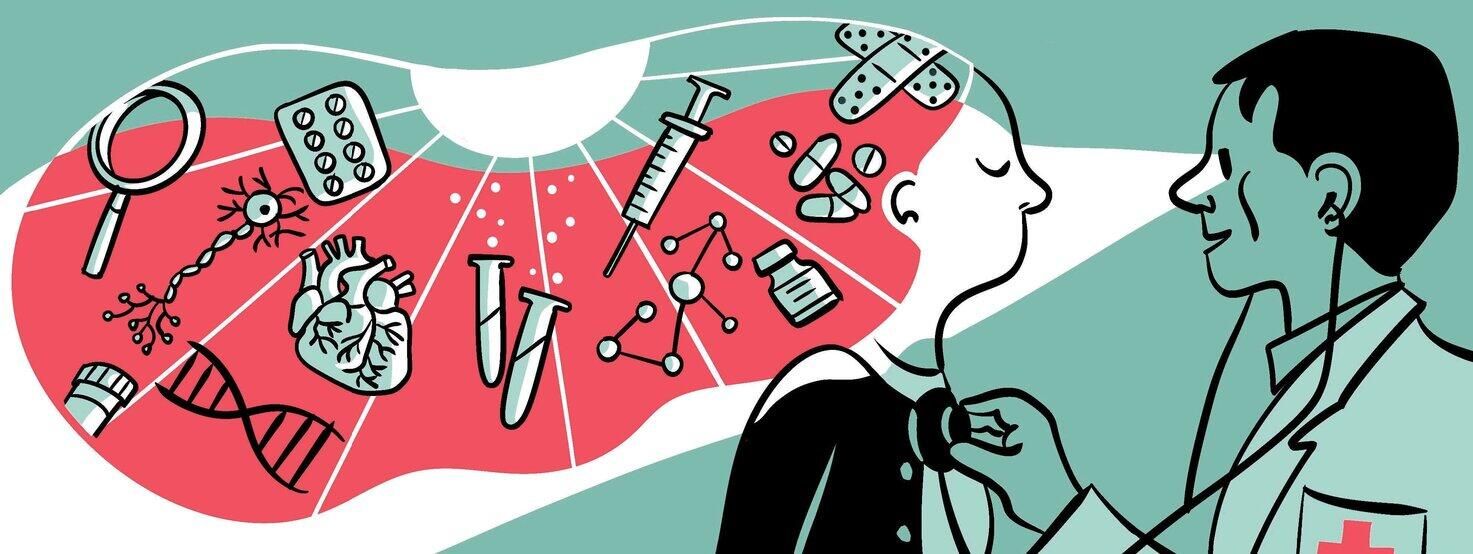
Why is it important to finally treat women… like women?
Situated on the peaks of Suresnes (Hauts-de-Seine), the Foch hospital deploys its four wings and their unobstructed view of the capital and the Eiffel Tower. This vast building was able to gain even more height by inaugurating, a year ago, the Institute of Women’s Health and Fertility, one of the rare centers dedicated to women’s health in a hospital environment. It offers women of all ages a care pathway in the same space: clinical expertise, examination and diagnostic rooms, etc.
“Its health policy was built around the moments that mark a woman’s life: fertility, pregnancy, menopause,” explains Sylvie Gasperowicz, midwife and health executive. No doubt, in part, because the Institute was born within the gynecology and reproductive medicine department of the hospital, directed by a leading authority in the field, Professor Jean-Marc Ayoubi.
But, a sign of the times, the provision of care is not limited to fertility and reproduction problems. “Women’s health must be treated as a whole,” says Professor Ayoubi. The center therefore houses several centers dedicated to chronic pain, cancer, and research.
“In France, less than a third of scientific researchers are women”
vie-publique.fr March 2025
Such structures are happy exceptions. In reality, the medical care of women remains worrying. If they live longer than men, they age in poorer health. Their disability-free life expectancy at age 65 has even declined since 2023, indicated the Directorate of Research, Studies, Evaluation and Statistics in January 2026.
In fact, women experience a delay in diagnosis and treatment. The example of a heart attack is emblematic. They call Samu on average fifteen minutes later than men, according to a Wamif study (2017-2019), in which Lariboisière hospital participated. “74,000 women die of a cardiovascular accident per year, compared to 69,000 men,” indicates Professor Martine Gilard, former president of the French Society of Cardiology and a pioneer in this field.
Because the symptoms, the vast majority of which are similar to those of men, can also sometimes be different: more diffuse pain, fatigue, nausea or vomiting. Some doctors ignore it – or still minimize it; women too. “There is a real loss of opportunity for women,” underlines Dr. Stéphanie Clément-Guinaudeau, cardiologist near Bordeaux (Gironde), who has been treating female patients for twenty years.
Improve support
Florence Blas had the bitter experience of this. Four years ago, this busy fifty-year-old experienced a sudden, severe pain in her back. Responsible for communications in Hauts-de-France, she is, despite everything, going on a business trip for a few days. When he returned, his pain spread to his shoulder and arm. His GP concluded that he had severe osteoarthritis and prescribed a powerful painkiller.
The pain returns, stronger. Florence increases the doses, goes to the emergency room. A few hours of waiting and an electrocardiogram later, she was sent home. Florence is “sorry for having disturbed them for nothing”. Except that his twinges redouble. Until in the middle of the night, she experienced unbearable pain in her chest and both arms. She drags herself to her cardiologist: bingo! He diagnosed a heart attack, called the Samu, who immediately took her to the hospital where she was operated on for a 90% blocked artery.
Today, Florence, dynamic and cheerful, recounts her misadventure half-jokingly. Only half, because the delay in diagnosis led to irrecoverable necrosis of his heart muscle. “I’m a textbook case: I didn’t want to worry my loved ones or disrupt the doctors’ busy schedule. I promised myself I would take care of my health “when I have time”. That is to say never! »
Like Florence, women hesitate, minimize, make appointments for their loved ones but rarely for themselves. Historian Muriel Salle*, lecturer at Claude-Bernard-Lyon-1 University (Rhône), quotes this quip that she borrows from a neurologist: “What is the best prevention of stroke in humans? His wife! »
More serious: 51% of them believe that their symptoms have at least once been downplayed or not taken seriously by a health professional because they are women, according to a French Hospital Federation/Ipsos survey (March 2025). Their poor care therefore results from a subtle cocktail between minimization on the part of women and ignorance of female specificities on the part of doctors.
Biological differences have long remained forgotten in medicine. “Medical knowledge was built on a masculine base. Because it was men who produced this knowledge, the medical profession having been prohibited to women until the 1880s,” recalls Muriel Salle. In other words, the norm is the male body.
That of women is an exception, even a dysfunctional organism. This perception explains in particular their long exclusion from scientific research. “Their hormonal cycle was accused of complicating the interpretation of the results,” laments Valérie Lemarchandel, scientific director of the Foundation for Medical Research. Result: researchers lack data on women.
However, biological differences are not reduced to genital and sexual organs. “Male and female fat, muscle and bone masses are not distributed in the same way,” notes Dr. Stéphanie Clément-Guinaudeau. Metabolisms and hormonal systems also work differently (read box at end of article).
Integrate women into research
These differences are reflected in the side effects of medications. There are almost twice as many side effects in women. “Women stop their treatments earlier than men,” says Professor Martine Gilard. Because we test the side effects mainly on the latter.
In laboratories, the animals tested are males. And then, during the research phases on defining the effectiveness of a treatment, few women are present. » A tablet takes twice as long to break down in a female body than in a male body. It must be said that the prototype of the studies is a man of 1.80 m and 77 kg…
“There remains a lot to do,” warns Professor Gilard: inform women, identify and prevent risk factors, offer assessments at different ages of life, communicate medical specialties, train future doctors… So many keys to truly personalized medicine.
*Co-author of Women and health, still a men’s affair?Ed. Belin, a reissue is planned for September 2026.
Diseases: partly biological inequalities
- Cardiovascular accidents: Young women are prone to a specific type of infarction, spontaneous coronary artery dissection. With equal tobacco consumption, women are more exposed to cardiovascular pathologies (+ 25%).
- Autoimmune diseases: four out of five patients with autoimmune diseases are women. Rheumatoid arthritis affects three times more women than men. Three-quarters of people with multiple sclerosis are women. On the other hand, responses to vaccines are better in women.
- Cancers: studies indicate a more positive response of men to immunotherapy. Side effects are more present in women.
- Alzheimer’s disease: two out of three patients are women.
Sources: European Heart Journal, Nature Research, Alzheimer’s Association, Public Health France.


