
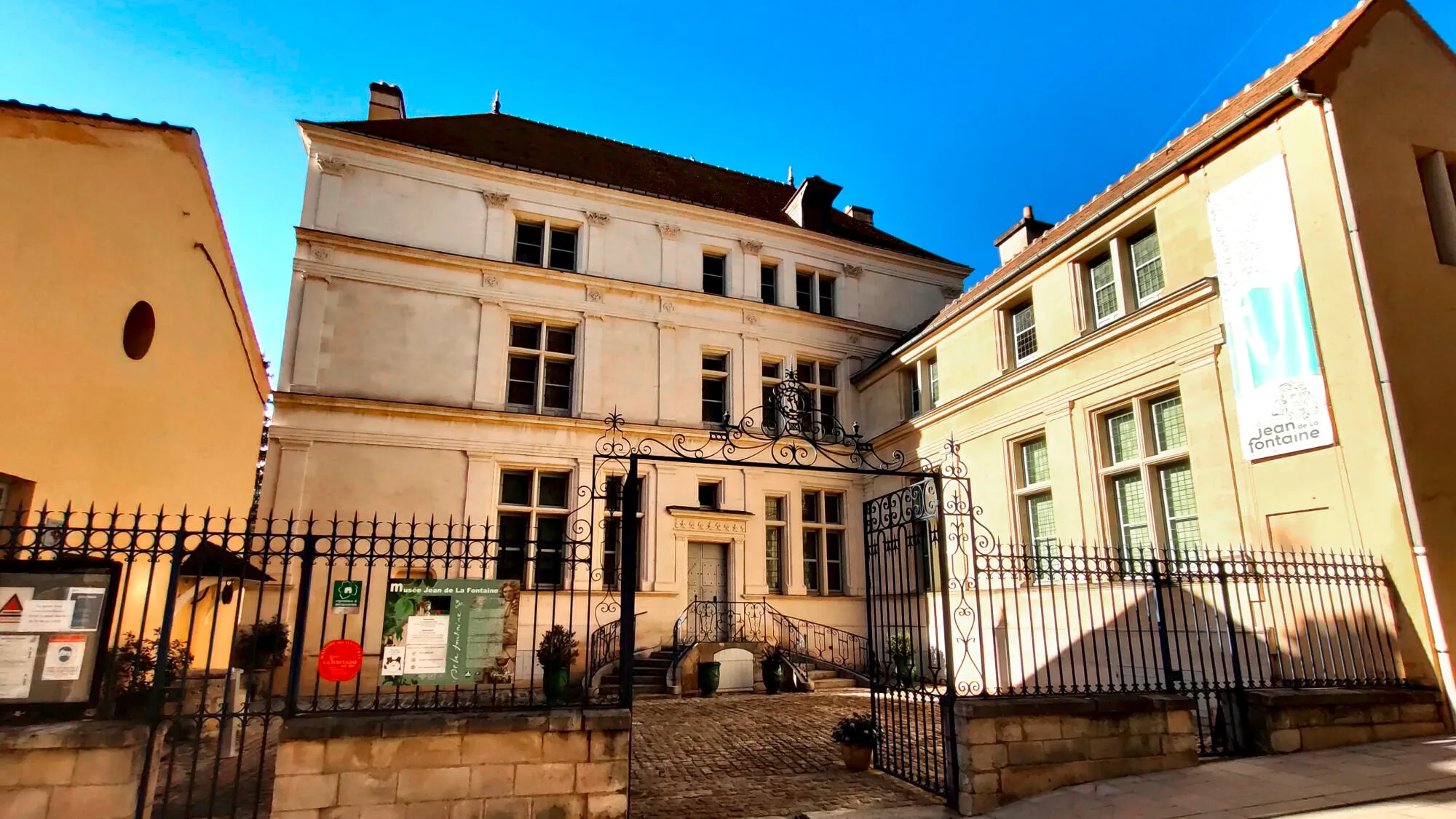
Reopening of the La Fontaine house
What do a group from an adult education center, German high school students and members of a seniors club have in common? They all met on March 5, 2026, at the newly reopened Jean-de-La-Fontaine museum.
Everyone knows – or thinks they know – the author of the Fables : for the former, it evokes memories of recitations learned at school; for adolescents from across the Rhine, it is a gateway to French culture. As for retirees, they see it as a reason for local pride: “Jean de La Fontaine got married here, in La Ferté-Milon, with a local girl, Marie Héricart,” Yves, 65, tells us.
The spirit of the place
At the entrance to the mansion where the writer was born and where he lived until the age of 55, Claire Tronson, one of the three mediators in charge of guided tours, warns: “Here, you will not find anything that belonged to him… except the house itself. These walls are those of his first steps, his first games, his first readings. It was here that he became a father, where he worked as a water and forest master. »
Then she admits: “Many gray areas surround her existence. The museum has only recovered as a period archive a baptism certificate, dated July 1621.”
What nevertheless endures in this place is the imprint that the author left with his 243 fables. Over the ages, these have inspired many artists, such as the painter Jean-Baptiste Oudry, in the 18th century, whose wallpaper panels illustrating The fox and the stork or drawings, like wash The Danube Peasant (1731).
In another register, tableware has also taken up these animal stories, as evidenced by candy boxes and illustrated plates from renowned manufacturers.
Unique set in the world
But the real treasure of the museum remains the collection of Baron Félix-Sébastien Feuillet de Conches. Between 1828 and 1840, this diplomat, passionate about La Fontaine, entrusted numerous ambassadors and consuls with sheets to be illustrated by the best artists from around the world: Chinese, Japanese, Indian, Persian miniatures…
Renowned French painters are also in demand, such as Delacroix, Ingres and Horace Vernet. This collection constitutes a unique ensemble in the world. Added to this are further acquisitions from the 20th century: etchings by Marc Chagall and lithographs by Salvador Dali.
The renovation of the museum made it possible to present numerous works previously kept in reserve. Above all, it shed light on the way in which Fables have irrigated artistic creation, served as an educational source, and constituted a popular reference in the service of mass consumption: images of Epinal, goose game, restaurant menus, wine labels, stamps, advertisements bear witness to this… Among these objects, a box of Camembert, for example, evokes The Raven and the Fox .
At the end of the visit, one observation emerges: thanks to its multiple representations and reinterpretations, the world of the fabulist gains consensus by reaching very diverse audiences. Yves, the retiree, discovered a poet “more complex and less frivolous” than he imagined, while Tobias, the high school student, sees “a real star”. Leaving Jean de La Fontaine’s house, it becomes clear that the Fables are no longer just the property of their author. They belong to each of us.


