
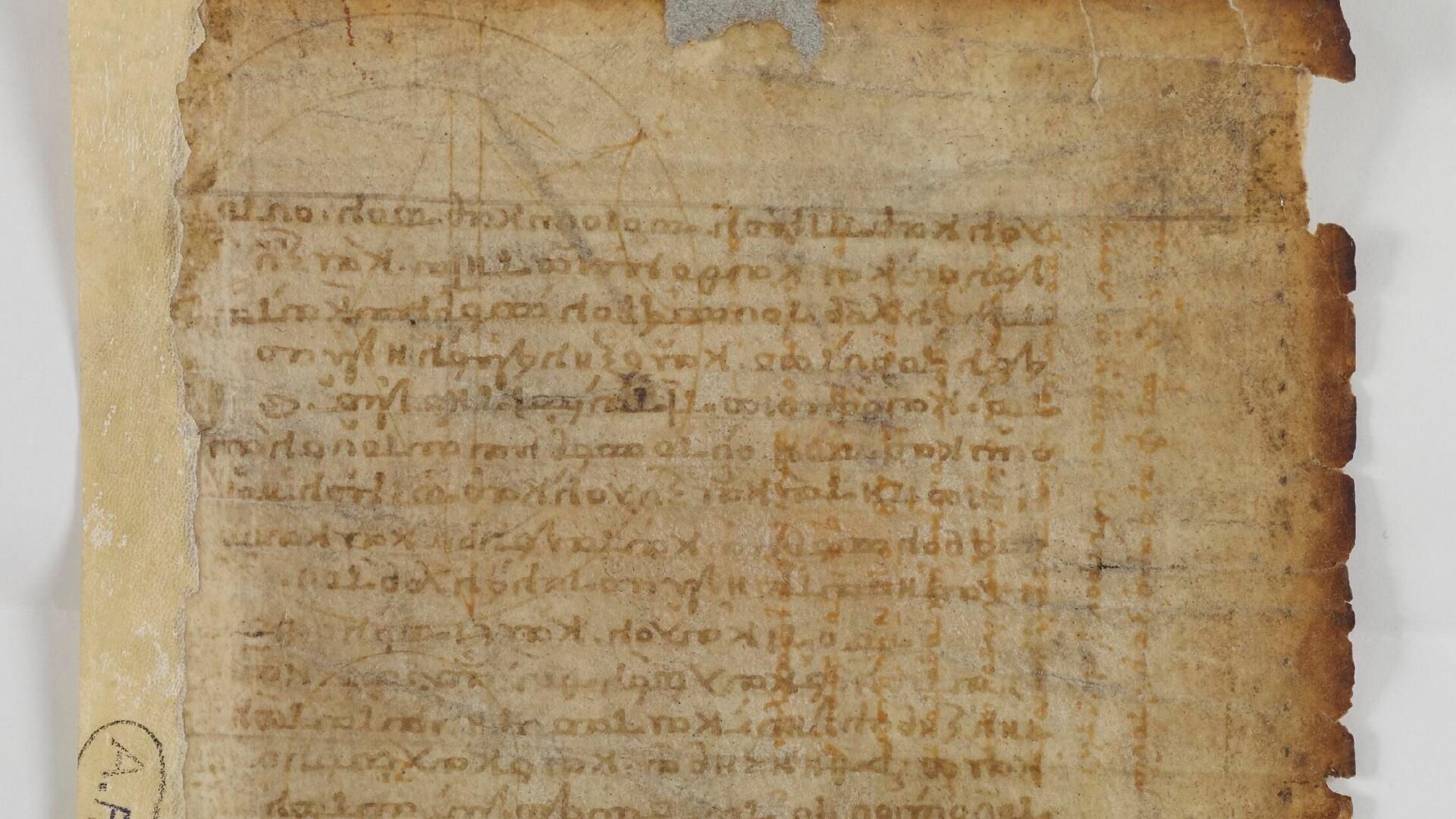
A page from Archimedes’ palimpsest found in Blois
“If someone had asked me six months ago if we could find this leaflet, I would have replied that it was like looking for a needle in a haystack. » And yet, it is indeed a page from Archimedes’ palimpsest that Victor Gysembergh identified at the Museum of Fine Arts in Blois (Loir-et-Cher), as indicated by the CNRS on March 9, 2026.
A specialist in ancient thought and texts, the CNRS researcher is used to examining city catalogs and digital databases in search of palimpsests. “A palimpsest is a recycled manuscript,” he explains. At the time, parchment was expensive. To give you an idea, one book was equivalent to a herd of animals. So we erased the text to rewrite on it. »
Search: “Palimpsest Blois”
A former royal city, Blois hosted for a long time part of the libraries of the kings of France before their centralization in Paris. “The idea of searching in this city started from a discussion between colleagues which evoked this episode in History,” says Victor Gysembergh.
By typing your keywords into the search engine of Arca, the global digital library of manuscripts, the image of a parchment appears. An illumination of the prophet Daniel with two lions adorns one side, the other is a succession of lines written by hand. This cursive writing “immediately alerts” the researcher: “I found it very similar to that of the Archimedes palimpsest preserved in Baltimore. » Another clue: a geometric figure is drawn there.
On the other side of his screen, Victor Gysembergh quickly deciphers the legible text and discovers that it is a passage from the treaty Of the sphere and the cylinder of Archimedes. It doesn’t take much to compare his find with photos of the original manuscript taken. The ambiguity is no longer in doubt: it is leaf 123 of the Greek mathematician’s palimpsest, considered lost since the end of the 20th century.
The oldest surviving copy of a text by Archimedes, born in the 3rd century BC, the work “is a rare text”. “He details the research that led him to his results,” explains Victor Gysembergh. Few ancient mathematicians left a trace of their demonstrations. »
A manuscript with an eventful destiny
For a long time, the original manuscript would have stayed in the Orthodox Patriarchate of Jerusalem, before landing in Constantinople. It was in this city, in 1906, that Johan Ludvig Heiberg, historian and Archimedes specialist, recognized him and undertook to photograph its 177 pages. Although the discovery of the codex caused a sensation at the time, it then disappeared without leaving any known official trace. We had to wait until the end of the 20th century to see it reappear in the private collection of a French family. With three sheets missing. According to Victor Gysembergh, illuminations would have been added during this time and exchanged, or even sold.
On October 29, 1998, the amputated manuscript was put up for auction in New York, at Christie’s. Acquired by an American collector for two million dollars, it was deposited a few months later at the Walters Art Museum in Baltimore (United States) where it has been preserved and studied ever since. As for our leaflet n°123, we only found it in 1974, when a certain André Frank bequeathed his collection of manuscripts to the city of Blois.
Technical aspect
Next step for the researcher: go to the royal city and “try out current technologies, such as a particle accelerator, to reveal the text under the illumination”. “It also opens up perspectives for the rest of the manuscript in Baltimore, certain pages of which have not yet been deciphered,” he rejoices, hoping that a new examination will also be carried out across the Atlantic – the last one dating from the 2000s.
And will we be able to find the last missing sheets? “Today, I would no longer say that it is impossible. The cutting would have taken place in France, they may be in private collections, libraries or museums in Europe, imagines Victor Gysembergh. If your readers are in possession of parchments with illuminations or cylinders…” The call is launched.


