Boards like paintings: Grenoble magnifies comics
At the Grenoble museum, until April 19, 2026, comic strips can no longer be read: they can be contemplated. Presented as real paintings, 400 original plates reveal the gesture and intention of comic book artists.
The exhibition Graphic epics at the same time embraces almost a century of creation, crossing the major centers of the genre: Europe, United States, Japan through Franco-Belgian classics, comics and mangas. The great traditions interact in a vast panorama where children’s and adult literature, intimate stories and fantastic epics, science fiction, thrillers, etc. mingle.
The first room of the exhibition, devoted to the history of comics in the 20th century, opens with Bécassine, born in 1905 under the pencil of Émile-Joseph Porphyre Pinchon, and a humorous drawing by Benjamin Rabier, Gédéon’s father, showing a dog pulling out a tooth from a rabbit under the amused gaze of the barnyard animals.
“A reminder that French comics are part of a long popular tradition,” underlines Sébastien Gokalp, director of the museum, who accompanies us on this visit.
The journey then reveals how the comic strip explores varied universes. It invites you to laugh, shiver, travel, be moved, discover history, or even simply give meaning to life.
Certainly, visitors find with emotion Spirou and Fantasio by André Franquin, Lucky Luke by Morris, Valerian by Jean-Claude Mézières or even The Rabbi’s Cat by Joann Sfar: figures who have spanned the decades and shaped the collective imagination.
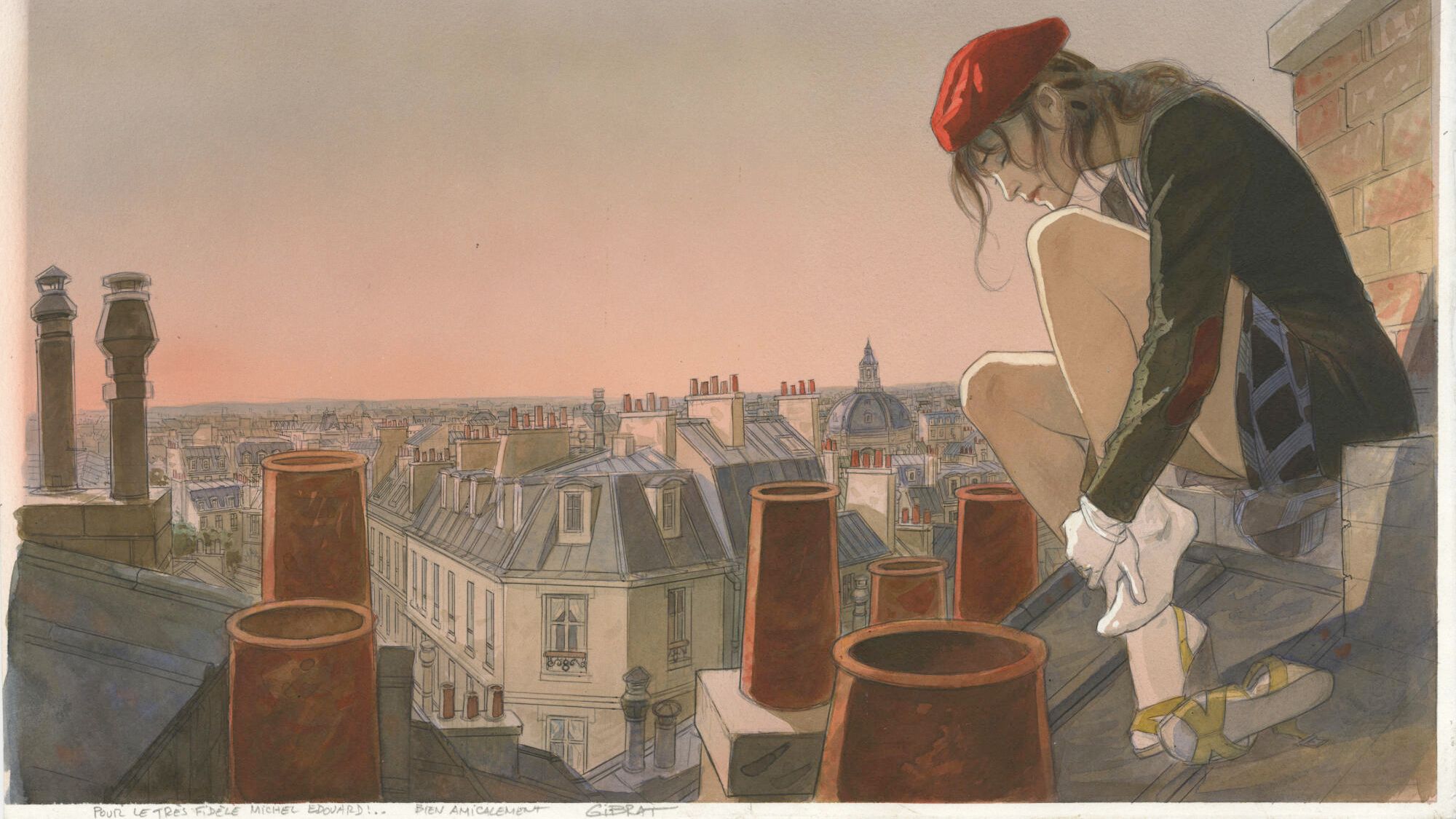
But the exhibition also reveals more introspective or contemplative works. In The Flight of the RavenJean-Pierre Gibrat sketches a young woman perched on a Parisian roof, bathed in diffused light where pink and gray respond to each other. A suspended scene offering silent poetry.
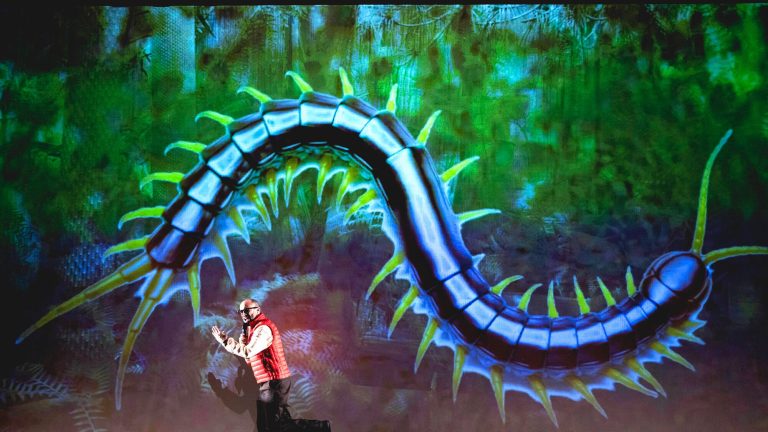
Another highlight: The Hunt for the Major by Moebius. Here, the laws of reality disintegrate. Acid colors in an arid desert, a man fleeing a giant rabbit and tiny creatures make up a dreamlike and disturbing world.
We don’t read this page: we wonder. “Like cinema, comics allow you to escape,” insists Sébastien Gokalp, emphasizing the narrative and emotional strength of “an accessible, inventive and resolutely plural medium.”
“In front of an exposed board, we perceive the quality of the drawing”
At the origin ofGraphic epics : an unprecedented partnership with the Hélène & Édouard Leclerc Fund for Culture in Landerneau (Finistère), which, for the first time, lent an exceptional selection from the Michel-Édouard Leclerc collection.
The latter has been collecting plates for over forty years and has met the greatest French, American and Japanese authors. “My objective was to save these works at a time when no public initiative supported this sector,” he explains.
Thanks to him, these boards were preserved. “This collection has become legendary, and never before has it been revealed to the public on such a scale,” observes the director. As for the International City of Comics and Images of Angoulême, it also joined the event by lending several iconic albums, from Tintin has Icy Fluid.
From Tarzan to the most contemporary mangas, including Barbarella and Les Bidochon, Graphic epicsdesigned for enthusiasts and novices alike, attracts schoolchildren, students, families and curious people of all ages.
“In front of an exposed board, we perceive the line, the space, the quality of the drawing. Whereas when we read a comic book, we are not immediately aware of it,” confides Sébastien Gokalp, before adding: “France is one of the countries where the 9th art is most appreciated; what’s more, she knew how to make this creation a heritage.” The Grenoble exhibition brilliantly confirms this!
Grenoble, the other comic book capital?
The capital of Isère appears to be a legitimate territory for the 9th art. One of the first comic strip exhibitions in France was presented there in 1977.
Even today, it remains a major hub for creation, publishing and distribution, thanks to its numerous specialized bookstores, the presence of the publisher Glénat and several local authors, like Jean-Marc Rochette, who lent a few plates for the exhibition, or Nicolas Keramidas.
Also note, in the department, an event that has become unmissable: the Alpe d’Huez comic book festival, the 19th edition of which will be held from April 10 to 12, 2026.