“Glacier – investigation into a disappearance”
Every day, glaciers melt and crack. In question? Global warming and pollution linked to human activity. Scientists are clear: there is an emergency, because those who disappear will never come back.
These ice giants are nevertheless fundamental. Without them, two billion humans could soon run out of fresh water. As for sea levels, they could rise dangerously. 900 million people living near the coast are already affected by rising sea waters, estimated at four millimeters per year.
A global click
Faced with this observation, the year 2025 constituted a tipping point. A collective awareness driven by the United Nations (UN) which, on the occasion of COP29, presented it as “the international year of glacier preservation”. It was on this occasion that the project for this documentary entitled Glaciers – investigation into a disappearanceavailable on the Arte.tv platform and broadcast on Tuesday March 3, 2026 on Arte.
Embody science
In an hour and a half, this program retraces two years of research and scientific actions carried out by glaciologists in the mountains, as well as on the two ice caps of Greenland and Antarctica. In turn, from the four corners of the globe, around ten experts speak. Among them, the French glaciologist Heidi Sevestre. “We felt a passion in her,” say directors Judith Rueff and Pierre-Olivier François. We wanted to film her in her role as a whistleblower. »
A word of cash
“Glaciers have always been unthought of. Many people considered them to be far from reality or were afraid of them” explains the researcher before rejoicing that things have recently changed: “the glaciologist community dares to express itself, motivated by taking action,” she rejoices. We see it in this film: scientists talk cash! It’s great, and it takes a lot of courage. »
This documentary highlights the work of these experts who are working hard to preserve these ice rocks. Collect samples, conduct analyses, record and compare data, warn populations… “Among these tasks, we especially try to anticipate and avoid the famous tipping point: the temperature from which all the problems will cascade. »
Complicated filming conditions
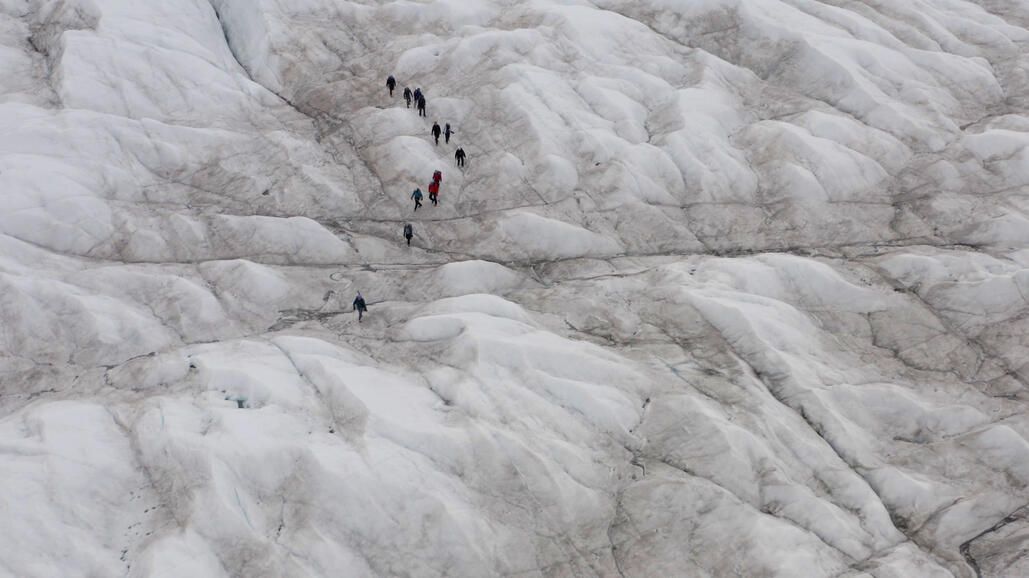
To document their actions, the directors accompanied the scientists as close as possible to the field. They followed, in western Greenland, the glaciologist Andrew Sole and a handful of his students who came to analyze the Isuunguata Sermia glacier and recover sensors installed during a previous trip.
“These five days have been trying. We were completely frozen and we slept in tents,” recalls Pierre-Olivier François, before recounting that the team was accompanied by armed men: “we couldn’t even go to the toilet without them. There were polar bears not far from the camp! »
The director has a moving memory of this trip. “When I found myself on the glacier, I was very moved,” he confides. We feel that it is not inert, that there is movement: it cracks, it makes noise, cracks form. And these ice waves, these colors… It’s just magnificent. »
Monitor, analyze and prevent
Another stop for the team: Kyrgyzstan, a country in Central Asia with more glaciers than the Alps and the Caucasus combined. Here, the filmmakers followed Witalij Saginajew, an expert on mountain dangers. They joined the monitoring post of the Adygene glacier, since a “glof” risks forming. In other words: the glacial lake threatens to flow into the valley.
“Kyrgyzstan was a very sporting stage for us,” assures Pierre-Olivier François. We each had a twenty kilo bag on our back. With all our equipment, our cameras and our drones, we had to call on porters to help us reach the post and the refuge perched at 3,600 meters above sea level. »
Wonder to raise awareness
If the documentary perfectly informs on current issues, it does not veer into catastrophism. “We could have, but we didn’t do it,” confides Pierre-Olivier François. This does not help the cause. We preferred to have a factual discourse, based on the words of scientists. »
The directors also focused on the quality of the images to tell this reality. “Amazement is very important when talking about these subjects,” they insist. It allows viewers to say to themselves: all this work is worth it, so what are we waiting for to mobilize? »
Glaciers – investigation into a disappearancea documentary broadcast on Arte on Tuesday March 3, 2026 at 9:05 p.m. and available on Arte.tv from February 24, 2026.
A screening open to the public and free will be organized at the Musée de la Marine upon registration on March 21, 2026 in Paris.