
his treasure revealed in Troyes
With brown hair and a rather long face, he must have looked proud in his rich costume adorned with gold and silver ornaments. He died young, shortly after age 30 according to the growth rings of his dental tissue. This Celtic prince has been examined from every angle since he was found under his mound. The research carried out on his remains and on the rich furnishings of his tomb are presented in a landmark exhibition at the Museum of Modern Art in Troyes (Aube).
The story begins in 2014, when archaeologists from Inrap, the public organization for preventive excavations, stripped the ground of a necropolis in Lavau, in the suburbs of the city. “We were surprised to discover a vast complex where several tombs and mounds from the early Iron Age (from the 8th to the 5th century BC) were gathered together, surrounded by ditches,” says Bastien Dubuis, head of the excavation and co-curator of the exhibition. Around 450 BC, the prince’s imposing tumulus, which marked the landscape on the banks of the Seine, was therefore part of a whole, with those of his ancestors buried one hundred and fifty years earlier.
Ceremonial float
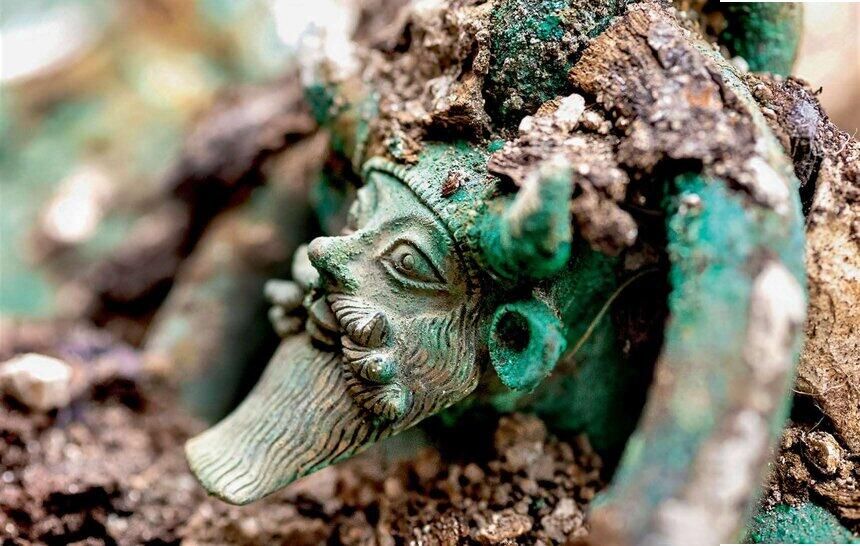
When a bronze head emerges from the earth, maliciously observing the archaeologists, they identify Acheloos, Greek god of the river, and understand that they are facing a major discovery: that of an inviolate princely tomb. Acheloos adorns the handle of an enormous cauldron… Émilie Millet, a specialist in metal objects, gets to work. “In addition to the cauldron, we discovered a whole service for drinking the wine it contained, during religious banquets,” she explains.
Immediately, the archaeologist compares this burial to the famous tomb of the Princess of Vix, discovered near Châtillon-sur-Seine (Côte-d’Or), not far from there, which also yielded a gigantic and richly decorated wine vase. The latter died only thirty years before the Prince of Lavau. Both were buried on their ceremonial chariot and wore a magnificent gold torc – the two necklaces have similarities in style.
“When we study the refined decoration of the objects from these princely tombs, we realize that there are many Greek and Etruscan influences mixed with typically Celtic motifs and know-how,” explains Émilie Millet, the other co-curator of the exhibition.
A real treasure
Around a virtual reconstruction of the tomb, projected on the ground, the route presents, in display cases with a yellow background, the real treasure that was discovered there. Jewelry, weapons and elements of tableware from other princely tombs – many discovered in Germany – are placed next to each other, on a brown background.
Baltic amber, black stone from England, Greek ceramics, imported gold, silver and tin… The tomb of Lavau confirms that, along the Seine, the Celtic principalities lived in constant and close relationship both with the Mediterranean world and with their northern neighbors.
At the same time, the exhibition gives an account of this magical Celtic world which is re-emerging: “Nothing in the choice of decorations and objects was due to chance,” explains Émilie Millet. The winged lions on the prince’s fibula (brooch) and the ducks on his torque evoke a mythological story. And the fact that he only carries a ceremonial knife indicates that he was more likely a “priest-king” than a warrior. » No doubt deified by his people, the Prince of Lavau has just acquired, under the gaze of scientists, a new share of immortality.


