
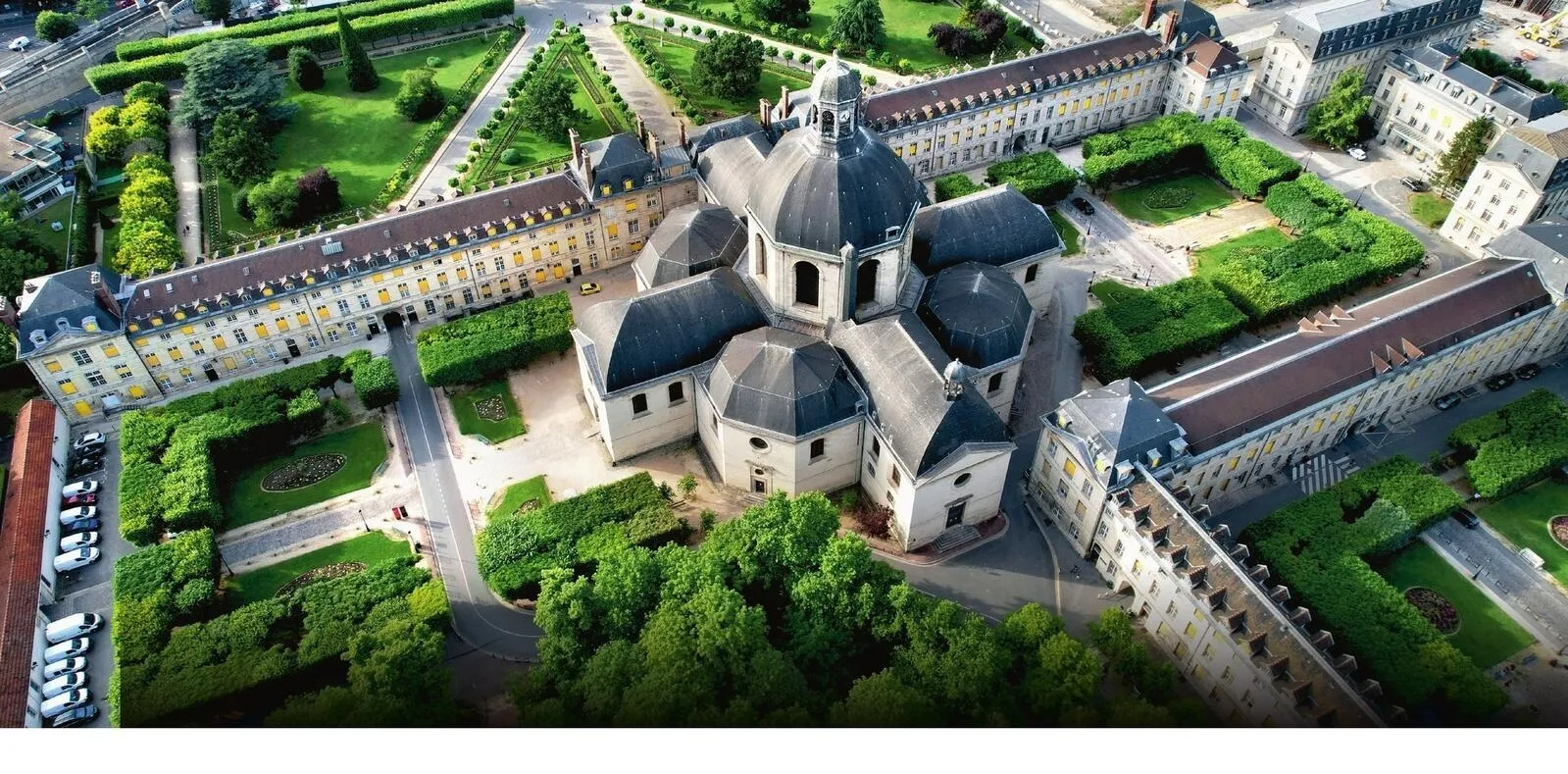
Hospital chapels, these havens of peace to be preserved
Cracks allowing water to pass through, a vault that threatens to collapse, an interior decor that is gradually fading… The Visitandines chapel of the Tulle hospital (Corrèze), listed as a historic monument for its rare architecture dating back to 1743, oozes the humidity and sadness of abandoned places. It has been closed since 2018 by emergency order and the Catholic chaplaincy had to withdraw to another, less significant space.
Mobilized for several years, Patrick Poujade, a nurse-anesthetist who also defines himself as “a lover of heritage”, feels like he is shouting in the desert: “In 2008, a file was drawn up with the city. But the catering company went bankrupt and the hospital took back possession of the walls. »
In 2022, once again, the local press is delighted that a project will be announced by the hospital center, with the support of the Regional Directorate of Cultural Affairs (Drac). But, four years later, “nothing has changed!” worries Patrick Poujade. Except that we put a miserable garbage bag to seal a broken skylight…” The nurse still hopes, with the help of the mayor, to organize an educational project with a neighboring vocational school: “It is urgent to repair at least the roof. I don’t know how many more years the frame can last…”
Costly negligence
The alert is not isolated: the observation is of the same order in Chauny (Aisne), in Vienne (Isère) or even in Rouffach (Haut-Rhin), where the exceptional double place of worship (Catholic and Protestant) is closed to the public…
“There are dozens of chapels in France, at the heart of a functioning hospital, which have a history, an interesting architecture, but are in very poor condition. I have been trying to raise awareness about this fragile heritage for twenty years,” sighs Olivier de Rohan-Chabot, president of the La Sauvegarde de l’art français foundation, which is involved in the restoration of numerous religious buildings.
Unlike parish churches, he explains, these are often unknown to residents. And with the restructuring, moves, and even sales of historic care centers, it is impossible to know how many are still functional today. The historian Pierre-Louis Laget puts forward an estimate of between “2,000 and 3,000 chapels, including several hundred classified or registered (i.e. protected, editor’s note) as historical monuments.
Obviously, they are of no interest to their owners, the hospital establishments, who have often neglected their maintenance. In these times of budgetary scarcity, they logically prefer to allocate their real estate loans to the construction of operating theaters. The institution is, of course, required to offer a place of contemplation, but it can be any room allocated to each chaplaincy, or even a multi-faith space. As for the dioceses, they only contribute to the organization of their chaplaincy.
And yet, believes Olivier de Rohan-Chabot: “A real chapel retains an important role in the hospital: for patients and their suffering families, it is often the only soothing and beautiful space where they can meet to pray, but also to cry, meditate, breathe… regardless of the religion or atheism of those who need it. »
To raise awareness around this neglected heritage, The Safeguarding of French Art launched in 2025, in partnership with the French Foundation of the Order of Malta, with a long tradition of hospitality, a specific prize endowed with 20,000 euros. This money will help to strengthen the waterproofing of the chapel at Espalion hospital (Aveyron), the first winner.
During its thirty-six years of existence, the Grand Prix Pèlerin du Patrimoine has also rewarded several hospital chapels. Latest, in 2023: Saint-François, at the Marguerite-de-Lorraine hospital center in Mortagne-au-Perche (Orne), included on the list of historic monuments for its very beautiful painted decorations. The building has just regained its frame and roof at the end of the first phase of work which cost 1.8 million euros. “We raised the rooster on October 13! » rejoices Vincent Lebel.
The president of the Mortagne-au-Perche Patrimoine association is aware of his double opportunity. First, the hospital volunteered to restore this former Poor Clare convent, in order to set up its administration and a third place there. “They had planned to contribute 200,000 euros to the renovation of the chapel which is part of the project. ” Above all, Drac Normandie provided 20% of the budget in the form of a subsidy, as seems normal for a building listed as a Historic Monument… Except that, since a reform in 1977, “each ministry is responsible for work on the buildings assigned to it or to its public establishments”, we explain to Culture. And, since 2009, hospitals have been considered public establishments under the Ministry of Health!
The Drac with absent subscribers
In fact, most of the Drac now refuse to contribute to the restoration of classified or registered hospital chapels, even though they require that the work be carried out according to the rules of the art. An article from May 2025, from the journal Hospital management (n° 646), however, notes that a protocol could be signed: one has existed since 1983 between the Ministry of Culture and that of the Armed Forces, in order to finance the restoration of military heritage. And the defenders of hospital heritage observe that this rule has only recently been imposed on them, with the State seeking to make savings everywhere.
This is the misfortune of the Saint-Louis chapel, a majestic building which rises in the heart of the largest hospital in France, the Pitié-Salpêtrière, in Paris. Designed by Louis Le Vau, the architect of Louis XIV, it has been classified since 1927: a budget of 25 million euros is necessary to completely restore and redevelop it. However, funds must be found without the participation of Drac Île-de-France – even though the latter’s subsidies could amount to up to 40% for a listed castle, for example.
“We are going to advance in independent installments of around 5 million euros, hoping to raise awareness among major patrons of this forgotten jewel of Grand Siècle architecture,” explains Barnabé Louche. For four years, this director of patronage and culture within the AP-HP* Sorbonne University university hospital group has organized more than 150 cultural events each year. The aim is to rediscover this building to a wide audience – where one of the four large side chapels houses Catholic worship.
At the same time, “we have already invested 500,000 euros to shelter the works of art, establish a scientific inventory of the building, urgently restore a point of the framework and revive the place,” summarizes Barnabé Louche. A subscription is launched by the AP-HP foundation. Partnerships have been established with the Heritage Foundation, the École du Louvre and the National Heritage Institute for school projects on works of art. And with other institutions as well.
If the task seems difficult for this exceptional and Parisian monument, how can we save more modest chapels elsewhere? “By going door to door with residents and mobilizing companies to offer part of the work,” says Jocelyne Guerra, former health executive at the Senlis hospital (Oise) and president of an association which managed to raise 275,000 euros to rebuild one of the collapsed aisles of the pretty, unclassified Saint-Lazare chapel. Heir to a medieval leper colony, it was able to reopen in 2023 and celebrate its thousand years last year.
Open to other uses
For Vincent Lebel too, it is essential to rely on a dynamic association, which knows how to communicate, and where volunteers are committed to putting together files with local authorities and all possible patrons. With success in his case: Heritage Loto, Vieilles Maisons Françaises (VMF) prize, Sesame prize in 2025… The latter was launched in 2022 by the Heritage Foundation. It provides 20,000 euros for initiatives by associations or municipalities promoting the transmission of religious heritage by opening the building to uses other than worship “with respect for the spirit of the place and the spiritual dimension of each person”, insists Bertrand de Feydeau, vice-president of the Foundation.
Just like at the Pitié-Salpêtrière, Mortagne-au-Perche Patrimoine offers a whole program of concerts and is committed in the long term to showing visitors the chapel outside of services. Patrick Poujade would like to be able to mobilize as much for the one in Tulle, “but I am currently working too hard to look for volunteers and fill out files,” he sighs. A whistleblower alone is not enough, in fact. We need an active association, a hospital establishment which facilitates the safeguarding of this heritage, local authorities as reinforcements, popular support which translates into subscription and patronage, and, of course, a convinced chaplaincy…
In Senlis, Geneviève, 92, remembers: “I went to Saint-Lazare, as a child, every Sunday, to mass for the sick. » She is now a resident of the nursing home located within the hospital grounds and likes to cross the courtyard to “pray to the Blessed Virgin”. Adjoua de Liniers, chaplain since 2022, now wants the hospital to improve the signage so that patients, caregivers and visitors can find their way more easily. “There is always someone poking their head in,” she remarks, “because I always leave the door open. »
* Public assistance-hospitals of Paris


