
Brittany: how to prepare for a possible water shortage?
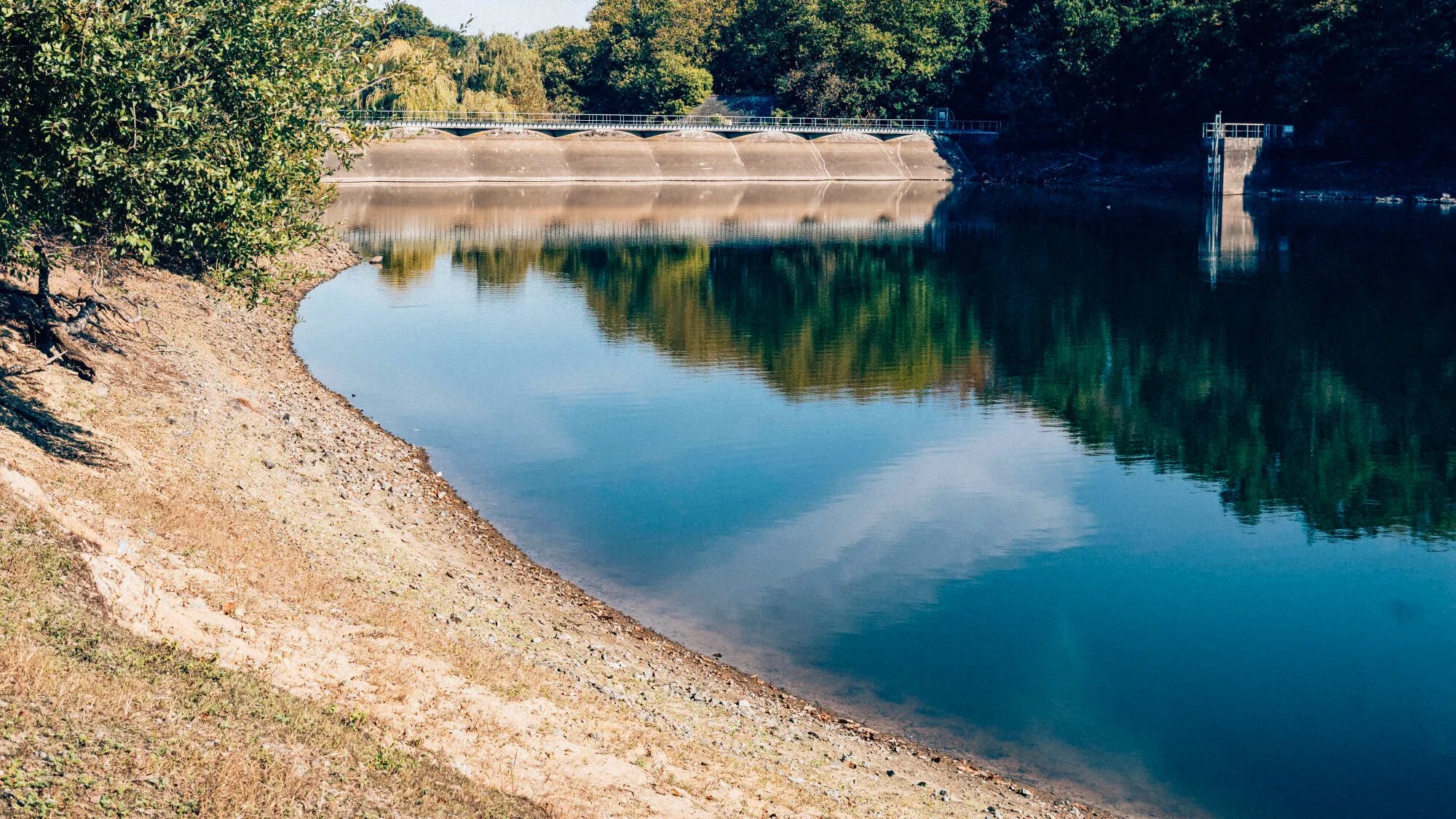
Can we still talk about “good weather”? In this month of October 2026, a few kilometers south of Saint-Malo (Ille-et-Vilaine), the reservoir of the Beaufort dam, in Plerguer, sparkles under a desperately blue and dry sky.
“The water level is one meter below normal this season,” points out Jean-Francis Richeux, president of the Water Union of the Saint-Malo region, which provides for the needs of 137,000 inhabitants in 42 municipalities, including the corsair town. Without heavy rainfall in the coming days, we still have enough to deliver drinking water until the end of November. »
In order to avoid tap cuts, the country of Saint-Malo has been in “drought crisis” level since mid-August 2026. A classification by prefectural decree which leads to restrictions on use for individuals and professionals: closure of car wash stations, ban on watering your vegetable garden during the day, etc.
Of the 77 departments still on red alert, Brittany is particularly concerned, and for good reason: 76% of drinking water is drawn from surface water (rivers and dams), and only 24% from groundwater.
“We depend almost exclusively on precipitation to recharge our reserves, this makes us very vulnerable to the drought which is continuing this fall,” worries Nicolas Forray, secretary general of the Eaux et rivières de Bretagne association. Concarneau, Morlaix, Brest, in Finistère, are in an unprecedented state of tension. The slightest accident in a network, and an entire city can find itself without tap water. »
The prefect of the department thus announced that, in the absence of significant rain or a massive reduction in water consumption, an Orsec (Organization of Civil Security Response) drought plan would be triggered at the beginning of November at the department level. A decision that would have a major impact, with rationing of drinking water and the cessation of many economic activities, particularly in the agri-food industry, where water is essential to clean production lines.
According to figures from the Ministry of Ecological Transition, at the end of September 2026, no less than 94,000 people were already affected by emergency measures for the water supply in mainland France: tanker truck, delivery of water bottles, nighttime cuts, etc.
Learning about scarcity
A situation that the Beaufort mixed water union, water distributor for 35 municipalities in the Saint-Malo region, would like to avoid. For several months, he has been anticipating the day when the prefect of Ille-et-Vilaine would decide on an Orsec drought plan. On this October afternoon, Sébastien Petit, technician for the union, goes door to door in a residential area of Plerguer.
The residents participate for two and a half days in a very special role-playing exercise. The technician checks in each house that the pressure settings will allow individuals to benefit from a thin trickle of water at the tap, in the event of a general shortage.
“The idea is to bring home an essential volume of 40 liters of water per person every day, so that people do not have to go and collect it with jerry cans from a distribution point,” explains Séverine Bourserie, director of the Mixed Union. “The other benefit of this measure is to preserve the network pipes. Prolonged outages damage them and considerably delay the return to normal. »
A simulation for which Josiane Pierrot, 72, has carefully prepared. “I made all my laundry machines before,” she explains. In his laundry room, packs of water bottles sit alongside two jerrycans filled in advance, for cooking and washing with gloves. “The rainwater that remains in my garden collector, I will use to flush the toilet,” she explains. A learning about scarcity that she finds beneficial in these times of water scarcity.
But the proactive approach of the Beaufort Water Union also encounters resistance. “Just a trickle of water to wash my hair, it was hell!” Cat grooming is not for me,” says Émilie, around fifty, in front of her house at Château neuf in Ille-et-Vilaine, a week after experiencing the same exercise of anticipation.
A few streets further, Ludovic says that he and his family went to take a shower “at the father-in-law’s” while waiting to return to normal flow. “Afterwards, we still installed the four-minute shower hourglass given by the water union,” he says. It has become a game for my teenagers, who, before, were loathsome under the jet. »
A small victory which says a lot about the savings possible in this sanctuary of well-being that the bathroom has become, and where a large part of what Séverine Bourserie calls “comfort water” flows. As opposed to “healthy water”: this famous “essential” volume of 40 liters per day and per person which is sufficient to meet our basic dietary and hygienic needs.
“85% of our subscribers are individuals, and it is therefore with them that the immediate savings levers are found to delay a probable power outage,” she underlines before leading a meeting with elected officials from Plerguer.
Anticipate tensions
Will the challenge be met until the much-hoped-for rains? In Brittany, as elsewhere, living with less water represents an effort and everyone wants to be sure that it is shared fairly… “If there are restrictions, it must be for everyone,” insists Josiane Pierrot. Do you think that the customers of the Thermes marin de Saint-Malo time their showers? That’s what people have resentment here. »
Another controversial subject in this thirsty autumn: the Route du Rhum, whose sailing events should attract nearly 1.5 million visitors from October 20 to 1er November in the privateer town. Faced with the avalanche of criticism over the lack of communication regarding the risk of shortage, the organizer OC Sport Pen Duick finally committed to leading, during the event, “a specific campaign to raise awareness of water sobriety”.
Behind the symbols, it is ultimately an entire model of economic development that is questioned in the light of a common good that we thought was abundant but whose scarcity we must now learn to understand.
“Climate change requires us to better anticipate the evolution of water resources,” underlines Jean-Raynald de Dreuzy, hydrologist at the École normale supérieure in Rennes. At the scale of a watershed, what quantities will be available in the coming decades, particularly in dry periods, and how will this availability evolve? This knowledge is essential to inform discussions between different types of water users (businesses, farmers, individuals, etc.) and anticipate social tensions around its sharing. »
For now, while waiting for the rain which will perhaps allow the taps to continue flowing, from Brittany to the Vosges, one thing is obvious: “The modernity of tomorrow will be to have learned to live in a drier world”, summarizes researcher Simon Porcher in his latest book. Clearly, everything is changing and the “good weather” is no longer what we think it is.


