
In Finistère, an exhibition on the little-known Jean Painlevé, a filmmaker in the service of science
Arriving on the second floor of the Pont-Aven museum (Finistère), the visitor is captivated. The subdued light, as if filtered by water, reveals a monumental sea urchin, enlarged two hundred thousand times, whose spines gently come to life. The tone is set: here, we dive. Spread over 310 m2, the exhibition adopts a scenography in five stages and 200 elements combining video, photographs, promotional posters and facsimiles of articles. “There is a lot to read, a lot to see,” warns Sophie Kervran, the museum’s director. An assumed density for an event which retraces the colossal work of a man.
Jean Painlevé (1902-1989) could have just been a son of… But he knew how to make a name for himself, to the point of making us forget the imposing shadow of his father, Paul, a renowned mathematician and twice President of the Council (the equivalent of Prime Minister) in 1917, then in 1925. Jean began studying medicine. Without success. But the zoology courses at the Sorbonne, the knowledge acquired in anatomy and physiology, combined with his curiosity for the use of still embryonic cinematographic equipment, will change his destiny.
Observe the invisible nearby
The exhibition, shown for the first time in Paris in 2022, takes on particular resonance in Brittany, a region of inspiration for Painlevé, who photographed his first octopus there at the age of… 11. The route opens onto the coastline, a privileged area for his observations. Unlike Professor Auguste Piccard, who dove into the abyss, Painlevé simply scrutinizes algae and shores, “observer of the invisible nearby”, sums up Sophie Kervran nicely.
Using optical devices, it magnifies images up to 150,000 times, revealing invisible worlds. A section of the exhibition is dedicated to Geneviève Hamon (1905-1987), his companion and essential collaborator. Editor, assistant, intellectual partner, she co-signed her films since the 1950s. The exhibition reminds us that Painlevé and Hamon were not the first to use cinema to experiment with science, but that they interacted with pioneers like Jean Comandon, director of Plant growth (1929), famous film showing the flourishing of plants thanks to the acceleration of movements.
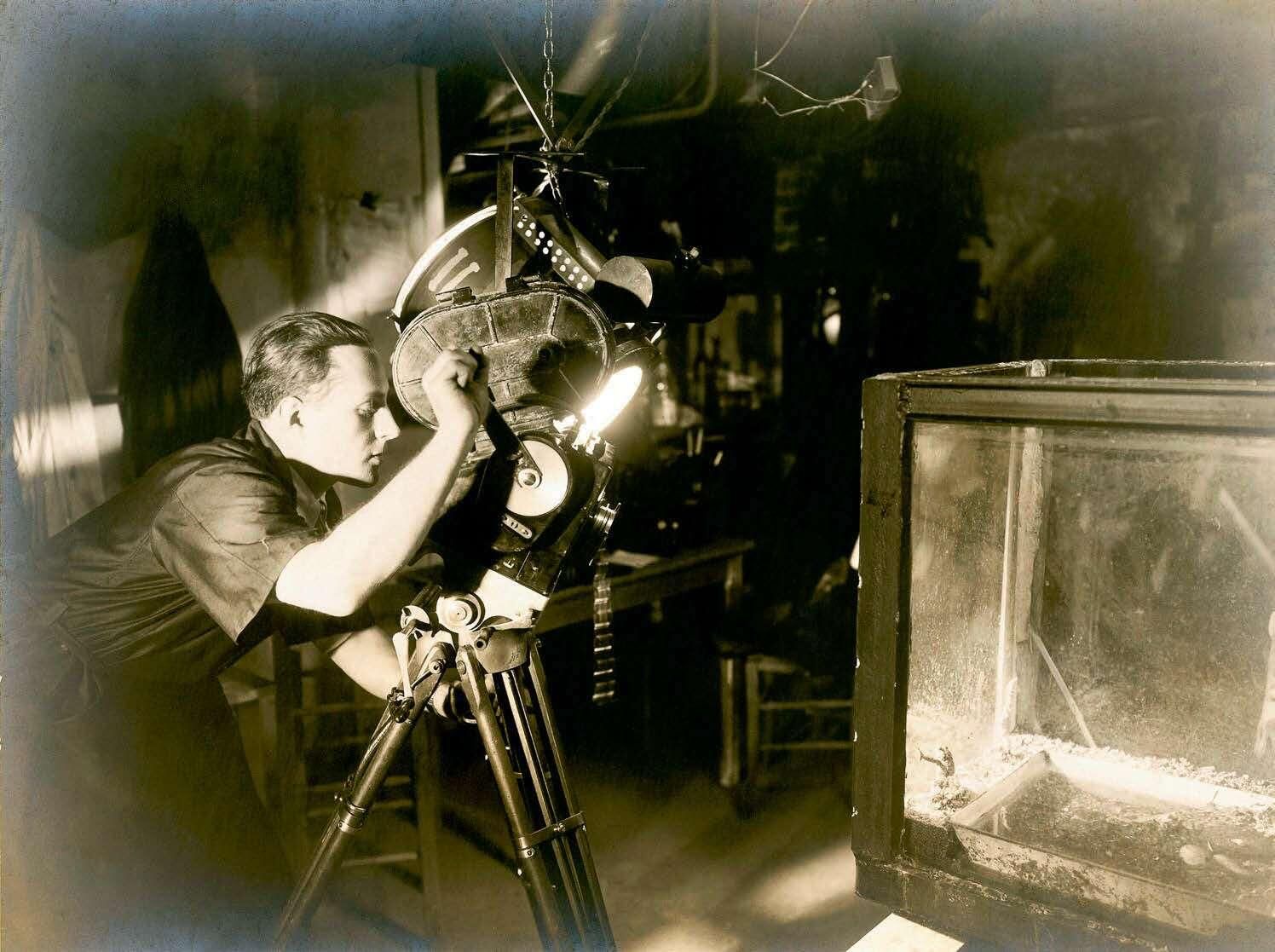
Jean Painlevé used a difficult technique consisting of capturing a lit subject on a black background. In the aquariums of his studio, in the Montparnasse district of Paris, he observed, waited, photographed, filmed. For The seahorse, his most famous work, it took him seventy-five hours of filming for one minute of sequence showing the spectacular childbirth of a male. The film was censored in the United States in 1936 for “indecency”.
A precursor to Jamy and Mac Lesggy
Painlevé considered his films as educational tools, intended to be shown in schools, but also as research documents for scientists. He also took a stand against fascism, as evidenced by his short film The vampire (1945), “an allegory of totalitarian regimes hungry for the blood of their populations,” explains Pia Viewing, the scientific curator of the exhibition.
At the end of the visit, we can only salute the role of popularizer of Jean Painlevé, more of a precursor of the presenters of scientific programs for the general public, like Jamy Gourmaud (It’s not rocket science, Jamy’s world) or Mac Lesggy (E=M6) so many explorers of the Cousteau type. His work invites us, well before the emergence of political ecology, to question the place of beauty in science and to take a new look at the living world.


