
In Savoie, monks and children to save the toads
“When I arrived here twenty-eight years ago,” remembers Brother Bruno, “the road was covered with crushed toads as spring approached. » Nestled in a valley in the Bauges massif, at an altitude of 900 m, the Cistercian abbey of Tamié is only 15 km from Albertville (Savoie). It overlooks a pond popular with toads.
The animal lives in the surrounding undergrowth but migrates to the body of water once a year to lay its eggs. Problem, in Tamié, a road separates the two natural environments. The departmental road is very busy: bad luck for the amphibian, its breeding season coincides with that of winter sports.
When they approach the pond, the males stop on the road and call the females: their vulnerability is then total. Every year, there is a massacre. If we no longer see as many crushed on the road, it is because their population is experiencing a drastic decline.
Even here, while nature is omnipresent, “all species are collapsing,” the religious saddens. We no longer have flies, no more horseflies, the bees stick out their tongues more and more! Asian hornets are proliferating, and for two years, we have had mosquitoes, whereas there never were any.”
Human helping hand
Also, when members of the Albertville association “I get involved in my territory” approached the monks, they immediately agreed to lend them a hand in trying to preserve the toads: “It’s part of safeguarding Creation. »
Vincent Fauvel, a member of the association, remembers this meeting: “I acted as an intermediary between these two worlds, that of naturalist activists and that of religious people. The meeting took place with great mutual respect. The discussion focused on biodiversity and shared concern. »
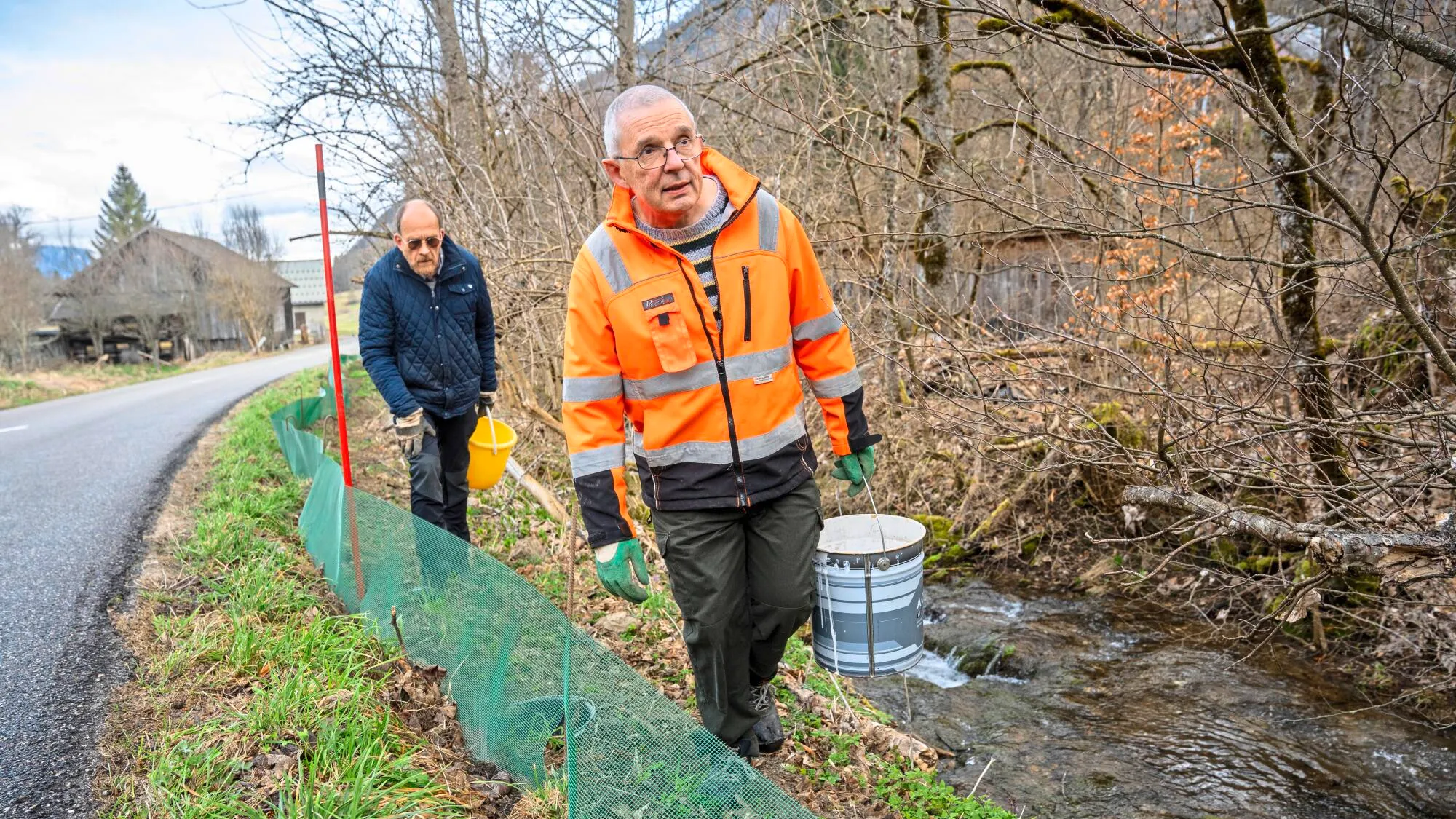
At the end of winter, like last year, volunteers and brothers installed nets along the roadway (pictured above)over some 200 m, to block the toads. Until the end of the breeding period, lasting three weeks, just after the first service, at 5 a.m., a few monks and novices go down to inspect the nets and collect the amphibians. They then release them into the pond on the other side of the road.
Handling and moving wild animals is prohibited. For these rescue operations, an exemption was issued by the prefecture to France Nature Environnement, to which “I get involved in my territory” is affiliated.
Laetitia Léger is the Water & Sentinels project manager and, as such, keeps an eye on these interventions: “Amphibians are weakened throughout the territory. The cause: climate change, the fragmentation and reduction of their habitat, the filling of ponds, soil pollution, which makes them susceptible to fungal diseases…” So yes, even if the battle seems poorly underway, this little human help “is really a help for the toad population in the area”.
A few kilometers from the abbey, the association identified two other breeding sites, where it organized similar rescue operations, again involving residents of all ages. In the morning, the students of Mercury’s CE2 class arrive at the village school wearing boots, gloves and buckets in hand.
After explanations on the life cycle of the common toad, the children walk to the pond, behind the multipurpose room. Suddenly, exclamations: they came across a crushed toad. Immediate effect: “Quick! We must save them! » Even those who are repelled by the animal overcome their reluctance.
Once the toads are collected and released into the water, the students look at long ribbons dotted with black in the reeds: the eggs. Mia observes the toad that she has just released into the pond. “When we took him out of the bucket,” she interprets, “he made little noises to say thank you! »
After explanations on the life cycle of the common toad, the children walk to the pond, behind the multipurpose room. Suddenly, exclamations: they came across a crushed toad. Immediate effect: “Quick! We must save them! » Even those who are repelled by the animal overcome their reluctance.
Once the toads are collected and released into the water, the students look at long ribbons dotted with black in the reeds: the eggs. Mia observes the toad that she has just released into the pond. “When we took him out of the bucket,” she interprets, “he made little noises to say thank you! »
2,000 individuals saved
In total, over the entire breeding period, the association “I get involved for my territory”, supported by the families of the villages of Mercury and Marthod and the brothers of Tamié Abbey, allowed 2,000 toads to reach their breeding ground without incident. In a few weeks, their eggs will become tadpoles, then young toads. The children are full of hope: “Next year there will be even more. »
Recipes for success
- Mobilization: Collecting toads, every morning and every evening, in all weathers, requires a group of motivated and reliable volunteers.
- Community support: To install nets, or even limit traffic, the support of the town hall or the department is imperative. Mercury town hall has also changed its green space maintenance practices.
- Awareness : The toad is little known and – for some – repulsive. Its preservation also requires a change of outlook and better knowledge of its life cycle.
Information: jemimplicate.fr


