
Military service: Emmanuel Macron’s bet
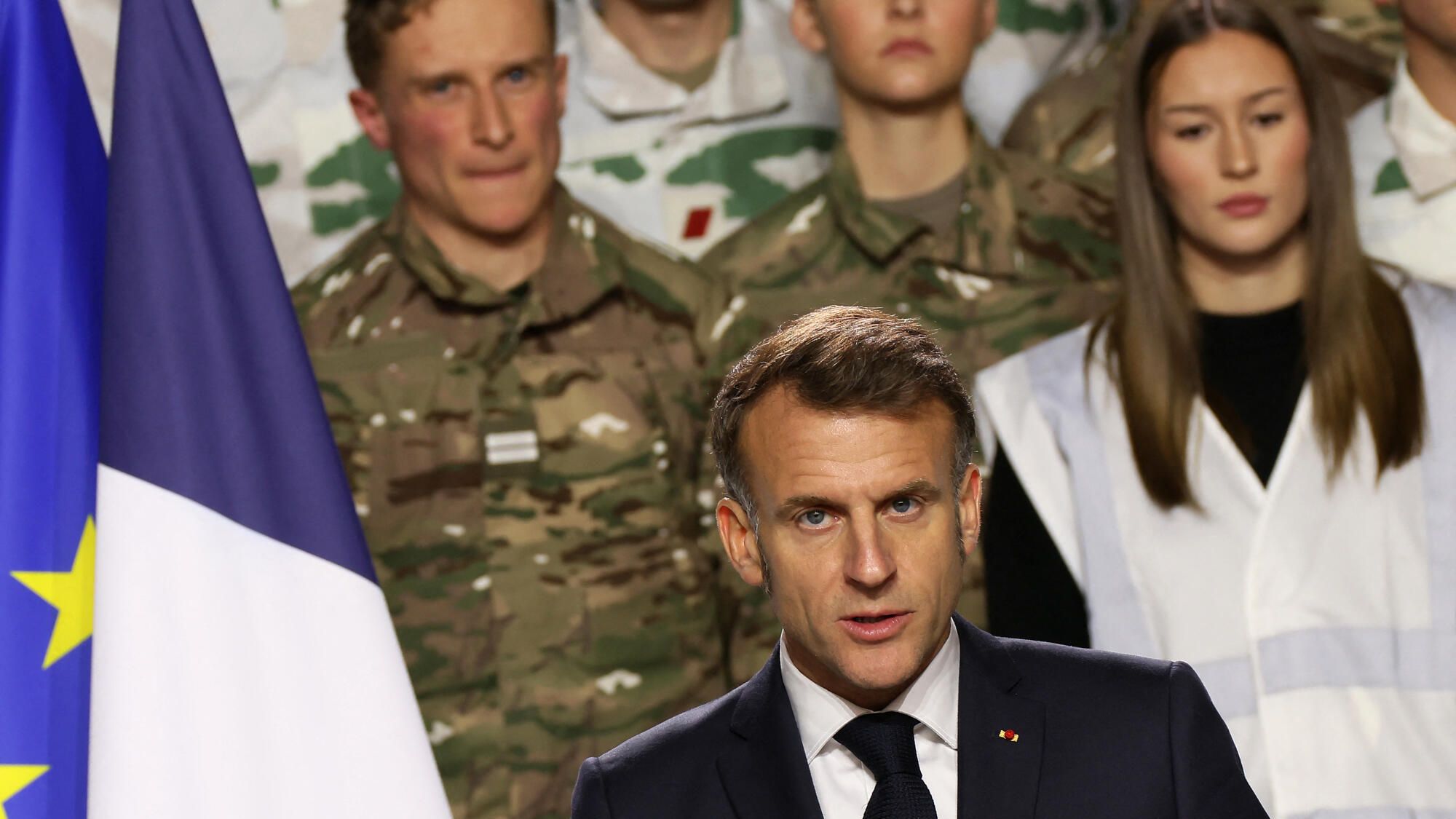
Is Emmanuel Macron late for a war? By announcing, on November 27, his intention to launch a ten-month “purely military and voluntary service” of ten months, the President of the Republic surprised people. The number of these “volunteers” who will be considered “military”, 3,000 expected next summer, should rise to 10,000 in 2030 and 50,000 by 2035.
In addition, “a day of mobilization” will be established for everyone and, in the event of a crisis, “Parliament may authorize the use, beyond just volunteers, of those whose skills will have been identified during this day” who will then be obligatorily mobilized.
“There is a generation ready to stand up for the homeland,” insisted the president. Certainly, the Head of State is undoubtedly banking on a short-term boost in his popularity rating, which is currently at its lowest, by dressing up in the role of “chief of the armies” conferred on him by Article 15 of the Constitution, but his initiative, even if its financing remains uncertain, raises a fundamental debate. At a time when the war, in the light of the conflict in Ukraine, is taking new forms, does this return to the idea of a mass commitment of the nation still have meaning? Do our armies still need soldiers?
In Ukraine, the emergence of drones, these remotely piloted aerial reconnaissance or attack devices, powered by artificial intelligence, has disrupted the combat at the front. From the winter of 2023-2024, classic artillery duels from one trench to another have given way to drone attacks, effective against concentrations of soldiers.
“Ukraine is today a theater of operations saturated with drones,” insists Australian military analyst Mick Ryan, author of Future Doctrine. Within 15 kilometers on either side of the front, vehicle movements are difficult, if not impossible.”
As a result, and contrary to what we may have believed at the start of this technological upgrade, “infantry troops on the ground remain more important than ever to hold the ground”, specifies this former general returning from the front, especially since the groups must be scattered so as not to serve as optimal targets.
Another aspect, also new, of the threat requires a more intensive use of men, the development of hybrid warfare. In Poland, the fires against civilian installations and the sabotage of the railway line linking Warsaw and the Ukrainian border in recent weeks have shown that, without war being formally declared, European countries are exposed to pressing dangers.
Until recent years, the French army favored scenarios for projecting its intervention forces within the framework of joint international operations or in Africa. Today, faced with a growing threat maintained by Vladimir Putin’s warmongering, national protection is coming back to the fore. Not only because the master of the Kremlin decided, in the fall of 2024, by decree, to increase the strength of the Russian army to 1.5 million men (or 400,000 more). But also for fear of clandestine actions on national soil.
From April 2022, a “national resilience strategy” was put in place. We must ensure the protection of stations, airports, sensitive industrial sites, stocks of fuel or medicines… But for this, we need infantrymen. The operational reserve had already proven its importance after the activation of Operation Sentinel in the aftermath of the jihadist attacks of 2015: the soldiers in fatigues in front of synagogues or sports competitions during the Summer 2024 Olympics were often reservists.
Because the number of professional French armies, excluding the gendarmerie, today stands at 200,000 men plus 41,000 reservists – half as many as in 1989, before the end of the Cold War. However, “this format does not make it possible to combine an external deployment with a significant commitment on the national territory beyond what is already involved in the Sentinel system○”, notes Guillaume Furgolle, researcher at the Center for Security Studies of the French Institute of International Relations. In other words, faced with the additional threat posed by the return of long-term war in Europe, more men in fatigues are needed.
France is not isolated. In 2023, Latvia adopted a return to compulsory military service. Lithuania, Norway, Sweden and Denmark have opted, in various forms, for selective conscription. It is these latter models which inspired the project defended by Emmanuel Macron.


