Lourdes 2025 (4/5) discover Marie through her prayer
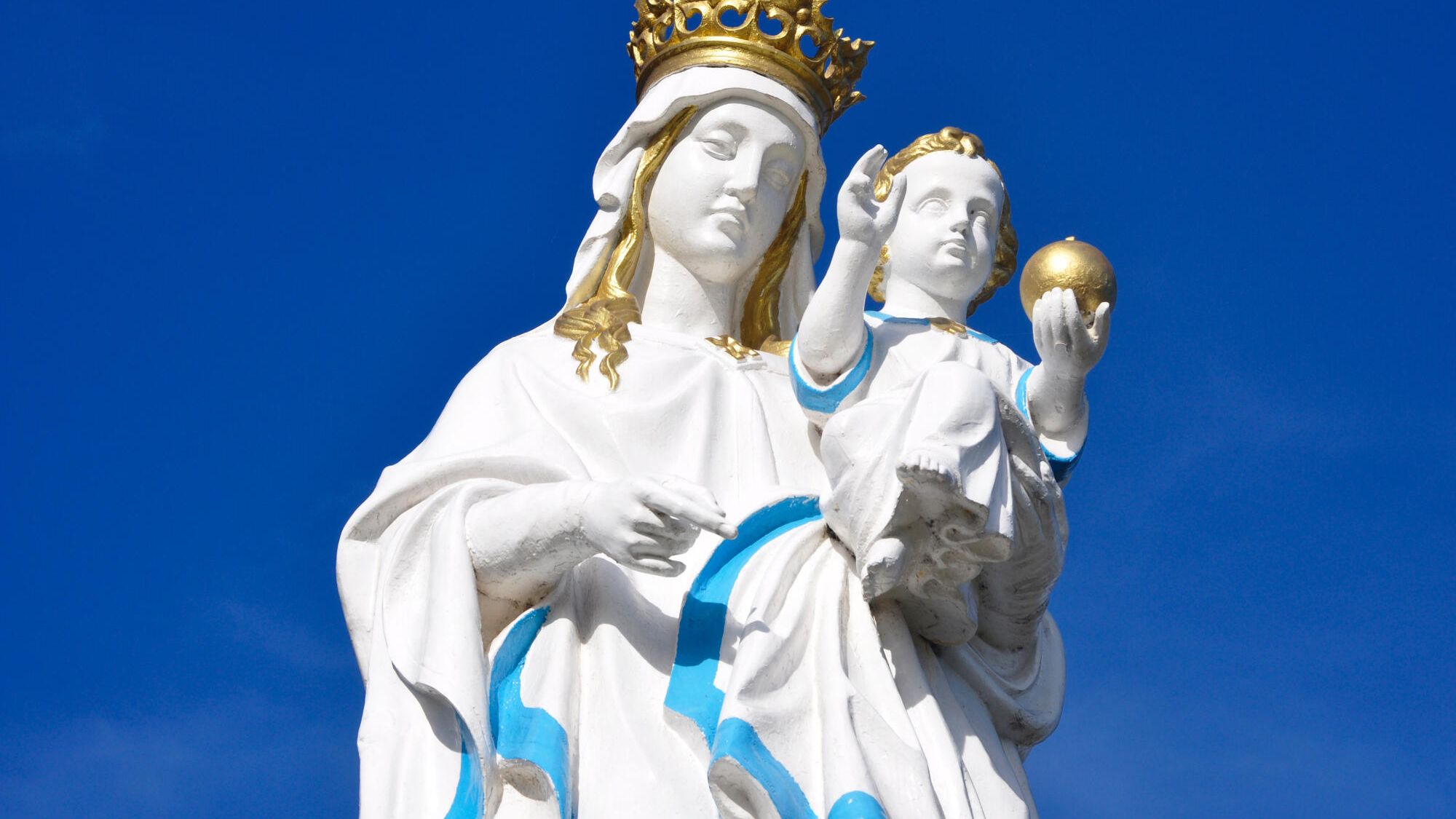
“Μρ θυ”: “Mother of God”. The monogram in gold letters on a blue background surrounded by the large fresco of the old church dedicated to the Theotokos Kyriotissa, In Istanbul (Türkiye), can remain mysterious for the pressed visitor. Unless you remember that these few Greek letters are the same as those found on most Byzantine icons presenting the Virgin and Children (illustration below). The name of the Byzantine Church itself, founded at the end of the 11th century, gives an important indication: Kyriotissa evokes, in Greek, the figure of a woman who has authority and theotokosthe surprising title of “the one that generates God”.
This fresco, just like the icons of Mary, invites to contemplate one of the great mysteries of the Christian faith that the Christian Arab Patriarch Jean Damascene (675-749) already expressed: “The hands of the Virgin carry the eternal and its knees are a more sublime throne than the cherubs. It is the royal throne on which the angels contemplate their master and their creator seated. ” Because Mary, due to the double nature of her son, is well considered since the councils of the 5th century as being really the mother of God – in Greek Μήτηp θεου (Métèr Théoû). From this God revealed in Jesus Christ and who takes flesh of our flesh.
Singular experience forever
In this old Stambouliote church – which has become the Kalenderhane mosque over the centuries -, the remains of the Byzantine frescoes are hidden today. And they have undergone several iconoclastic, Christian and Muslim crises. Result: the great golden figure of the solemn virgin with her princely son is now hardly recognizable, any trace of human figure having been hammered.
But, irony of history, this voluntary disfigurement still adds to the mystery announced there. The Italian theologian Cettina Militello testifies it in a resounding article published a few years ago in the Vatican Journal, The Romano Osservatore. She recalls the teaching of the Council of Chalcedon, in 451, according to which “the Son, perfect in humanity and perfect in divinity, true man and true God (…) was generated by Mary, Virgin, Mother of God.”
But she also highlights the difficulty of thinking about this maternity. Like, moreover, ordinary maternities. Does the future mother have an active role in the conception of her child or is she only a passive instrument of forces-biological or spiritual-which exceed it?
The incarnation of Christ thus refers to a question which affects our own humanity as a man and woman: how do we give birth to God the beings that are entrusted to us? For Marie in any case, our sister in humanity, the experience will forever remain singular. It is she who gives birth to the first one, a first-born, a “Son of man” as Jesus himself designates. And which will be revealed in its fullness of sons of God during the resurrection, this new birth.
The theologians will continue to discuss them, with reason, especially in certain circles of interreligious dialogue with the Muslim world, he who also worships the figure of Mary in the Koran as a believer with singular destiny. But for the faithful Christians, it is indeed as the daughter of Israel, wife of Joseph and mother of the verb, that she remains forever an icon of divine love for everyone.
When Marie gets closer
In 1962, the Protestant theologian Max Thurian, member of the community of Taizé, published Marie, mother of the lord -figure of the Church1. A daring exercise while the dialogue between Protestants and Catholics still often buy on how to understand and venerate the Virgin. For him, “to name Mary Mother of God is to express in the sole way the mystery of the incarnation”. A work “at equal distance from mariolatry and indifference”, salutes a Protestant critic of the time.
Thirty years later, the Ecumenical Group of Dombes theology published a new synthesis2 which testifies to a visible rapprochement. More than the expression “Mother of God”, it is that of “Mother of the Savior” who facilitates the meeting, since nothing of the work and the cooperation of the Virgin can be understood without reference to her son. With the theological conciseness that characterizes it, Saint Augustine already said it in the 4th century: “According to the Spirit, she is rather the daughter of our chief who is the Savior. But according to the flesh, she is the mother of the chief himself. ”
- Coll. Faith Vivante, 61, The Press of Taizé.
- Mary in the design of God and the communion of the saints. T1. In history and writing. T2. Controversy and conversion. Group of Dombes, Bayard ed. / Centurion (1997 and 1998).


