
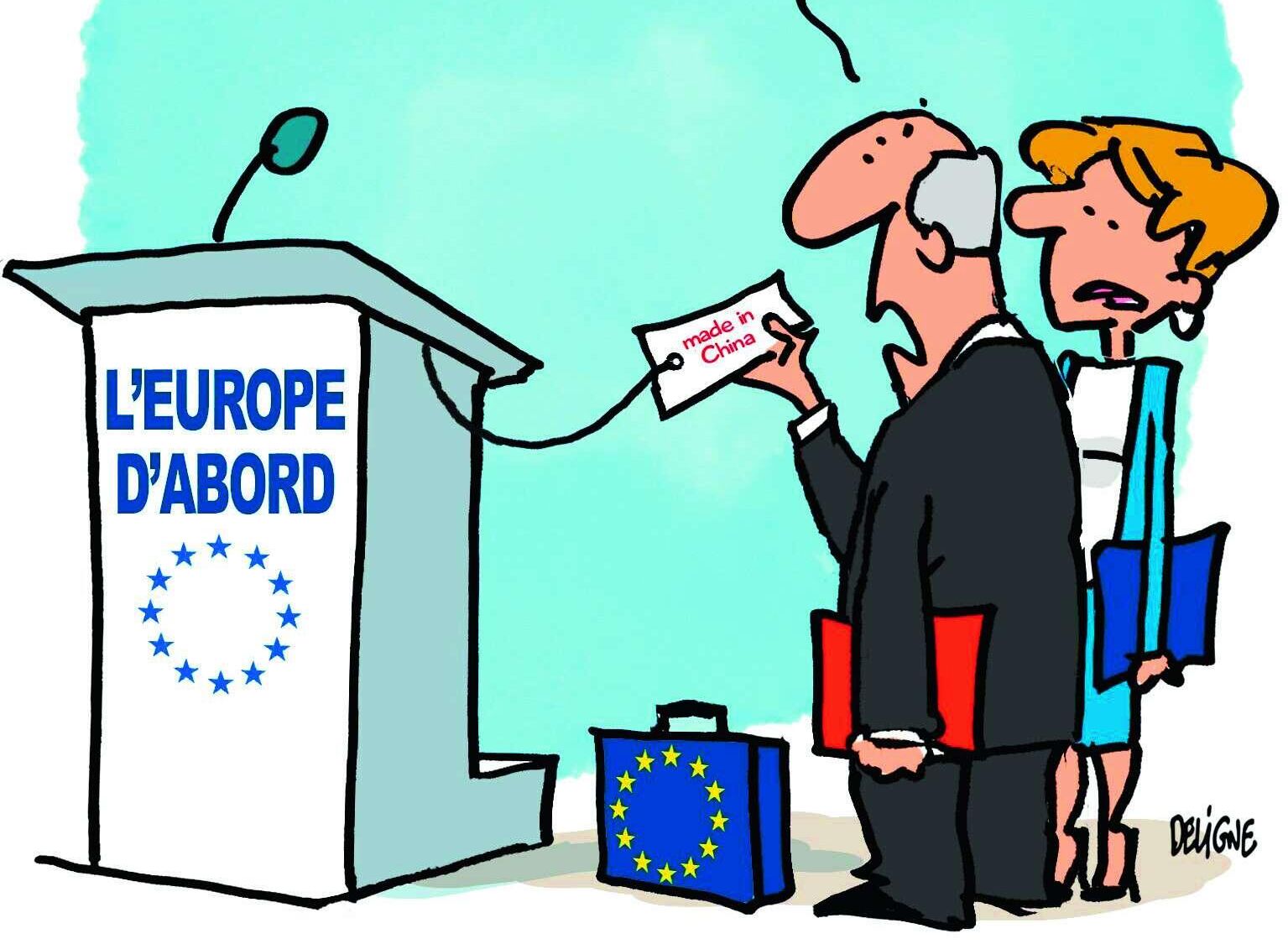
“Made in Europe”, a scam or a historic turning point?
Imagine that your mayor wants to order electric cars for your municipality’s employees. His team will draw up a call for tenders, to which companies from all over the world will be able to respond. If a Chinese model corresponds better to the criteria of the order than a German or French model, your councilor will be unable to opt for the second rather than the first… under penalty of being prosecuted for favoritism.
Good news for the industry of the Old Continent, the rules of the game could soon change. On Wednesday March 4, the European Commission broke a taboo by proposing that public money (i.e. public contracts and aid) should finance products made in Europe as a priority. The sectors targeted are strategic: cement, steel or aluminum, which are very energy-intensive, which are disadvantaged compared to international competition; electric cars and clean energies, such as wind turbines or solar panels, manufactured at lower cost in China.
“This is not a simple change in operating mode, it is a change in doctrine,” declared Stéphane Séjourné, French vice-president of the European Commission in charge of industrial strategy, when presenting the law. Made in Europe would deviate from the king principles of free trade: a historic turning point.
Right to competition
In 1957, the Treaty of Rome decided to establish a European common market. It nevertheless remains limited by the control of States over their economies. The 1980s marked the triumph of liberal thought, according to which the law of the market brings prosperity. For it to operate unhindered, border barriers, including local preference rules, must disappear.
“Competition law is becoming the alpha and omega of European construction,” relates economist Frédéric Farah. From the 1990s until today, multiple free trade agreements have been signed between Europe and the rest of the world.
Establishing a European preference would be a paradigm shift. “Stéphane Séjourné had a lot of difficulty getting his fellow commissioners to accept it,” reports Jean-Marc Germain, socialist MEP and privileged observer of the negotiations. Since his appointment in 2024, the French commissioner has been touring European capitals to convince heads of state.
Some countries are slowing down. Germany, whose growth is based on exports, fears retaliatory measures from its partners. Scandinavians and Dutch, traditionally more liberal, are also resistant.
The failure of the liberal dream
Successive crises, however, got the better of opposition. Covid-19 highlights the dangers of external dependence, the conflict in Ukraine is causing an energy crisis, the American trade war is shattering the dream of peaceful globalization, and the Chinese industrial offensive threatens to sink the European automobile industry.
After the presentation – postponed several times – of the law by the Commission, head to Parliament. The radical right and the left should support sovereignty measures. “The industrial aspect will surely pass,” rejoices Jean-Marc Germain. But basically, “we are a little disappointed,” he admits. Under pressure from Germany, made in Europe could be extended to the Union’s “trusted partners”, such as Japan, Canada or Vietnam.
A lack of ambition, which can however be made up for, the text being only at the beginning of its legislative journey. “The discussions in Parliament will be an opportunity to strengthen it,” hopes Jean-Marc Germain. If the initial project has been watered down, it nevertheless remains one foot in the door of free competition. It opens the way to future developments: “The first step is always the most difficult,” the MEP wants to believe.


