
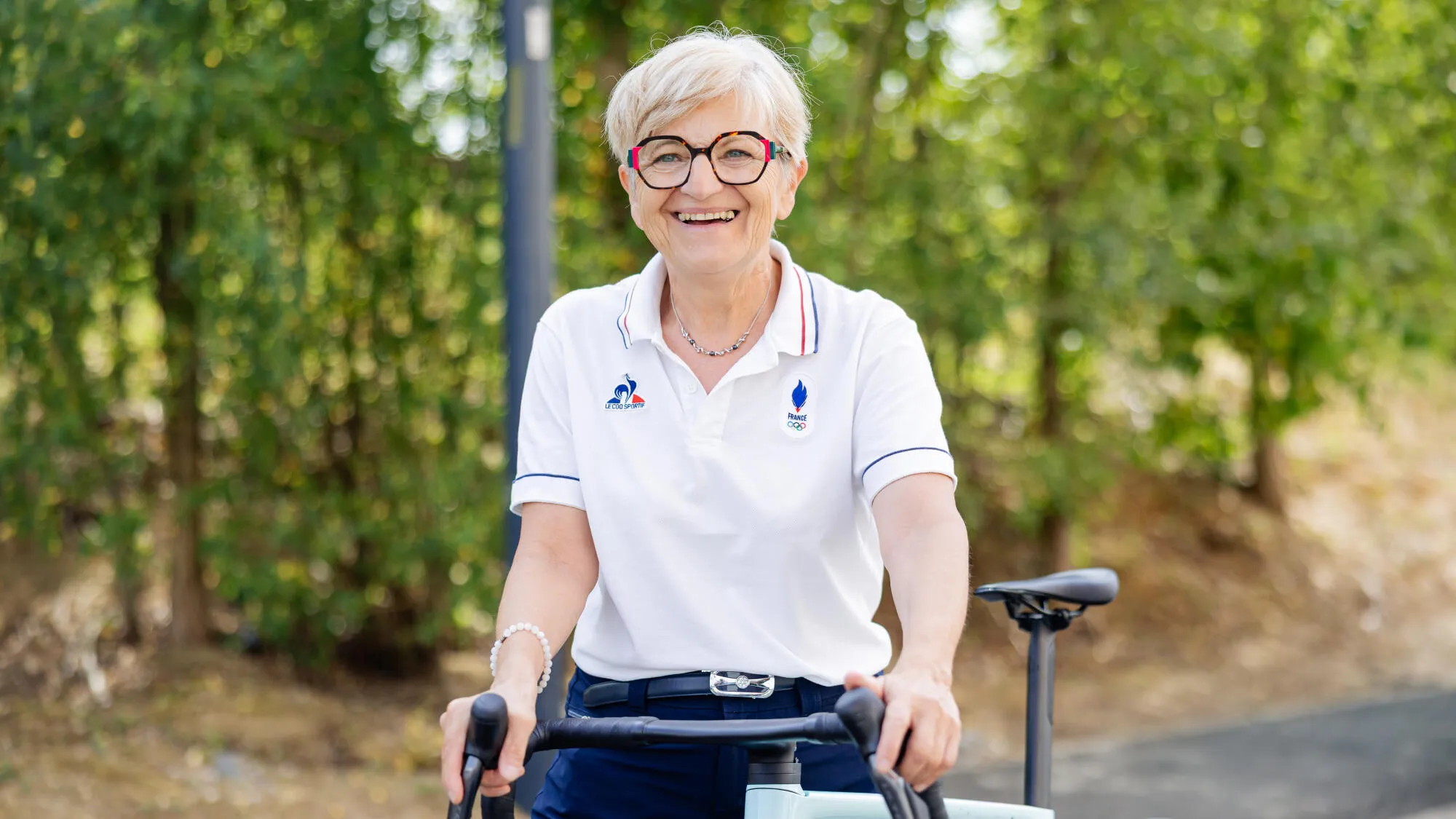
Marie-Françoise Potereau, former high-level cyclist
This year, the Tour de France Femmes begins its fifth edition, from 1er to August 9, 2026. Can you present it to us?
It will be even sportier and more spectacular than last year. The course will take the 154 runners from the 21 teams from Lausanne, Switzerland, to Nice (Alpes-Maritimes) in nine stages. It increases the difficulty of the event and its media success with the ascent of Mont Ventoux (Vaucluse) and 1,210 m of altitude difference. All cyclists dream of being able to climb it one day!
Who will be the runners to follow closely?
Our French women, of course, in particular the champion Pauline Ferrand-Prévot. She won the 2025 edition and won a gold medal at the Paris Olympic Games in 2024 in cross-country mountain biking. The Dutch Demi Vollering, from FDJ United-Suez, could also shine. She has already won the Grande Boucle in 2023.
The general public still doesn’t follow women’s sport very much. Has the Women’s Tour captured the hearts of the French?
The 2025 edition benefited from unprecedented success, notably thanks to the victory of Pauline Ferrand-Prévot! I still get chills when I see the climb of the Col de Joux Plane in the Alps, at an altitude of 1,700 m. This show has set audience records (25.6 million viewers over the nine stages, editor’s note) and confirmed the credibility of the athletes. Today, even little boys dream of cycling “like Pauline”.
Certainly, when the Women’s Tour started, the town halls were not rushing to welcome it. But the organizer (Amaury Sport Organization, editor’s note) played cleverly by encouraging communities that were aiming for a male stage to first welcome its female counterpart. Today, the municipalities know that a women’s stage offers very positive visibility. They fight to get it.
But the Tour de France Femmes was not always so popular. You know it, you who participated in the first edition in 1984!
The Tour de France management launched a women’s Tour in 1984. It was held at the same time as the men’s Tour, but the stages were shorter. I participated in its five editions in a folkloric atmosphere. Many spectators looked at us like curious animals, disconcerted to see girls on a racing bike. We did not receive any salary, we had to combine training and competitions with our professional lives.
I, who grew up at the foot of the Savoie mountains, climbed passes alone, without a coach, took advice from local clubs… We had no serious preparation and the Women’s Tour, in its formula at the time, ended in 1989 for lack of investment. But I smile when I think about it. This competition lit the spark. The adventure of women’s cycling could finally begin.
“A women’s stage offers good visibility. The municipalities are fighting to obtain it. »
Marie-Françoise Potereau Participant in the first women’s Tour de France, in 1984, then vice-president of the French Cycling Federation
How did you live your passion in a world that was not open to women for a long time?
Some people support you in your sporting journey, thanks to their generosity. As a teenager, I was an athlete surrounded by athletes who loved competition and who encouraged me. My father was a rowing champion, my sports teacher was a French middle-distance ski champion… My strong Savoyard character did the rest. The rowing club refused girls? Nothing to do! I signed up for the Cycling Association in my town, in Aix-les-Bains, among the boys.
After my years of cycling, I wanted to take control of my destiny and not give up on sport, by becoming a sports coach. Then, I took on responsibilities at the Federation to create a place for women in this environment. Nothing was easy because, until the 2000s, cycling had almost no female employees.
I will give you an example with Michel Callot, current president of the French Cycling Federation of which I was elected vice-president. When he was in his twenties, he arrived at the Annemasse Vélo club and asked to meet the coach to join the team. But the coach was me! He mistook me for the secretary! Today we still joke about it.
How did women’s cycling become professionalized?
The sporting world has finally understood that women must turn their passion into a profession to be very successful. In 2020, the International Cycling Union established a very high-level professional division for women, equivalent to that for men. These cyclists benefit from a salary and maternity leave. They are supervised by physiotherapists, doctors, physical trainers, like the men, even if the budgets are more modest.
All these efforts have resulted in champions hatching. The gap remains significant between these elite runners and some of the amateur teams, but the gap can be bridged by further structuring the discipline.
Do women have their own way of running and training?
Women don’t have to imitate men, they have their own way. We should not try to make a copy and paste of the men’s Tour de France at all costs, spread over three weeks. Our stages are shorter, fewer in number but that doesn’t stop the show.
The federations must also change their working methods by moving away from a male-dominated environment which no longer makes sense. In sport, men of the older generation have often imposed a very authoritarian culture of commitment, with staggering schedules. Today, women want to have a career while reconciling professional and family life. And the men of the new generation share this mentality.
The challenge is also to create a pool of future champions. How to make little girls want to do it?
We must first show girls that they have their place in sport and competition. The bicycle is a tool of emancipation and freedom, it allows anyone to move anywhere. I think that federations should not only focus on competition. To create vocations, they must also emphasize the simple pleasure of cycling, cycle tourism and leisure.
“At 68, I still cross the passes. That’s what makes me happy. »
Marie-Françoise Potereau Participant in the first women’s Tour de France, in 1984, then vice-president of the French Cycling Federation
Why do women still have so much difficulty finding a place around the peloton?
When I was elected, I set up an indicator of the number of women within the Cycling Federation, all professions combined. It was an uproar! People told me: “Put yourself in our place, it’s too hard to find women!” » But competent coaches, mechanics and referees exist! We must encourage these gentlemen to make room for them.
For example, it was not easy to get Morgane Garnier accepted as head of the body of referees of our Federation in 2025. We were touching the heart of power in this very closed world. But we must progress. Women only represent 15% of cycling leaders and instructors. The number of licensees in clubs reached 12% in 2026.
The men’s Tour de France has just ended. Tadej Pogacar once again impressed, while Paul Seixas revealed himself to the general public. What do you remember from this edition?
Pogacar has once again won the bet (the Slovenian won the Tour for fifth time, editor’s note). But I’m happy because the competition that’s coming up is French. Paul Seixas impressed me. At just 19 years old, he showed he can compete with the best. But we must now give it time to grow.
Your cycling career is now behind you. Do you still attack mountain passes on your racing bike?
And not just a little! I need to do the activities I love to get up in the morning. Feel the adrenaline. Of course, at 68 years old, I no longer have the same gearing as when I raced the Tour. But I’m lucky, I always cross the Col du Chat, on the Lac du Bourget loop, in my native Savoie, several times a month. That’s what makes me happy.
The biography of Marie-Françoise Potereau
- 1958. Born in Aixles-Bains (Savoie).
- 1983. Joins the French women’s road cycling team.
- 1984. Rider in the first women’s Tour de France.
- 1991. Refused in the competition for technical executives of the French Cycling Federation, reserved for men.
- 1996. Wins the competition.
- 2014. Vice-president of the Federation.
- 2021. Vice-president of the French National Olympic and Sports Committee, responsible for diversity policy.


