Mgr Guillet, Bishop of Saint-Denis: “Young people stand up for others”
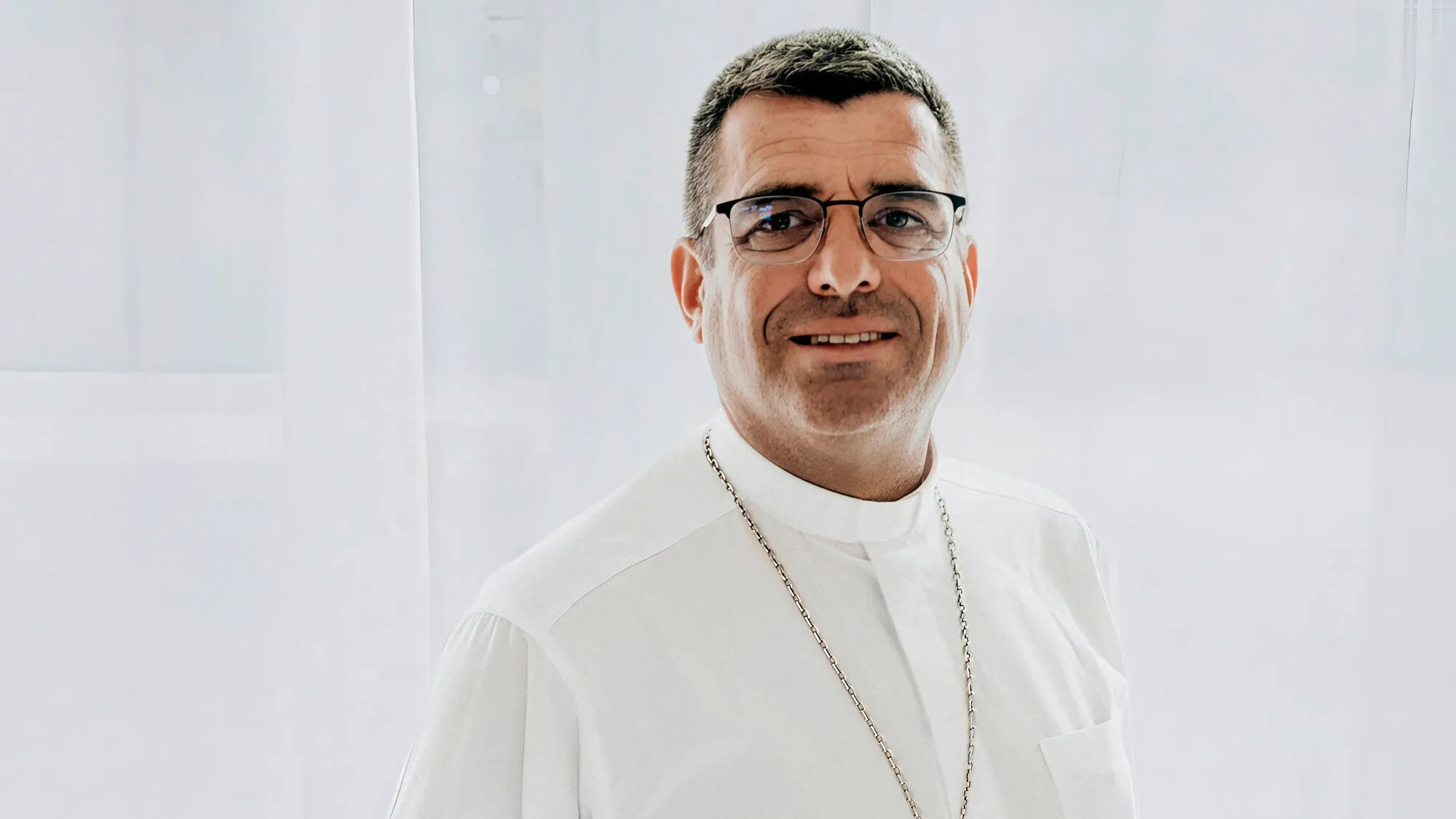
In a few days, you will welcome Léon XIV at the Stade de France. When Pope Francis appointed you bishop of Saint-Denis in 2024, would you have thought one day you would receive his successor in your diocese?
It’s obviously a surprise, but it’s not the first time that a pope has come to us! During his first trip to France, in 1980, John Paul II visited the Saint-Denis basilica. This bears the name of the saint who evangelized Île-de-France in the 3rde century and also houses its relics.
Our diocese therefore keeps the memory of the beginning of Christian life in the north of the country. If Léon XIV will not go to the basilica, he will go to the Stade de France, only a few hundred meters away.
His arrival in the department is the result of a certain coincidence – the largest public reception area in the country is located there – but it is up to us to welcome him, as well as all the young people who will come to the vigil. We will ensure that no one is forgotten and that all those who live in this astonishing territory that is Seine-Saint-Denis are represented.
Exactly, who are the Catholics in your diocese?
It is above all a very populated department – around two million inhabitants – with great religious diversity and where practicing Catholics are few in number, around 25,000. The population is also particularly young, with a large part of it under 30 years old.
Concerning the faithful, they reflect the image of the department: young, multicultural and multi-religious (from parents of different religions, editor’s note). Many of them come from overseas, Africa or Asia. Furthermore, they are not exempt from the social and economic fragilities that affect all Sequano-Dionysians.
Our Church is poor and minority but full of life. The Christian communities of Seine-Saint-Denis display a face which is good news for the Church of France. They say that living together in diversity is possible. Of course, our neighborhoods have problems, but there too, there is a rise of young people ready to take care of others. Our diocese is proof that there is reason to hope.
“Our Church is diverse, poor and minority but full of life. »
Isn’t this a somewhat idealistic vision?
I am well aware of the difficulties in the department! To name just a few: the challenge of integration, precariousness, unemployment, delinquency, the temptation of the parallel economy which unfolds at the bottom of the towers… We often hear that Seine-Saint-Denis is among the “lost territories of the Republic” and this expression annoys me.
The young people of the department live there, grow up there, study there. And they carry within them a joy and a strength that is solid and true, stronger than contrary winds. I want to believe them more than give credence to words that come from outside the 93. Why would I, who am on the ground, be more idealistic than someone who does not live there?
Priest of the diocese of Versailles, coming from a rather classical environment, were you not taken aback when you arrived in Saint-Denis?
Although I seem far from the land in which I grew up, my education has always encouraged me to open up to others, to approach the world positively. Scouting, in particular, taught me to cultivate an enthusiastic outlook. He gave me the taste to refuse being among myself and to put myself at the service of the most fragile.
When I entered the seminary, I told myself that I would be happy to live the Gospel with brothers and sisters who live in places where society is broken. I am convinced that participating in a Church present on the fault lines is participating in the plan of salvation.
Before Seine-Saint-Denis, I was priest of the town of Trappes (Yvelines) for almost a decade. There, the adventure was similar and I had a lot of joy serving in these working-class neighborhoods. I was amazed by these life-giving Christian communities. I can testify that in these places, the Christian faith lifts the communities up.
That’s to say ?
In our cities, Christians bring peace: they educate the youngest, build bridges to other communities, and are attentive to the poorest. It is not a Church which lives in darkness, tears or fear, but which is in the joy that is shared and in the courage to assume its faith in sometimes difficult environments.
It is a Church of hope which has a good taste of the Gospel. It is not because we are in the minority that we are powerless. On the contrary, History teaches us that there can be creative minorities. This is what I hope for my Church: that it participates with all humanists of good will in the construction of society, while proclaiming the glory of God. The joy that faith gives is a strong testimony.
These communities seem to nourish your hope…
We often hear that diversity is a source of problems, that living together is not possible. Looks are suspicious, even within the Church. I can understand these concerns and they must be welcomed. But we must overcome fear and we know the way: discover ourselves, talk to each other, put ourselves at the service of each other.
Just as we must trust others, we must trust the rule of law in which we live. We are a country in which the legal framework is assured, we can trust the police and the justice system. In these conditions, we can live in peace and look at others as brothers.
“We must overcome fear and trust to live in peace and look at others as brothers. »
And you, what are your concerns?
They are of several orders. I am worried about my country. I am very afraid that our outlook will become harsh, that society will become polarized in fear of others. I don’t want young people in the neighborhoods to fear those who watch them from afar, and for residents of big cities to be afraid of these young people.
This concern for France also comes from the fact that fewer and fewer people know the beautiful face of Christ, who is our Savior and gives meaning to our lives. I also have concerns for my diocese and its material poverty. Of course, the Lord is with us, but my Church must still live.
Will I be able to continue to pay the priests and employees of the diocese? Will we have the means to finance activities for young people? Will my diocese go bankrupt in a few years? I think about it every day.
As a bishop, I am also worried about my own weaknesses. I feel that I am a poor guy with limited strength and that I am not necessarily a visionary. And yet, the Church has entrusted me with a diocese, with its two million inhabitants towards whom I have a responsibility, whether they are believers or not.
I must work so that the Christians of 93 have all the means of salvation, that the children grow up well, that the elders end their lives well, that the sick are cared for, that peace comes. Fortunately, I’m not alone in this, otherwise I wouldn’t sleep anymore! It is by the grace of God! I constantly pray to Him to give me direction.
What do you hope for from Leo XIV’s visit?
The next few months will be a period of tension for our country, with a presidential election which promises to be complex. I do not expect Leo
He must bring us back to the essential with a word of truth. This is what is expected, well beyond Christians, as a non-Catholic elected official in my department recently told me. The words of the Pope can reach us all and stimulate us, even shake us.
The biography of Mgr Étienne Guillet
- October 28, 1976. Born in Abbeville (Somme).
- 1999. Volunteering in Thailand with the Paris Foreign Missions.
- 2006. Ordination for the diocese of Versailles.
- 2008. Appointed chaplain of a juvenile correctional facility.
- 2024. Appointed to Saint-Denis (Seine-Saint-Denis) by Pope Francis. He is the youngest French bishop.