
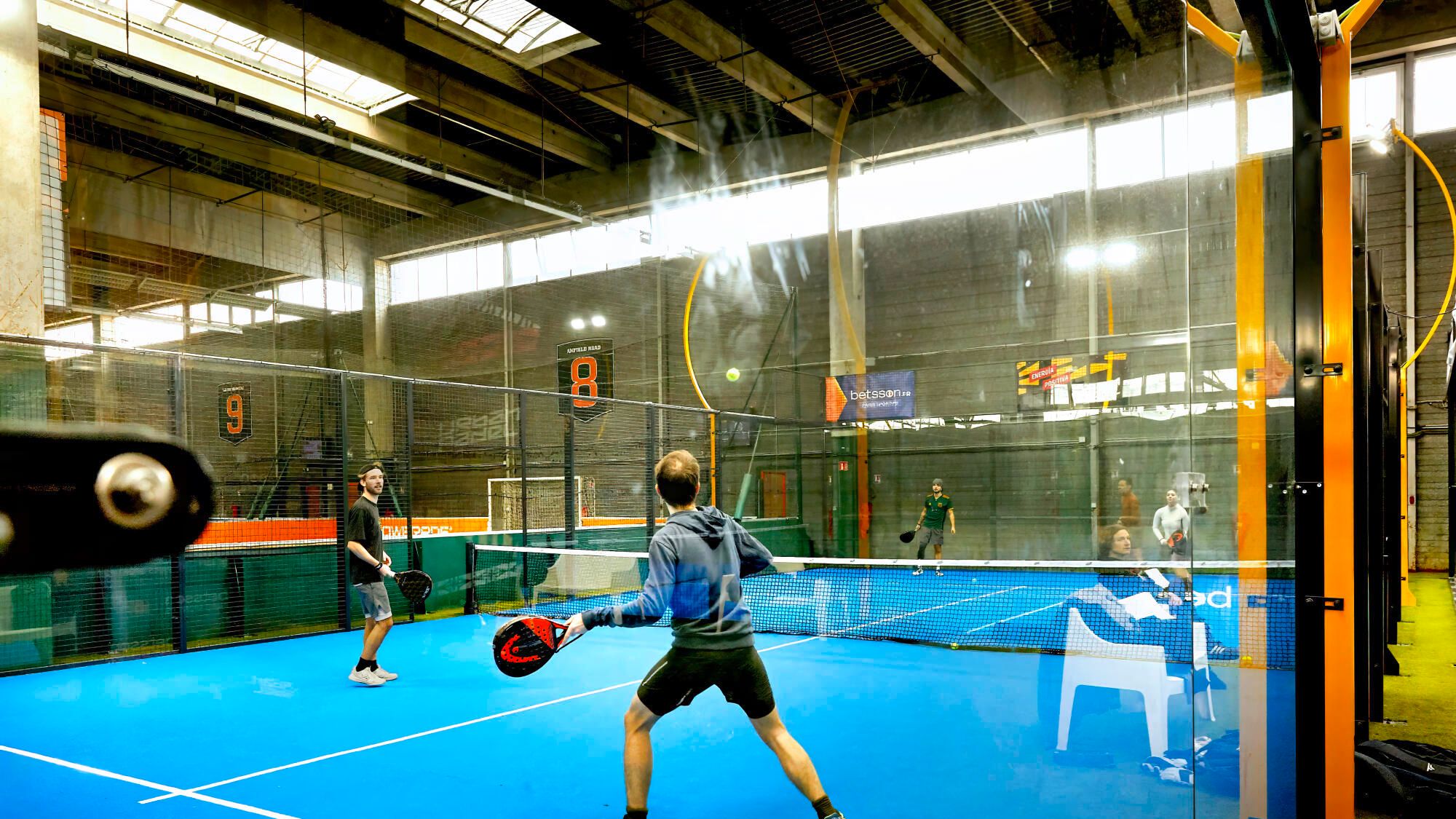
Padel, this racket sport that the French love
Last September, Arthur suffered redundancy. Suddenly, this 26-year-old Parisian engineer has to occupy his days. He decides, with unemployed friends like him, to try the sport of the moment, padel.
This is the revelation. “We were won over from the start,” says Arthur. Some sports have a low effort-enjoyment ratio. In surfing for example, for thirty minutes of effort, you have two minutes of fun. » With the padel, it’s “thirty minutes of effort, thirty minutes of fun”. He and his friends play each day and stay after his rental ends if no one else shows up. Then going on vacation to Indonesia, they hastened to reserve courts there to practice their new favorite sport.
Ten years ago, the padel had 5,000 practitioners in France, specified an article from the time of Padel magazine. At the end of 2025, there were 850,000, according to the French Tennis Federation (FFT), which oversees this sport. And one million practitioners has already been reached in 2026, calculated the site Padel Now. “It increases by 30% each year,” notes Jean Vacca, its founder. It is no longer a fashion phenomenon. » The explosion mainly took place during confinements. Padel was then one of the few authorized sports, because it did not require contact. Word of mouth and media hype did the rest.
Other countries have contracted the same fever. “Italy, Portugal and Sweden are booming,” notes Franck Binisti, editor-in-chief of Padel magazine. Something in padel immediately seems to convert its practitioners. 90% of those who try it play it again, according to the World Padel Report 2025. How to explain it?
Caged dopamine
First of all, by its simplicity. Jade makes me understand the rules, very similar to tennis, in three minutes. Then by the immediate pleasure that comes from succeeding in returning the ball without great effort – I experience it from the first exchange.
Its transparent wall at the back of the track sometimes puts the ball back into play. Players have the right to let it bounce on the wall before returning it. This breaks the routine of the exchanges and makes the match more uncertain. So more fun. “Those loud impacts, those vibrations, add excitement. It makes you want to hit like crazy,” considers Manu Garcia, founder of French Padel Shop, an online equipment sales store. “The padel is dopamine in a cage,” summarizes Jean Vacca.
Another attraction: the resolutely social nature of this activity, which is practiced by four people. “I made a lot of friends there,” confides Jean Vacca. I even found one of my associates on land. » The exchanges, in fact, are not limited to the track. “If your tennis partner has to pick up their kids from school after the match, there will be no third half. At padel, as we play with four people, there is often a player available for a drink after a game,” remarks Manu Garcia.
If I had to bet on the most practiced sport between tennis and padel in ten years, I would bet everything on padel.
Jean Vacca Founder of Padel Now
No age limit for this sport which is practiced “from 4 to 90 years old”, says Franck Binisti. Particularly because it is not too physically demanding: “I started padel in 2009 because I had fractured my vertebrae,” he says. It’s perfect for re-education, much less violent than tennis or squash. » Many tennis players retrain as they get older. Like Jean Vacca: “As I got older, I could no longer serve after an hour of tennis. » The icing on the cake, the matches are short. A valuable asset in a hyperactive age.
An executive clientele
In short, padel responds to the trends of its time. Investors have understood this well. They jumped into what appears to be a good deal. The field where Arthur played in Aubervilliers was only inaugurated in 2025 by Urban Padel. In two years, this company has built more than 110 in France. Jean Vacca has already taken 100,000 euros out of his pocket to develop the reference application: Padel Now. It will connect players. And above all, it will allow them to reserve land. He hopes to release it within the year. If it is for the moment “a financial pit”, he believes it wholeheartedly. “Because the more you play padel, the more you get a taste for it. I experienced it. If I had to bet on the most practiced sport between tennis and padel in ten years, I would bet everything on padel. Besides, I’ve already done it a little…”
There are still obstacles to its growth. The first remains financial, according to the practitioners interviewed for the 2025 study of the Padel Observatory. The bill can quickly add up. A new racket costs 150 euros, up to 300 euros if you want to play competitively. And it must be changed regularly. As for the pitches, they are often rented for 15 euros per hour and per player. Unsurprisingly, 42% of padel players are executives or from higher intellectual professions (according to a study by Padel magazine). This is true on the slopes. Jade, for example, graduated from business school. “All my school friends took up padel,” she explains.
The second obstacle identified by the study is the difficulty of finding three partners (read box below). Nothing to scare Jean Vacca: “91% of French adults have never played padel, according to our 2026 survey. The potential is enormous. And when there are more lands, prices will fall. In Spain, which has 6 million practitioners, a game costs 5 euros. » Manu Garcia adds: “There are four times less land in France than in Spain. » He who markets padel tracks says he is assured of having work for at least ten or fifteen years.
He is convinced: “We are only at the beginning of this sport. »
A sport created in Mexico
Don’t you dare pronounce padel other than “padèle” in front of Jean Vacca, founder of Padel Now. “It’s one of my daily struggles,” he smiles, “so that it is no longer confused with paddle,” a water sport.
Why “padèle”? Because padel was born in Mexico, in 1969. It must therefore be pronounced in Spanish. It was designed by Enrique Corcuera, a businessman who did not have the space to install a tennis court at his home. In 1974, his friend Prince Alfonso de Hohenlohe was seduced, and imported him to the Old Continent. Immediate success. The Spanish are today the most numerous practitioners in Europe.
In France, the first fields appeared in the South, under the leadership of the Franco-Spaniards. “One of the first French champions in the 1990s was called François San Miguel. He was not Breton,” smiles entrepreneur Manu Garcia. Today, the discipline has 35 million players worldwide (World Padel Report 2025).
Where to find teammates?
Le padel is played with four players, two against two. It is therefore essential to find partners. The best option is to contact your local club. To identify it, you can consult the online map listing them, on the website of Padel magazine . These clubs organize activities, initiation tournaments, sometimes barbecues. Ideal for getting to know each other.
Almost all of them have also created groups on the messaging app WhatsApp. They make it easy to find teammates near you. Padel court rental companies also often have their WhatsApp group. There are also applications dedicated to finding partners such as Playtomic or Anybuddy. To find players of a similar level, go to the level simulator on the Padel Now website (padel-now.co).


