
South Korea conquers the French public
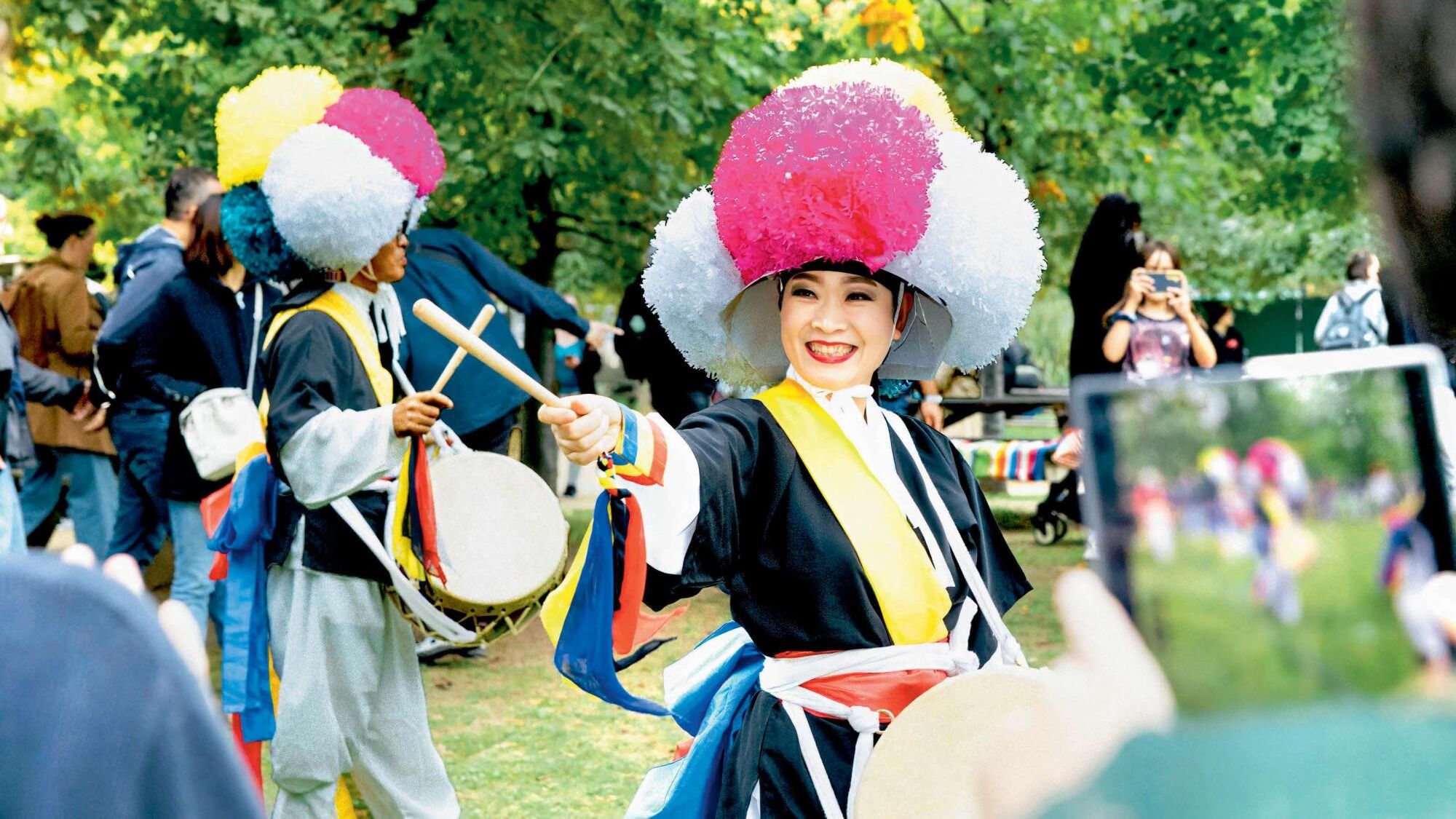
There a man in a kimono demonstrates taekwondo; here, percussionists perform in traditional Korean outfits; culinary scents escape from colorful stalls, where menus line up kimbap, bungeoppang, jjajangmyeon… We are not in South Korea, only at the Jardin d’acclimatation in Paris.
At the end of September, the park dedicated an entire weekend to the folklore of the land of the Morning Calm, on the occasion of Chuseok, the harvest and full moon festival. “I come to discover this culture, even if it’s K-pop that interests me the most,” confides Emma, a 15-year-old Parisian who is taking part in the festival with her mother, Delphine.
K-pop, K-beauty, K-food…
Like many teenagers, the schoolgirl loves Korean pop K-pop for those initiated, this multifaceted musical movement that appeared in the 1990s and carried by groups of young adults (mostly single-sex) with very aesthetically worked style and choreography. Thus, last July, the group Stray Kids, made up of eight singers aged 24 to 28, filled the Stade de France (Seine-Saint-Denis) for a fiery performance.
Noémie, 14, traveled from Bordeaux (Gironde) accompanied by her mother, Gabrielle. “I had never felt such adrenaline, it was crazy,” enthuses the schoolgirl, who hosts a WhatsApp conversation dedicated to her favorite K-pop groups and covered the walls of her room with images of them. “We call it “stanning” a group, that is to say following its activity very closely,” she explains. First there to accompany her daughter, Gabrielle admits to having been surprised by this “high quality” show, despite its “very marketing aspect”.
The “K” is now available as desired: “K-beauty” for cosmetic products which are flooding the European market, “K-food” for culinary offerings, “K-dramas” for series… In 2025, Korean production Squid Game has thus become the most watched series on Netflix since the platform existed. Five years earlier, the much noticed Parasite, by director Bong Joon Ho, won the Palme d’Or at the Cannes Film Festival and four Oscars, including best film.
“Nothing is so engaging as a change of scenery”
Marie Desplechin writer (born 1959)
A craze linked to confinement
This global cultural diffusion has a name: the Hallyu. This Chinese term meaning “Korean wave” refers to a true economic miracle. “This small state which, after the Second World War, was among the poorest, became the 13th largest economy in the world in just fifty years, without ever having been a colonial power. We Europeans took a century and a half to make the same revolution,” explains Sylvie Octobre*, a sociologist specializing in South Korea.
Vassalized by China then invaded several times by Japan, the state of 52 million inhabitants today emerged extremely impoverished from the Two-Korean War (1950-1953). A colossal economic effort, largely supported by the population (who went so far as to give their wedding rings and gold teeth to replenish the coffers), propelled it among the world’s major industrial producers. But, in 1997, a violent economic crisis affecting all of Asia forced entrepreneurs to diversify their investments. This is where culture comes into play.
“The creation is first and foremost national, it was not designed solely to be exported. This is evidenced by the use of Korean in musical or television productions, even though the language is only spoken in Korea,” argues Sylvie Octobre. The State is supporting this growth. In the West, the distribution of audiovisual works is initially limited to the Internet, and has not yet reached radio or television. Until the Covid-19 crisis and the massive use of users on platforms and social networks changed the situation.
Thus, Emmanuelle, 32, became interested in Korean culture first thanks to series: “The classic scenario consists of a poor young girl courted and saved by a very rich heir. Steeped in Confucianism, Korea is indeed very patriarchal. I am aware that these cultural products are designed to disseminate a certain image of the country, she explains, but all nations have their faults. » The Lille native even took up Korean and now co-hosts the podcast Talk to me K-drama, which deciphers Korean series to learn more about the country.
The other face of Korea
The growing attraction to Korea is not just reserved for teenagers and young adults. At the Jardin d’Acclimatation festival, Guillaume, 48, offers a demonstration of taekkyon, a traditional Korean martial art. “I lived six years in Korea to learn the practice, before returning to teach it in France,” he says.
Particularity of this discipline: the fights are most often accompanied by percussion. Anne-Sophie dressed in her traditional costume to accompany the drum demonstration that she has been practicing for ten years: “I was seduced by the very popular dynamic of this instrument: in Korea, it was played on farms during the harvest.” This 49-year-old secretary from Ile-de-France stayed there for a music course. She also recognizes that a certain fantasy surrounds the country: “Phenomena like K-pop don’t show it, but Korean society remains very conservative. The place of women, for example, remains very regulated.”
Sylvie Octobre notes this paradox. There Hallyu works very well, particularly among younger generations, because it spreads values of openness, inclusion and pacification which meet their aspirations. And the country is indeed experiencing protest movements against moral constraints, of which women are particularly victims. Still, the desire to know South Korea from the inside remains. If Emmanuelle is still dreaming of going there, the decision has been made for Emma and Delphine. Next year, if all goes well, they will fly to the land of Morning Calm.
* Co-author with Vincenzo Cicchelli of K-pop, soft power and global culture, Ed. PUF, 324 p. ; €22.
In 2027, Seoul will host WYD
After Portugal and Panama, it is Korea’s turn. In August 2027, Seoul will meet young Catholics from around the world for the 41st World Youth Day (WYD).
The event will bring together several million participants. The theme “Courage!” I am the conqueror of the world” (Jn 16:33) was chosen by Pope Francis. However, Catholics are a minority (11%) in this largely irreligious country.
In September 2024, Cardinal Farell, prefect of the Dicastery for the Laity, Family and Life, described a local Church “full of vitality and initiative”. And added: “The dynamic Asian context will help young people to think about the dialogue between faith and modernity.”


