the end of Viktor Orban?
First there is beautiful Budapest, its pastel facades inherited from the Austro-Hungarian Empire, its tourists who kiss on the bridges in the Danube breeze. Then, behind this postcard image, there is the Hungary of Viktor Orban. The one where residents wait at the bus stop under campaign posters that stir fear of Ukraine in the run-up to the legislative elections of April 12, 2026.
In one of them, the Ukrainian president stares at passers-by. “Let’s not let Zelensky laugh at the end,” it says. The message voters need to understand: if Viktor Orban loses the elections, the country will send young Hungarians to fight in Ukraine. The neighboring war emerged as the setting for this campaign.
“And all this, financed with our taxes! » annoys one resident, while others shrug their shoulders, a sign of great weariness after sixteen years of Viktor Orban in power. A few days before an election which, for the first time, seems to be able to escape him, a formidable opponent has come to reshuffle the cards. Peter Magyar, formerly of Fidesz, the ruling conservative and nationalist right, joined Tisza, the center-right party, and has been gaining popularity since defecting and denouncing the flaws in the Orban system. On the contrary, he assures him that he wants to move the debate away from this permanent fear of Ukraine to bring the campaign back to internal difficulties, while the current Prime Minister is criticized for his empty program.
Since 2010, Viktor Orban has reigned supreme over Hungary, of which he has become the face and voice. In each election, he designates his public enemy number one to boost his popularity: sometimes Europe and Western decadence, sometimes migrants. This year, it’s Volodymyr Zelensky and, through him, the shadow of the war in Ukraine. A speech which continues to work among part of its base, nourished by nostalgia for a powerful Hungary and the trauma of the Treaty of Trianon, which amputated the country by two thirds of its territory after the First World War. But this system, which centralizes institutions – the Ministries of Health and Education have been placed under the supervision of the Ministry of the Interior –, controls the media narrative and part of the economy, is today showing its limits, for the first time.
A youth who emigrates
A two-hour drive is enough to leave Budapest and reach the south of the country, in shades of green as far as the eye can see. In the villages, only a few elderly people provide any semblance of life, riding bikes that seem as old as they are. Viktor Orban has always conquered this rural and aging region without much difficulty, but here, young people are emigrating in numbers to other European countries, attracted by salaries and a more flourishing job market.
Lizett, a chemistry student, is seriously considering it if the current Prime Minister is re-elected. At 22, the young woman, with straight hair and demure glasses, is saddened. She almost never experienced laboratory experiments during her schooling, due to expired chemicals. “It was written in Russian, they dated from the Soviet era,” she remembers. In four years, she had few opportunities to practice for her college entrance exam, when other students “had never even seen test tubes.”
In Hungary, the observation is the same everywhere: the standard of living is falling, inflation is eating into income. Meanwhile, images of the Prime Minister’s entourage living in luxury are getting worse and worse. Residents denounce a system of corruption. How could Lorinc Meszaros, a former plumber-heating engineer and childhood friend of Viktor Orban, become the richest man in the country in a decade?
Another case that annoys: the former governor of the central bank, also close to power, is accused of having embezzled public funds. Veronika says she sees the consequences every day. “We received aid from the European Union to rebuild our country roads. We have never seen the color! » estimates this 60-year-old woman, who returns home on a road strewn with potholes. Nearly 20 billion euros remain blocked in Brussels today due to a lack of control and a lack of transparency from the country’s authorities.
Aging public services
So much money is then missing from public services, one of the biggest concerns of the population. The most glaring example remains the hospital. “It feels more like Chernobyl!” » says Lizett, whose grandmother was hospitalized in March 2026. Installed in a room shared with five other patients, the grandmother quickly began to experience breathing difficulties. The family suspects that promiscuity with others has worsened his condition, but talking to doctors is an obstacle course. Lizett’s grandmother died a few days later.
For a long time, the protest remained weak. Many voters, moreover, prefer to stay away from journalists and keep their opinions to themselves. Veronika, a retired history professor, would however have liked to denounce the change in program imposed in 2020, which forced her to teach the thought of Albert Wass, an author criticized for his nationalist and anti-Semitic positions in the 20th century. But she did not want to take the risk of finding herself unemployed, like other colleagues who had the courage to protest.
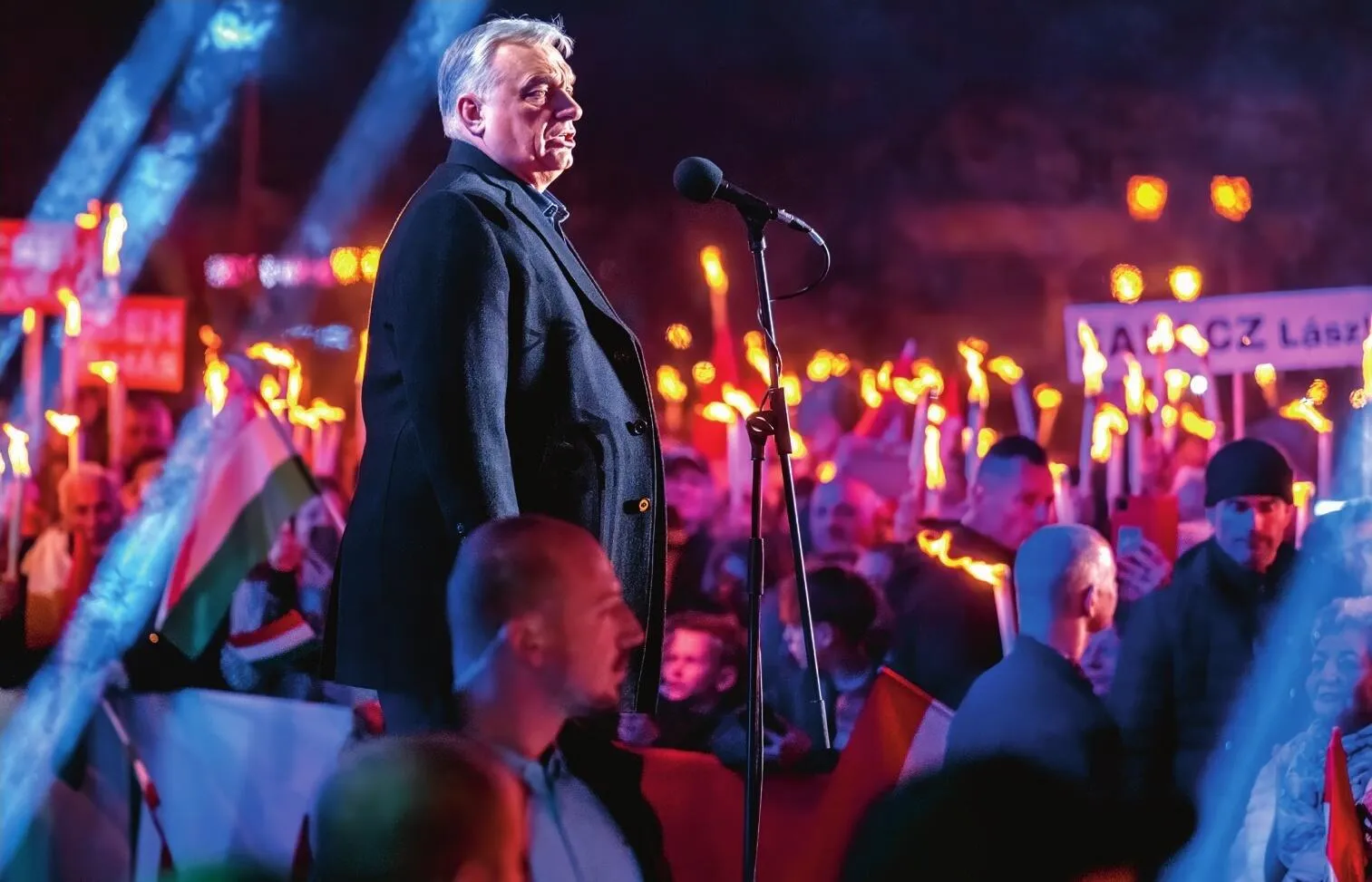
In Kecskemet, an hour from the capital, “the Tsar of Budapest” speaks a few days before the elections. “Victor!” Victor! » shout his ardent supporters. At first glance, the moment seems suspended. Torches wave between the Hungarian flags, warming the transfixed spectators. But background noise parasitizes the speech… Young opponents came in droves to express their fed up. Horns here, “Orban get out” there, which the state news channels will refrain from broadcasting. For the moment, Hungary is still Viktor Orban’s.
Voting intentions in Hungary: who is in the lead between Fidesz and Tisza according to the latest poll?
- 40% for Fidesz (Viktor Orban).
- 49% for Tisza (Peter Magyar).
Source: Republikon Institute survey, March 23-26, 2026.
What is Hungary’s share of the total GDP of the European Union?
1.1%, this is the share of Hungary’s GDP in that of the European Union, in 2023.
Source: Eurostat