The odyssey of the French board game
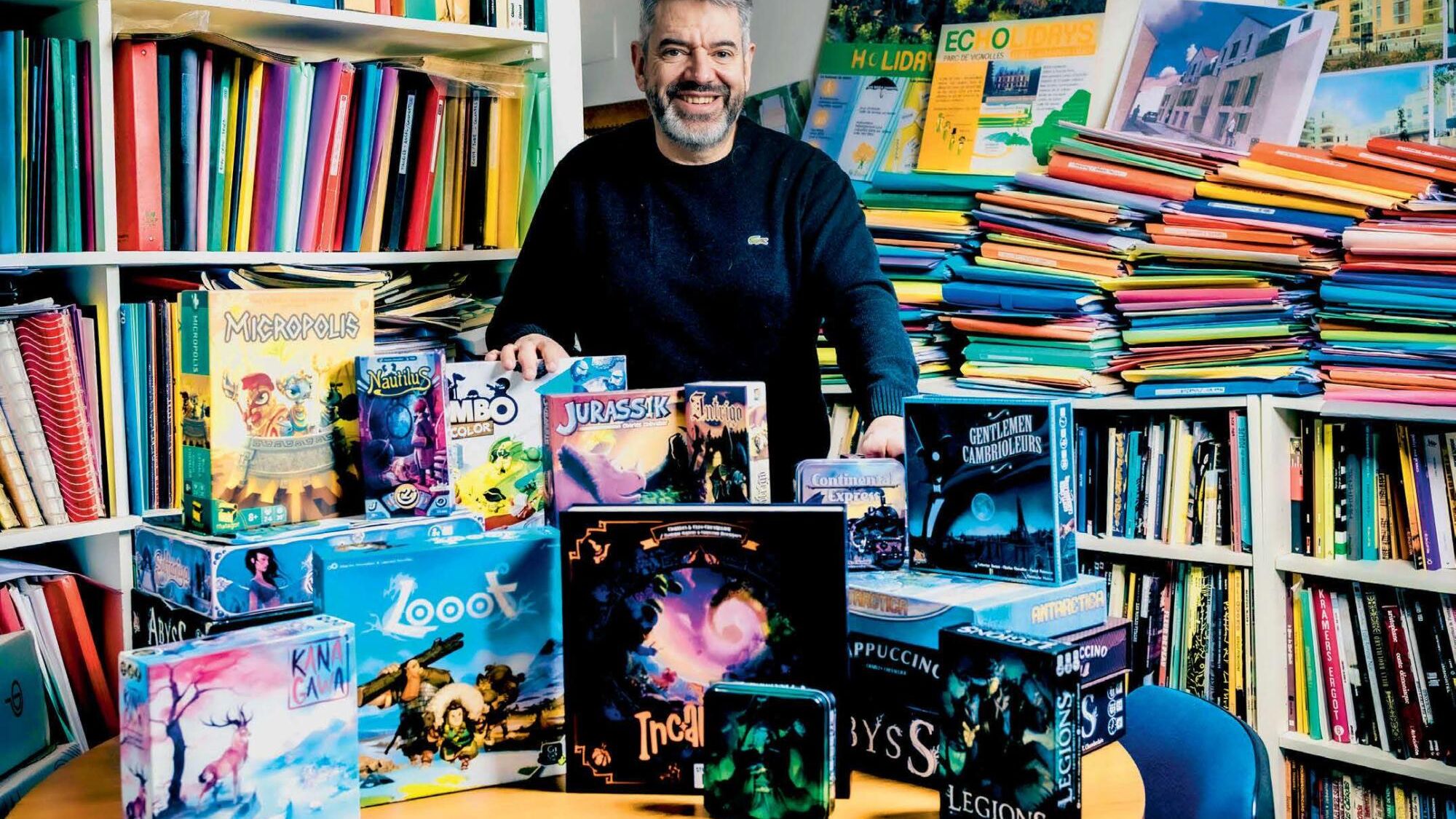
Even as a child, Charles Chevallier made his own games, alone in his room, with two pieces of string and a few markers. Inventor of board games? At the time, the profession didn’t really exist. The French landscape remained fallow: a few publishers, a handful of authors, no structured ecosystem. So, as a teenager, he chose to become an architect, “a real profession”.
For more than twenty years, he designed buildings and pavilions. Then, overcome by nostalgia in the mid-2000s, Charles Chevallier took out his youthful prototypes from the boxes. And decides to talk about it to those around him. “I arrive with my game: a board, some money and we pluck the others – I stuck to the American model. And there, I discover a world where everything has changed. I understand that I missed a revolution. »
Up until this point, the equation of the game world was quite simple; the Americans dominated. In the stores, almost no French creations. Only the Mille Bornes, invented in 1954, has found a warm place in living rooms.
In reality, the great classics, Monopoly and Cluedo, created between 1935 and 1949, dictated an effective recipe that will last for almost half a century. The games are family-friendly, based on the spirit of competition, and above all calibrated to be sold en masse in supermarkets. “The gift bought in haste on December 24,” remembers Murielle, not really the type to do it in advance for Christmas.
A European economy
But in the early 1990s, American licenses ran out of steam. In Germany, a new generation of enthusiasts considers mainstream games too simplistic and is innovating. The “specialized” game appears: more sophisticated, longer, sometimes austere for casual players.
An aridity that does not come from nowhere: in a country still marked by the scars of war, creators abandon warlike or capitalist themes for epic or ecological stories. An “almost politically correct game”, marvels Charles Chevallier, then immersed in his first creation which would become Intrigo.
Scotland Yard, Carcassonne, The Settlers of Catane… These game names unknown to the general public are a hit among those in the know and break the codes. Their success led to the emergence of a true European economy. Under German leadership, the sector is structured: authors propose projects to publishers, who then mobilize illustrators, manufacturers and distributors. A plan that promotes creation, and from which France will benefit.
1,500 games launched per year
A French actor, above all, will seize this opportunity: Asmodee. Created in 1995, the publisher focuses on games that are portable, accessible and quick to play. Above all, it abandons advertising and mass distribution to rely on specialized stores, which are increasing in number in France. A paid choice.
The successes follow one another: Jungle Speed, and its totem which you catch as soon as two identical symbols appear, becomes a worldwide phenomenon. The werewolves of Thiercelieux, a party game where you have to unmask a wolf monster, stands out for its tone and design.
Quite logically, French authors grow with the rise of the company. As with philosophy or electro music, a French touch is exported. Creators become sought-after signings. “It was incredible, despite a form of anonymity, we filled huge rooms,” smiles Pierre Bellet, founder of the publisher Laboludic, a traveling companion at that time.
Today, thirty years after its creation, Asmodee has become the world number two: 2,400 employees, 39 million games produced in 2021, in around fifty countries, and since its listing on the stock exchange in February 2025, a valuation which exceeds two billion euros. At the same time, with 4,500 references published each year, France has become the leading European market.
Driven by a generation fed up with video games, the sector also benefited from the forced Covid-19 break, which reinforced the habit of playing at home. Board gaming has become a hobby in its own right, just like going to the cinema. But the balance remains fragile. “Many authors have difficulty making ends meet,” recalls Charles Chevallier, still an architect despite around fifty published games and several international awards.
According to his estimates, an author receives 2 to 3% of the price of a box, or twenty to thirty euro cents. Out of a hundred creators, only about fifteen make a living. As in literature, a handful of bestsellers finance the overwhelming majority of titles. Result: each publisher hopes to achieve the phenomenon that will explode sales, in a frantic race for new products.
With 1,500 games launched each year in France – one every six hours – the competition is such that “if a game has not found its audience in three weeks, its future is compromised”, regrets Pierre Bellet. A pressure that pushes more and more authors towards independence.
Strong sales on Amazon
This is how the last big French hit began: Crack List, a reinvention of Petit Bac released in January 2022. Its creator, Pierre Faucon, retired from television, had received a series of refusals from publishers. Until his daughter, a business graduate, pushed him to persevere.
Together, they rethink the graphics, invest in online campaigns and decide to print 10,000 boxes in a Polish workshop. They sell out within a few days. The Faucons restart production, renting a warehouse near their home. Three years later, more than two million copies have been sold. “A fairy tale like only one every fifteen years,” smiles the designer.
His idea took advantage of a recent trend: the desire for quick games, perfect as an aperitif. But also the rise of Amazon. The American platform represents, according to Pierre Faucon, 15% of sales in the sector. Enough to encourage fathers or reckless students to gather their savings, convinced that they have a brilliant idea – at the risk, sometimes, of losing their money.
For the Falcons, the odyssey continues. Crack List is now exported to Germany and Italy. The family business has eight people and is now targeting the American market. A way, for them, to extend the French epic of the board game.
What percentage of the sale price does a board game creator receive?
A board game creator receives on average approximately 3% of the sale price of the game.
Source: C. Chevallier.