
these inhabitants of the Vosges are reinventing themselves
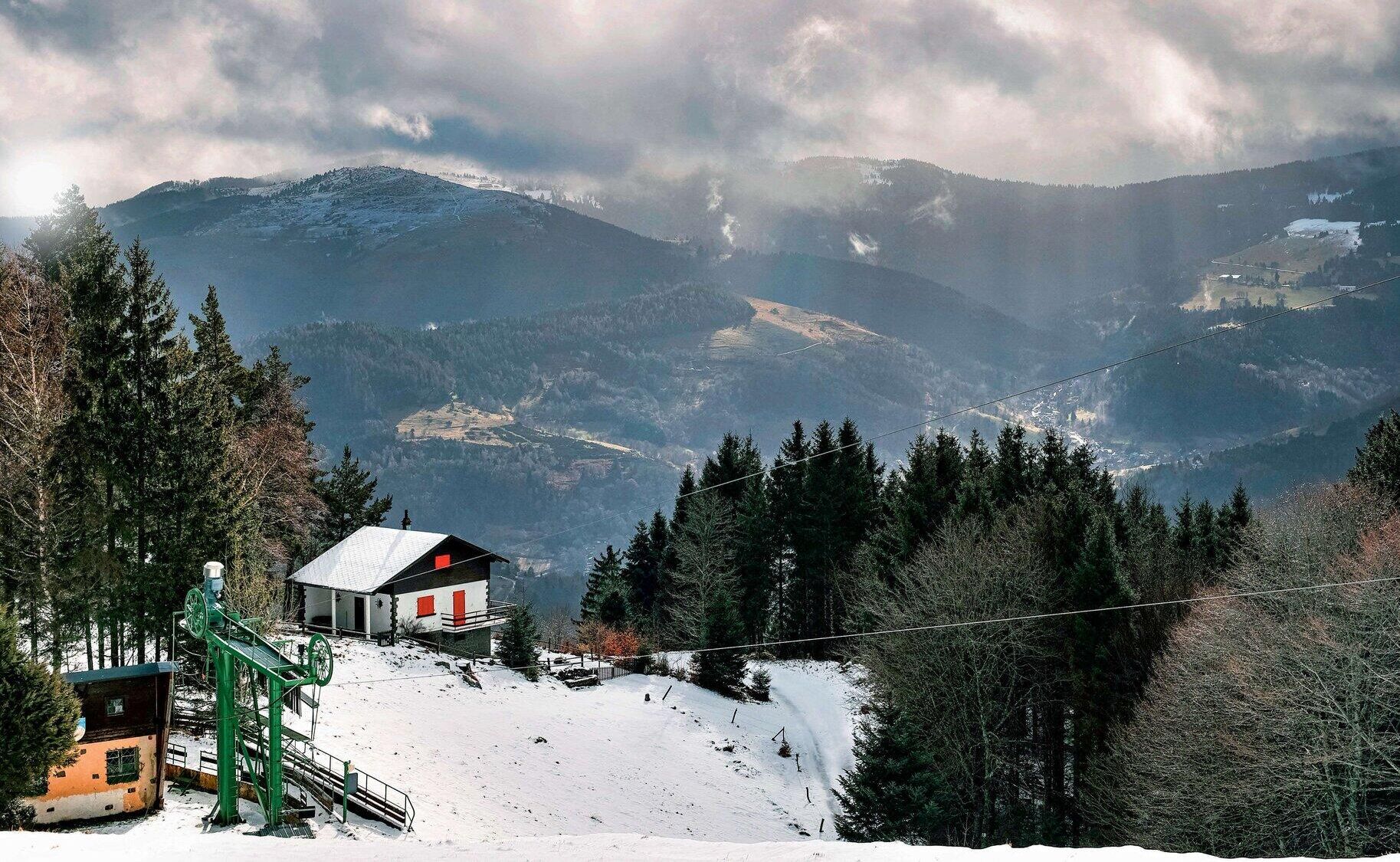
At nearly 1,000 meters above sea level, ears become blocked and the rain gives way to damp flakes. At the end of the road, the Gaschney 360° station, former flagship of alpine skiing in the Munster valley (Haut-Rhin). A handful of chalets, two refuges and a dilapidated building reminiscent of the 1970s, on which the promise of finding ski passes, rental skis and pancakes is still displayed.
The silence does not immediately appeal to the visitor. Facing the snow on the slope and the steel pylons, we still believe we hear the voice of the station. Buzzing of the chairlift, clicking of the lift poles, squealing of the skis… However, on this Monday morning of the winter holidays, nothing. A shy sun breaks through and lifts the veil on today’s reality. Gaschney, “the soul of the Vosges massif” as it self-proclaimed, has become one of these media “ghost resorts”.
In August 2025, following very complicated seasons, the public service delegation, which was coming to an end, was not renewed by the joint mountain resort development union. This was the second definitive closure in the Munster valley, a year after that of Tanet, a few kilometers away.
It’s not just ski lifts that stop, but a way of living together. For more than seventy years, skiing and snow have cemented society, structured winters and family life. They leave a void that the valley begins to measure.
“We knew the beginning and the end”
In front of his farm inn, Claude Deybach scrapes the snow. The simple polo shirt he wears betrays the local man at least as much as his accent. For fifty years, his family has managed the place. “There is no solution against nature,” he grumbles, not very affable. That’s how it is, we resigned ourselves. »
Below the old slopes, now immaculate, Jean-Marie Valentin opens the memory box. The mountain guide points out the buildings and tells their story. Some winters, boosted by the presence of skiers, he went on for a hundred days in a row, “with three to four snowshoe hikes daily”.
During these outings, he gradually saw the end approaching. “From the 2000s, you had to go higher and higher to find snow. » Studies confirm: the Vosges massif has warmed by around 2°C since 1960 and the snow cover has melted by half. “We should not say that we no longer have snow,” Jean-Marie adds. But before, one meter at the Col de la Schlucht held the season. Today, in a few hours, it can melt. »
From above, the village of Soultzeren, which skiers could once reach from the pass, appears in shades of green and gray. From the living room of an old farm where the stable has been transformed into a gîte, a couple in their seventies gaze at their mountain. Under their woodwork, Raymond Braesch and his wife Gertrude rock themselves in nostalgia. “Ah, we had winters in the 1960s,” says the woman who grew up here. My father made tracks for us in the snow so that we could go to school, sometimes by sledding. »
On the living room table, Raymond sorts dozens of black and white photos. “We knew the beginning and the end. When we know how hard the veterans worked to build the stations, seeing them close is heartbreaking. » Coming from a family of breeders, he spent his first winters in the valley, with the cows. In 1938, his father converted the family marcairie into an inn, closed in winter. The arrival of the first ski lift in 1954 convinced the father, a visionary, to make the family live in the inn, known as the Schallern: “It was really the start, it worked well,” recalls Raymond. There was no road yet, but it attracted people in winter. »
No shuttle or cable car. People took the train to Muhlbach-sur-Munster and completed the ascent on foot on an open forest path. As a young man, Raymond often took it down to resupply the family inn from the farms in the valley. This harsh youth, without telephone or electricity, has its share of anecdotes taken from another time. Like these parents who braved the cold and the snow to have their newborns baptized in the valley. “They put them in the rucksack (backpack in Alsatian, editor’s note) with hot bricks, so they don’t get cold, he smiles. But we lived well, we weren’t unhappy. »
The peak hours of white gold
With the Trente Glorieuses, the democratization of the automobile gave the resort another dimension, making it easier to access. In this still rural region, skiing is the only activity. Local entrepreneurs see the enthusiasm and invest in infrastructure. A way for some, too, to employ their staff when activity is interrupted during the winter.
Unlike the Alps, the Vosges resorts were not designed as integrated tourist resorts, with accommodation and shops directly on the snow front, but as sports annexes to the village. An activity by and for locals. Clubs sprouted everywhere. Municipal schools took students from CP on “Snow Thursdays”, even providing them with ski equipment.
A child of this era, Annie Degout is today the treasurer of the Hohneck Colmar ski club. His father was one of the founders of the first Gaschney ski lift. The club still runs a shelter there, which today rings empty. Officially 60 beds at the time; 80 with those who slept on old mattresses in the unheated attic.
A smile crosses his face as he recounts the weekends of the 1970s and 1980s. “From November to April, every Friday evening, we went up. The shelter was full. There was an atmosphere Tanned people go skiing, with all generations: the old, the young, the children. » The evenings continued, hitting the cards over a drink in this place then cut off from the world.
Towards a tourism revival
Happy memories that always float in Thierry Hiniger’s mind. On the grounds of the former Tanet station, he sips coffee in his Schantzwasen inn. Nestled in the forest, this former refuge, once only accessible by ski, has become a charming inn with Austrian chalet decoration.
Born in 1961, Thierry could talk about the hours of this blessed era. Of this “community” which found itself in the ski club. In the wake of the Protestant church, the place served as another cardinal point of the village. “Obviously, we have it in our blood,” he breathes, taking off his glasses, revealing the piercing blue of his eyes. As long as there was skiing, there was real soul. »
Although the old wise men were reassuring at the dawn of the 1990s, arguing that the lack of snow was cyclical, the former lumberjack felt the tide turning. After buying the refuge in 1992, he slowly saw local customers abandon his massif. The older ones were getting too old, the younger ones preferred to go away for a week in the Alps. Everyone experienced the same feeling: as it melted, the snow took with it the social bond. In ski clubs, now, volunteers are hard to find. “When I saw that this fabric was being lost, I understood that it was the end,” points out Thierry Hiniger
This destiny without skiing, basically, he had accepted it a long time ago. Leaving the inn, he takes us towards a fence blocking access to the forest. With a bale of straw on his back, Thierry advances in the snow, betrayed only by the crunch of the powder under his feet. At the bend of a tree, a small group of reindeer nonchalantly waits for their pittance. There are now 35 of them, watched over by two trainers. They embody the tourism revival of Tanet.
In 2005, the entrepreneur acquired some deer from Lapland with the ambition of offering sleigh rides. The project fizzled out, but the reindeer aroused the curiosity of walkers so much that the idea of offering them a seven-hectare space in the forest and tracing an educational trail there emerged in 2014. A huge success.
In the region of the Christmas markets, the place is taken by storm from November onwards, to the point of saturating the narrow road leading to the inn. He brings the businesses in the area behind him. Reinventing itself is the objective of this valley of nearly 16,000 inhabitants, which must rethink its social structure outside of the ski slopes. The snowy paths of the past have given way to roads taken by young people who go to study or work elsewhere.
The valley is aging, the population is decreasing: those over 60 represented 33.2% of the population in 2021, compared to 25.2% in 2010, while the birth rate is collapsing. The ski clubs are hanging on, still taking the kids skiing, sometimes as far as Switzerland – where the snow holds up – but the loss of breath is palpable. “Every time the elders stop, the young people have difficulty taking over,” recognizes Annie Degout. There are always a few, but it will never be enough. »
Cheese and nature
The time of fighting to maintain skiing is over and no one is agitating the chimera of snow cannons to postpone the deadline, as in Ventron (Vosges), below the Moselotte, a river drawing its source from the Hohneck. There, die-hards intend to relaunch lifts which have not run since 2018. The future must be written quickly, because tourism generates more than 35 million euros each year in the Munster valley, terminus of the diagonal of the void.
“We are not crying, our knees in the snow, in front of our closed stations,” assures, combatively, Cyril Braesch, director of the joint union for the development of the resorts in the Munster valley. Our valley was known for its cheese before it was known for skiing. »
Paradoxically, climate uncertainties could become an asset. With their snow cover being too illegible, the Vosges have been protected from the real estate madness of resort builders having disfigured certain Alpine massifs. Gaschney and Tanet can still dream of themselves as symbols of sustainable, nature-oriented tourism.
A hope praised even by the ancients, not blinded by nostalgia. “I’m not worried,” concludes Raymond Braesch, a yellowed photo of the massif in his hand. Nature always attracts. Even if there is no more skiing, the mountain will remain. »
“Four seasons” activities, miracle or mirage?
It’s a refrain heard at every ski resort closure: “We’re stopping alpine skiing, we’re going to think about four seasons”, said Monique Martin, vice-president of the community of communes of the Munster valley, in July 2025, when the Gaschney closed.
This nebulous formula, advocated by the government, implies that the resorts would compensate for the loss of income from skiing by smoothing their activities over the other three seasons. Except that “there is no model for après-ski”, decided Julie Mazet, then tourism manager for the Buëch Dévoluy community of communes, in the Hautes-Alpes, where the Céüze 2000 station closed in 2020.
Ski touring, trail running, treks or mountain biking do not generate as much income as alpine skiing in winter alone. This observation is particularly true for resorts with massive hotel infrastructures, impossible to fill other than through winter sports.
For small structures, such as in the Vosges, the turn is possible. But nothing was thought of upstream, regret the stakeholders concerned, in a tense climate with environmental movements. The latter now dream of transforming the former station into a natural sanctuary, free of all human activity.


