
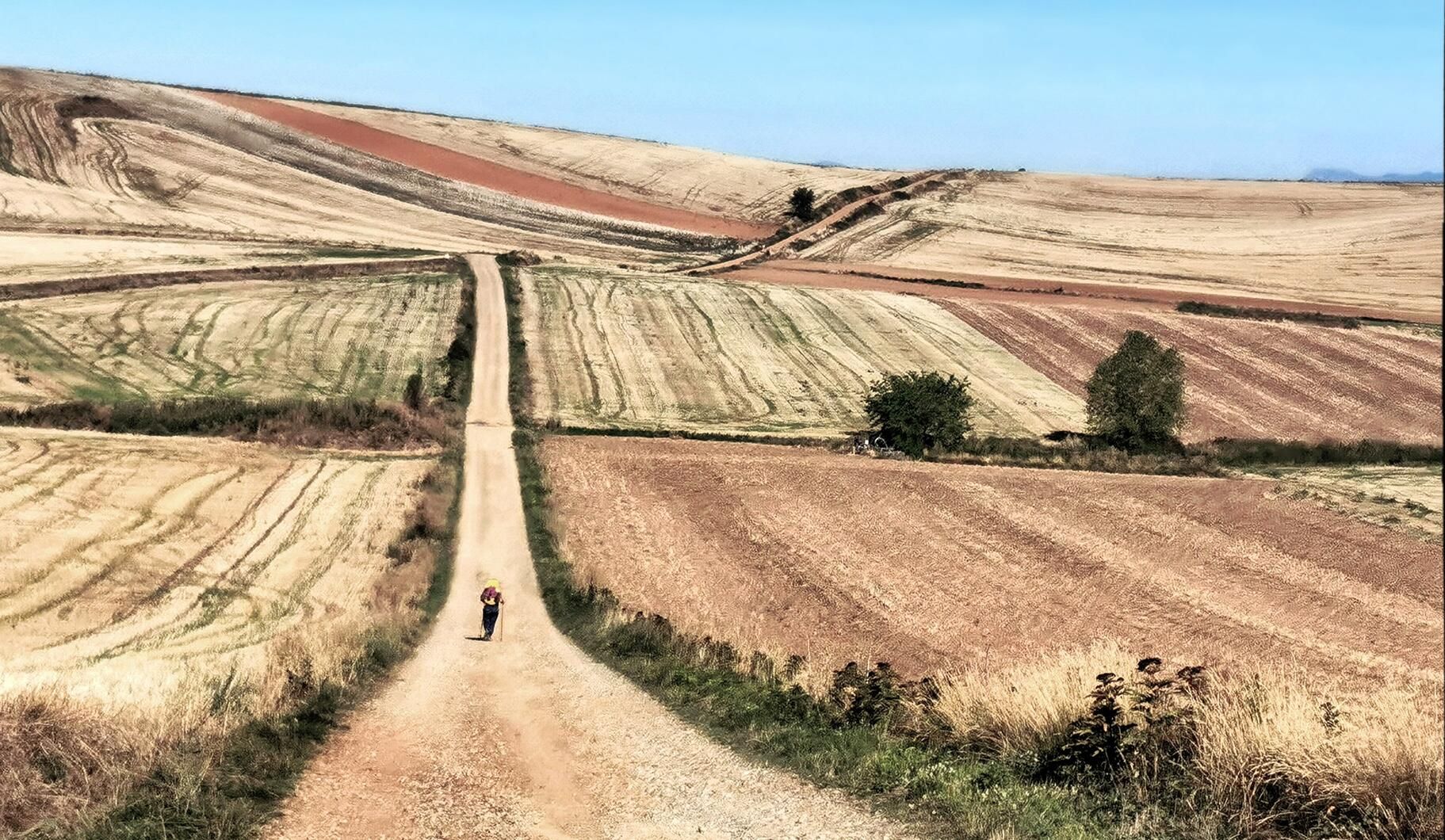
10 tips for living 2026 as an inner pilgrimage
Cultivate relationships with others
Pope Francis – “Walking does us good: it puts us in touch with what is happening around us; (…) in short, it brings us closer to the lives of others. »
The Pilgrim: How, this year, can we leave more room for others, how can we have simpler and more authentic relationships with them, like on the journey?
Father Patrice Sonnier: From the Road to Compostela to our city streets, we can remain pilgrims listening to others. On the way, I don’t “consume” people: I meet them. In the city, I can become a pilgrim again: slow down, raise my head, bless, listen.
The relationship often begins with a tiny gesture: a hello, a smile, a thank you. What I give is not primarily time: it is presence.
Practice solidarity, fraternity, hospitality
Pope Francis – “By walking together, (…) you have experienced how much effort it costs to welcome the brother or sister who is at my side, but also how much joy their presence can give me if I receive them in my life, without prejudice or closure. »
Every day, we come across people who may need our help, our listening, our welcome. Isn’t this attention also a priority?
Practicing hospitality towards “the unknown” (on the road as in the city) is not easy, it is a very concrete art of civic life: combining prudence and openness, realism and a ready heart. Hospitality is not primarily an emotion, it is a way of relating to the world.
On the way to Compostela, we quickly learn that the real border is not between “pilgrim” and “non-pilgrim”, but between the one whom I see as a risk and the one whom I recognize as a brother / sister in humanity.
Concretely, while remaining vigilant and cautious in my relationship with a stranger, I can do a simple exercise: when someone comes into view, internally replace “a stranger” with “someone who has a story” and pray like this: “Lord, teach me to see him as You see him. »
Question your thirst
Pope Francis – “Walking means not remaining still, (…) considering a height to reach today, knowing that tomorrow the path will take us higher – or further. »
The pilgrim who returns home sometimes has difficulty readjusting to his daily life. How can we chase away the banality of this daily life?
On the way, everything is bare and simple; in the city, everything is dense and complex. Everything goes quickly and attention is interrupted: we are no longer able to read the events as a story, as a path. Keeping the spirit of the pilgrimage means ritualizing everyday life and relearning wonder in reality.
Concretely – without forgetting that the city is tiring because it disperses us – choose a daily route (metro, walk, car) and give it a unique meaning. Choose a starting intention: “Today, I walk towards peace / patience / compassion. At a fixed landmark on my journey (a bridge, a station, a red light), I pray to myself: “Lord, make me a peacemaker”. »
Stay in joy
Pope Francis – “Walking consists of making an effort. (…) But anyone who travels on foot (…) receives much more than the effort made. »
In life as on the journey, we experience trials. How to stay happy?
The spirit of the pilgrimage is nourished by an interior law, that of love: to endure over time, without closing down. The secret is to learn to move forward “by receiving” as much as by giving, remembering Christ’s golden rule concerning the free gift of self: “Freely you have received, freely give” (Mt 10:8), accompanied by the promise: “It is more blessed to give than to receive” (Acts 20:35). These are concrete benchmarks to keep the effort inhabited by openness, peace and joy.
In the city, wear and tear often comes from the “analysis/defense/control” reflex. Openness to others does not mean accepting everything about them, it means refusing to let harshness become an internal climate of distrust and fear.
Take risks
Pope Francis – “To set out a thousand years ago was to take the risk of never returning home because of the many dangers one could encounter along the way. »
In our professions, our occupations, our projects, are risks necessary to progress?
Risk is not an accident: it is often the price of a frank and determined step towards a sought-after good. But there are two kinds of risk-taking: that which opens and broadens by setting in motion towards more truth and charity; and that which damages, isolates, confuses and cuts us off from ourselves, from others and from God. In this case, renouncing novelty can be rich and fruitful.
The question is therefore: “How can I welcome the unexpected without dissolving into it? » This is a concrete way of combining audacity and solidity: in order not to lose your footing, you need a point that does not move when everything is moving. This fixed point on the horizon of a process is given by a compass which can be a simple intention such as: “I am walking towards peace, beauty, goodness, truth; so I am confident and I can risk myself down this path. » A simple prayer is a sure compass that nourishes faith in Providence.
Finally, it’s good to have someone you trust who you can say, “This is where I’m at. Am I on the right path? »
Identify your goal
Pope Francis – “The pilgrim knows his point of arrival. (…) To journey means to have a goal, not to be at the mercy of chance. »
Like the pilgrim heading towards a sanctuary, all life has meaning. How to find out?
Chance takes over when we live mainly in reaction (to emergencies, to expectations, to fears, to the desires of the moment). To regain control and not let ourselves be tossed around like a wisp of straw in the tumultuous waters of the world, we also need a short, memorable compass, which can be summed up in one sentence: “I want to become someone who…” (identity) “… by putting my gifts at the service of… (mission) “… in a concrete way, where I am” (incarnation). For example: “I want to become a unified person, who puts his gifts of listening and speaking at the service of the most isolated, in my neighborhood, with my work colleagues. »
Just like the pilgrim who places in his bag what he needs to lead his walk, the city dweller can count on his talents to lead his life and give it fruitful meaning. Hidden talents are rarely spotted by looking in the mirror. They appear in the traces we leave in others. To identify them, you need to ask yourself: what gives momentum (after what do I feel more alive?); what makes me feel good because it feels good (what acts make me joyful because they are useful?); what others recognize in me (when am I told: “with you, it’s clearer/simpler/more peaceful”?).
Accept to change
Pope Francis – “What announces itself as the accomplishment of a transformation (is) the accompaniment of each thing towards its fullness of being, of truth, of beauty. »
Routine is often more comfortable than change. But don’t we sometimes have to break away from our habits?
Along the way, we naturally come to ask ourselves: “Why am I walking? » Walking becomes a routine. The word “routine” also designates a habit, a way of doing things “according to the route”, often with the idea of mechanical repetition.
But while walking, moving indoors can free you from routine. Here are some very simple levers, human and spiritual, with three concrete gestures:
1) Interior noise maintains repetition; silence makes something new appear. Decide to spend 20 to 30 minutes a day without speaking or headphones. Then, we hear what we no longer heard: true thoughts, the discreet call of God.
2) Discovery is not just “seeing”, it is being amazed. Change your route on foot, entering a church, a park, a bookstore for a few minutes. So, the exploration of the world also becomes an exploration of God and oneself, without anxiety.
3) Without rereading, the experience passes; with a rereading, it becomes a source. In the evening, note three things: a beauty, a difficulty, a gratitude. Then we realize that life is already full of “signs”. And the joy is consolidated!
Learn slowness
Pope Francis – “There is an ancient rule of pilgrims which says that the true pilgrim must keep pace with the slowest person. »
In this world where everything goes too fast, and where performance is an absolute criterion, how can we slow down the pace?
Globalization, the globalization of the Internet, social networks and, more recently, artificial intelligence, plunges us into a “liquid society”. Everything moves, nothing lasts, the stable benchmarks necessary for human life (time, relationships, truth, commitment) become flexible – until they disappear. We can see a new form of freedom, but also a drift: fatigue, dispersion, fear of commitment, fragile identity and existential anxiety.
This danger does not lie in the movement of the “liquid society”, but in the absence of a home base. The challenge we all face is to become both flexible and rooted like a tree: deep roots, mobile branches. To achieve this, here are some good habits for sailors on the high seas: read a passage from the Gospel every day, at home, in your prayer corner; read a spiritual author for an hour every day; follow religious services on Sunday in a sanctuary, an abbey, a parish church. Liquidity is fought through consistency. Fertility is born from fidelity.
Maintain hope
Pope Francis – “We go to the sanctuary to look to the future with more confidence. The pilgrim needs hope. »
In recent years, the news has not encouraged optimism. How, despite everything, can we maintain hope?
To walk on a pilgrimage or to enter places where Christian art “bears witness” is not first of all to receive an idea: it is to experience, through the body and through the senses, that reality can carry meaning, and that human life is not condemned to the absurd, to fear or to cynicism.
This observation can give hope to everyone (believers or not), because it concerns universal needs. Christianity affirms that grace does not float outside the world: it passes through the flesh, matter, signs. When art is inhabited by faith (architecture, icons, stained glass windows, music), it does not “decorate”: it opens. It shows a world where light is allowed to enter. He gives form to the invisible: compassion, forgiveness, glory, tenderness, hope. Many draw consolation from this: “What I carry inside has a place. I’m not alone. »
Raise your eyes to the sky
Pope Francis – “The life of the Christian path: realizing that it is (…) Jesus who walks with us at all times. He is our pilgrim companion. »
In life as on the path, how can you mute your ego to let yourself be guided by the one who said “I am the path, the truth and the life”?
We look up… and yet, down here, we need concrete points of support. The soul rarely rises by pure will: it needs to be raised by the one who created heaven and earth. To join Christ in these spaces (path, nature, churches, art), the challenge is less to “feel something” than to make oneself available to a Presence.
To do this, we can adopt a very simple approach: enter, remain, receive, respond. Entering these places inhabited by an act of faith (for example, “Jesus, here I am”, “I believe that you are there, even if I feel nothing”) opens an interior space: it is no longer just “a beautiful place”, it is an appointment where we learn, with Jesus, to look at the earth from Heaven which comes through the presence of Christ welcomed in us.
Father Patrice Sonnier is chaplain of Saint-Joseph hospital in Paris. Teacher at Bernardins, he is the author of Hans Urs von Balthasar, contemplative prayer (Word and Silence, 2021). He works with the French Society of Friends of Saint-Jacques to lead, four times a year, a time of spiritual meditation with pilgrims. He also accompanies pilgrimages to the Holy Land.


