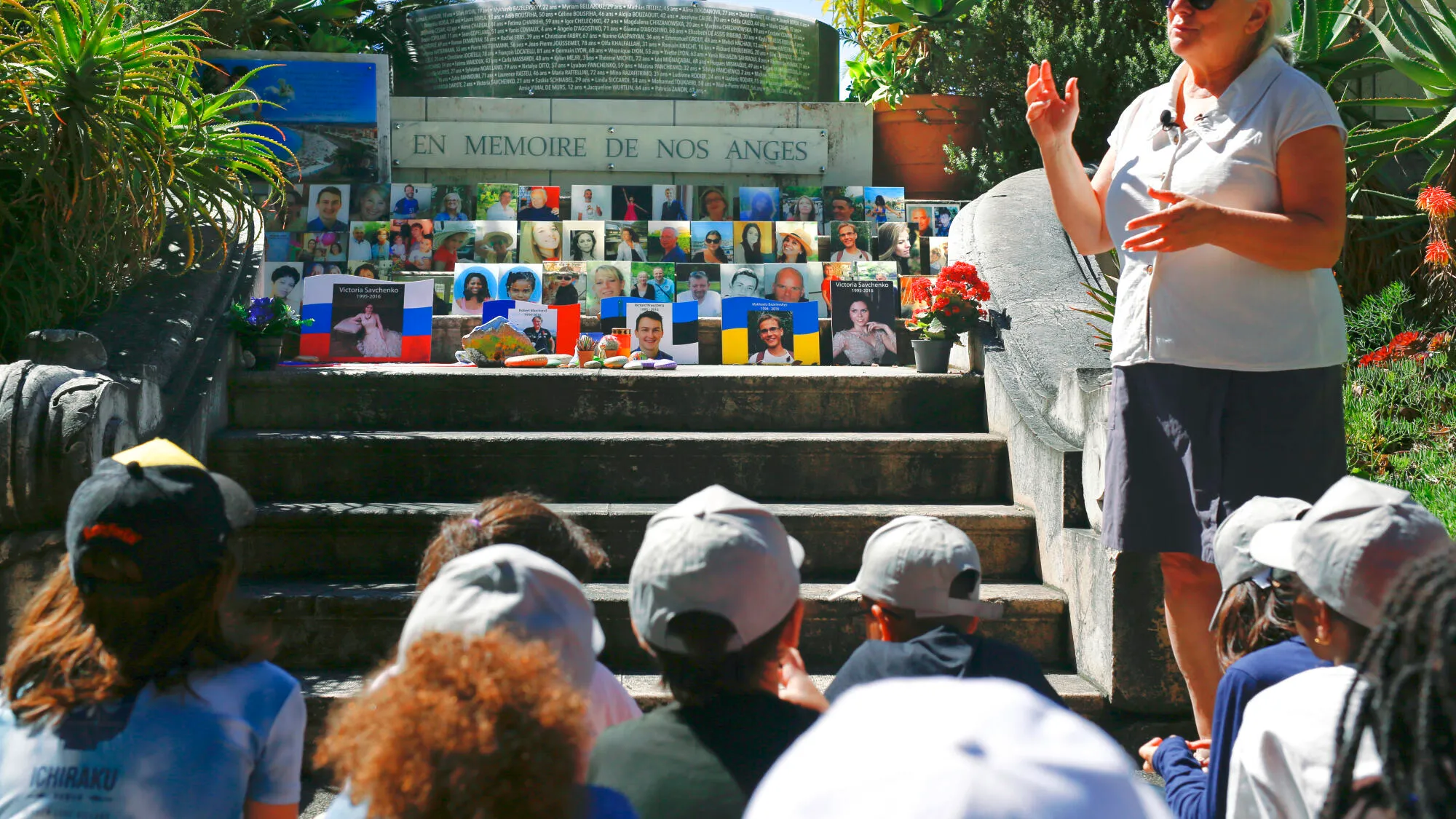
10 years of the Nice attack: the surviving children testify
For many, the Promenade des Anglais has become an impossible place. Where children today run after pigeons or splash around on the shores of the Mediterranean, they only see July 14, 2016. That evening, nearly 30,000 people watched the fireworks from the emblematic seafront of Nice, opposite the Bay of Angels. In the crowd, Sofia*, 7 years old, and her little brother, Milan*, 2 years old, accompanied by their parents. A little further away, on the beach, Stéphanie Marton and five of her children enjoy the show over pizzas.
Further afield still, there is Kimberley. For the first time, the 16-year-old obtained the right to go out alone in the evening without her parents. Just after Euro 2016, she took advantage of this moment with her best friend, the France team jersey on her shoulders. At the end of the fireworks, the two young girls buy string candies and immortalize this first moment of freedom with selfies.
Then screams break out. “Kim” lowers her phone. Some people turn around, others start to run. In a few seconds, the walk descends into panic. In the distance, Kimberley sees “bodies flying”. A 19-ton truck arrives, zigzagging through the crowd for almost two kilometers.
Milan, who can barely walk, is immediately grabbed by his mother. Her sister Sofia runs with all her might to escape the vehicle. The anonymous heroes reveal themselves: passers-by in their escape instinctively grab a baby in his stroller just before the heavy goods vehicle hits him. Coming up from the beach, Stéphanie’s children are still singing at the top of their lungs Life is beautiful by Keen’V, when their mother ordered them to get on the ground.
Guardian angel
The truck continues its deadly route. He rushes towards the candy stand where Kimberley is. The teenager sees the driver’s face: he is smiling. “It’s not an accident,” she told herself. At the wheel, Mohamed Lahouaiej-Bouhlel, a 31-year-old Tunisian delivery driver who has lived in France for nine years, has been radicalized in recent months, to the point of switching to jihadism.
Kimberley no longer moves, paralyzed, with tears in her eyes. Her best friend managed to get out of reach. A passerby then suddenly throws her to the side. The truck passes. While saving his life, the man was struck down by the vehicle. In shock, Kimberley hides under the bodies falling around her, hoping to pass herself off as dead. Then she starts screaming: “Dad, mom, help me! » But she is alone.
After a moment that seemed like an eternity, an adult saw her: “My dear, go home. »Haggard, the teenager then returns home with a head trauma, a crushed lung, and her pelvis displaced ten centimeters.
She will never be able to thank her guardian angel, who is one of the 86 dead, including fifteen minors. The youngest victim was 2 and a half years old. Rarely, in the recent history of terrorism in France, have such young people found themselves directly exposed to such violence. How were they able to recover from such a tragedy at an age where one must first build one’s personality and one’s vision of the world?
Buried aftereffects
Sofia has just finished her year at CP. She asks her mother to take her to the CUMP, the medical-psychological emergency unit. The mother is surprised. She thinks that her daughter must have heard about the device on the 24-hour news channels. At the time, the little one was already very alert and would even go straight to CE2 the following year. Anissa therefore accompanies him there. But at the entrance to the building, the little girl whispers to her: “I lied to you, mom, you’re the one who needs to go talk to someone…”
“However, it was up to me to protect them,” Anissa says today, crying, still consumed by guilt. Beside him, Milan, who seemed absorbed in his game on the phone like a 12-year-old boy, discreetly extends his hand to shake his mother. An almost invisible gesture, but which says it all: since the attack, the boy has been watching over her and regularly seeks to reassure her. Although he has no memory of the event, he admits trying to “replay the scene to understand”.
Despite everything, the after-effects remain buried: one Saturday a month, in addition to going to karate, the schoolboy goes to the psychologist. He also sees a theater educator every two weeks with whom he does improvisation. Speaking with his body allows him to express what he feels.
“I was called a liar”
From the start of the 2016 school year, wounds began to open on school benches. Mathias, one of Stéphanie’s sons, a good student in CP, no longer keeps up with CE1. The mother decides to leave the Côte d’Azur to find a calm and comforting place, in Normandy. But the situation does not improve: repeated fatigue, lack of concentration, absences… Mathias repeats twice and is then excluded from five colleges. He finally leaves high school in 2024, without finishing his second year. His sister Inès, 9 years old at the time of the attack, suffered harassment. “I was called a liar,” she remembers painfully.
As they grow up, many young victims develop permanent distrust. They fear the crowds and no longer want to leave their homes. At an age when one normally learns to meet new people and become independent, fear continues to dictate some of their choices.
At 26, Kimberley, who lives with her mother, takes refuge in her room and immerses herself in online video games. She made new virtual friends there but doesn’t feel the need to meet them. She has had no taste for life since that day. His parents had him hospitalized numerous times after several suicide attempts. Even today, she sometimes says the unspeakable: “I’m waiting to find myself between four boards. »
A discomfort still misunderstood by others. “It’s been ten years, move on,” Kimberley often hears from adults who weren’t there that evening. Impossible for her, as her psychological after-effects are so profound. As soon as she goes out into the street, the sight of a truck startles her. She relives the scene. “Passers-by think I’m crazy! » laments the young woman between two drags of a cigarette. With it, an entire generation of Nice residents remains traumatized, despite the opening, in 2017, of a pediatric psychotrauma evaluation center. A first in France.
The festival associated with horror
We must therefore help them to relearn how to live. On the advice of a psychologist, a “little black ball of fur” burst into the lives of Stéphanie’s children a few months after the dark evening. “We had to get them out of the apartment, they stayed locked there for fear of meeting terrorists in the street,” remembers the mother.
The family therefore adopted Naia, a Labrador cross golden retriever. The siblings had to organize themselves to take turns taking her out. “She is cuddly and soothing, she has done us so much good,” says Inès, who sleeps with the dog – almost as big as her bed – at the end of her mattress. For almost ten years, Naia has comforted her young mistress every time she has nightmares.
For many, fireworks have ceased to be a celebration. Many young victims attended their first fireworks show on July 14, 2016. Since then, they have associated them with horror. In July 2025, around fifty of them, accompanied by the Une voix pour les enfants association, were able to observe a fireworks display from the boxes of the Cagnes-sur-Mer racecourse, a town neighboring Nice. They saw the rockets go off but did not hear any detonation.
This device was designed with psychologists to allow them to overcome the trauma. An immediately beneficial experience for Kenza, 14, who appeared with a pacifier in her mouth during the appeal trial of Mohamed Lahouaiej-Bouhlel’s accomplices, in the spring of 2024. “Since then, she no longer pees on herself when she is afraid,” says Hager Ben Aouissi, her mother who is also president of this association.
Refusing victim status
In this collective drama, everyone recovers at their own pace. And like Kenza, many need to reunite with those who have gone through the same ordeal. On June 17, 2026, around fifteen young survivors and their families met in the premises of the Une voix pour les enfants association, in the heart of Nice, behind the station, 2 km from the Promenade.
The objective was to prepare minds for the approach of the national tribute ceremony on July 14, 2026, in the presence of Emmanuel Macron. The main worry was being thrown into the middle of a crowd of several hundred people, at the very scene of the attack. After long minutes of discussion in a heavy atmosphere, the anxiety dissipated as the speakers spoke.
Others do not want to dwell on this past and refuse to maintain this status of “victim” for life. Even if the flashes of that evening still resurface in Sofia, she prefers to concentrate on her baccalaureate results. At the time of writing, she hopes to obtain a “very good” rating. She could have chosen the subject of philosophy: “Can we be happy when others are not?” » But she did not want to give in and preferred to continue moving forward thanks to a united family and loving parents. Every summer, his dad organizes a trip for them to the surprise destination. Answer this year in August.
In these shared moments, carelessness returns little by little. Ten years later, they are no longer just the children of the Promenade des Anglais. Their names are Anissa, Marlon, Kimberley, Inès, Mathias… Young people from Nice who keep their wounds but who move forward with their strength, their dreams, and on their own paths.
* The first name has been changed.