50 years of national lace workshops in Alençon
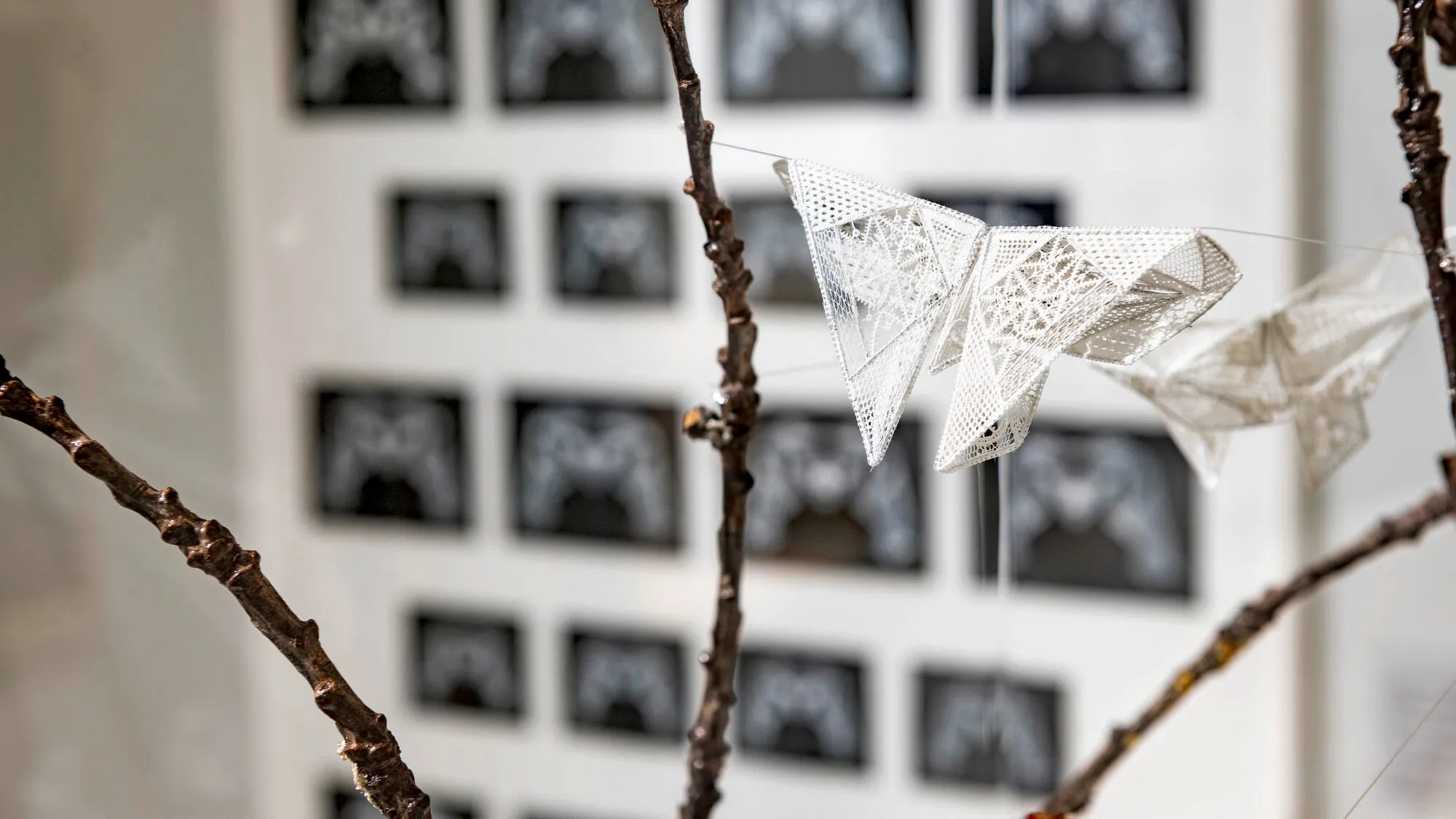
She almost was absent, but here she sits in the exhibition room of the Museum of Fine Arts and Lace in Alençon (Orne). Baptized Network (see photo above)this work, made of twenty lace butterflies in relief, suspended from cherry tree branches, is the latest creation from the Alençon lace conservatory workshop.
This descendant of the royal factory created under Louis XIV employs nine lacemakers compared to 10,000 in the 17th century. Nine women who perpetuate the know-how of Alençon point, a demanding and refined technique for working with thread, linen or cotton, by needle and by hand. Attached to the Mobilier national, the factory is celebrating its fifty years of creation, just like the bobbin lace conservatory workshop in Puy-en-Velay (Haute-Loire) created at the same time.
Made up of around thirty works, the “Dentelles d’Alençon et du Puy” exhibition offers a dialogue between these two structures which have sometimes worked, in lace or embroidery, on the same models. “This allows you to clearly see the play of textures,” notes Valérie Durand, head of the Alençon workshop. If its lace is recognized for its precision, finesse and curves, that of Puy-en-Velay offers more air and relief. This is evidenced by the two versions of Sigmund carpet, based on the creation of visual artist Anne Deguelle.
Conserve, innovate, create
Network required patience, dexterity and 7,300 hours of work. “Three-dimensional lace is a real challenge,” assures Johanna Mauboussin, the museum’s director. The work was finished just in time, with hope and fear. »
Its presence is a relief since it translates the challenges of the workshop: to preserve and transmit. But also to innovate and create, because Network takes on the contemporary origami work of Korean-Japanese artist Tsuyu Bridwell. “These creations dusted off the image of lace,” defends Johanna Mauboussin. This falls outside the scope of table services. »
As an opening, the last work of the course, worked jointly by the two workshops, is called Rain of roses from Alençon (photo above). This fresco currently in production represents, among other things, the city’s coat of arms and the dove of the Notre-Dame basilica. Falling roses also evoke the graces promised by the intercession of Saint Thérèse of the Child Jesus. “Presenting an unfinished creation shows that this know-how does not stop,” says the museum director. And this has been happening for four hundred years. » The lacemakers take care of this.