“Ping Parkinson”, taking the disease from behind
Usually, Jean-Marc, a 74-year-old from Grenoble, can hardly stand for more than ten minutes on the shelves of a store. However, in front of the ping-pong table, the miracle happens. His gaze is alert, his arm nimble as he sends the ball hitting the surface with a satisfying noise: “Ploc, plop”. In front of him, Pierre, his opponent, holds the racket with a trembling hand. But his spasms end as soon as the match begins.
Jean-Marc and Pierre are taking a ping Parkinson’s course, a funny name for a discipline which concerns people suffering from this chronic illness. The Tronche-Meylan-Grenoble table tennis club (Isère) created its section in 2022 and offers adapted courses.
Neurodegenerative, the pathology affects the central nervous system: the body stiffens, begins to tremble, and problems with speech, memory or swallowing appear. In France, 272,500 people are affected, according to the Ministry of Health.
Although the disease is incurable, therapies exist, and some are surprising to say the least. Since 2021, the France Parkinson association has been a partner of the French Table Tennis Federation to develop the Parkinson ping. A Japanese scientific study carried out in 2020 has indeed given rise to tremendous hope.
According to researchers at Fukuoka University, racket sport reduces the symptoms of the pathology. After following sick players for six months, they found that ping-pong stimulated cognitive functions, because you have to anticipate the trajectory of the ball and respond quickly to shots. It also develops hand dexterity through large, repetitive movements and requires you to move around the table.
“Before lessons, my wrist had a tendency to curl up,” says Jean-Marc. Now my brain controls my hand better. She has the possibility of opening up to get the ball with the racket.
The sections are developing
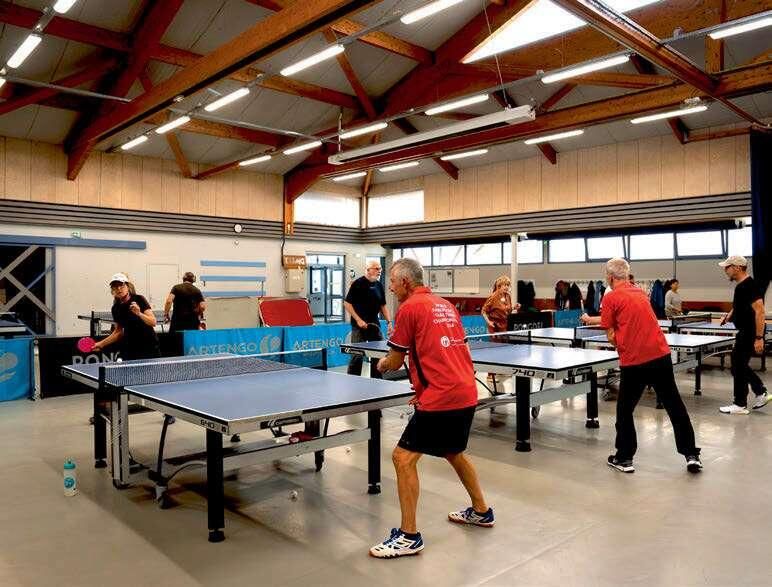
The septuagenarian has the chance to play in one of the most dynamic clubs in France. In our country, where the good news from Japan spread quickly, there are today around sixty sections of Ping Parkinson and 1,000 licensees. Among its members, the La Tronche club has 30 to 40 members suffering from the pathology. They meet at the Maison des sports for one to three sessions per week.
In the vast gymnasium, the small celluloid balls are flying in all directions because the sports instructor, Julien Campayo, has just launched a “pyramid”. The exercise consists of linking a forehand and a backhand, two forehands, then two backhands, three forehands…
“The players must bend and unfold their elbow quickly, pivot on their legs,” describes Julien. This pushes them to concentrate, develop their reflexes and, above all, to demonstrate perseverance.
The coach adapts to the rhythm of his students, but there is no question of falling into excessive kindness. The game should allow participants to forget the illness and become competitors like others. Because pathology promotes isolation and a feeling of stigmatization.
More constrained in their movements, patients can sometimes be ashamed of the way others see them and develop depressive symptoms – Parkinson’s causes a dopamine deficiency. Physical activity stimulates this happiness hormone and facilitates social connection.
“It allows me to move, to meet people, because at home I am too often in front of my computer,” rejoices Nhung, 60 years old. My doctor advised me to go to the La Tronche club to work on my motor functions.”
Global competitions
A beginner, Nhung discovered ping-pong on the tables of a campsite during her summer vacation. She will probably register for competitions soon.
For three years, the Open Ping Parkinson has brought table tennis players together for a national championship. Stéphane, 64, even participated in the 2024 World Championships reserved for people with Parkinson’s and Alzheimer’s. “And I played like shit!” he asserts, cheekily, before participating in an “up-down”, where each winner gains access to the higher ground.
The table tennis player is too modest: he ends the session on court no. 2, just behind Olivier Rajon. This La Tronche star is third in the national Parkinson’s ping ranking. Enough to awaken the winning instinct of other players.
Recipes for success
- Adapted training. The France Parkinson association offers to train sports educators to better understand the disease and support table tennis players, assisted by a physiotherapist.
- Mixed audiences. Patients may have a tendency to isolate themselves, embarrassed by the gaze of others. In order to remove this obstacle, the La Tronche ping-pong club offers to bring together sick and able-bodied people during a weekly session open to all audiences.
- Low prices. To encourage membership, the prices of the Grenoble club remain moderate. The cost is 100 euros per year for a weekly session and 140 euros for two sessions per week.