
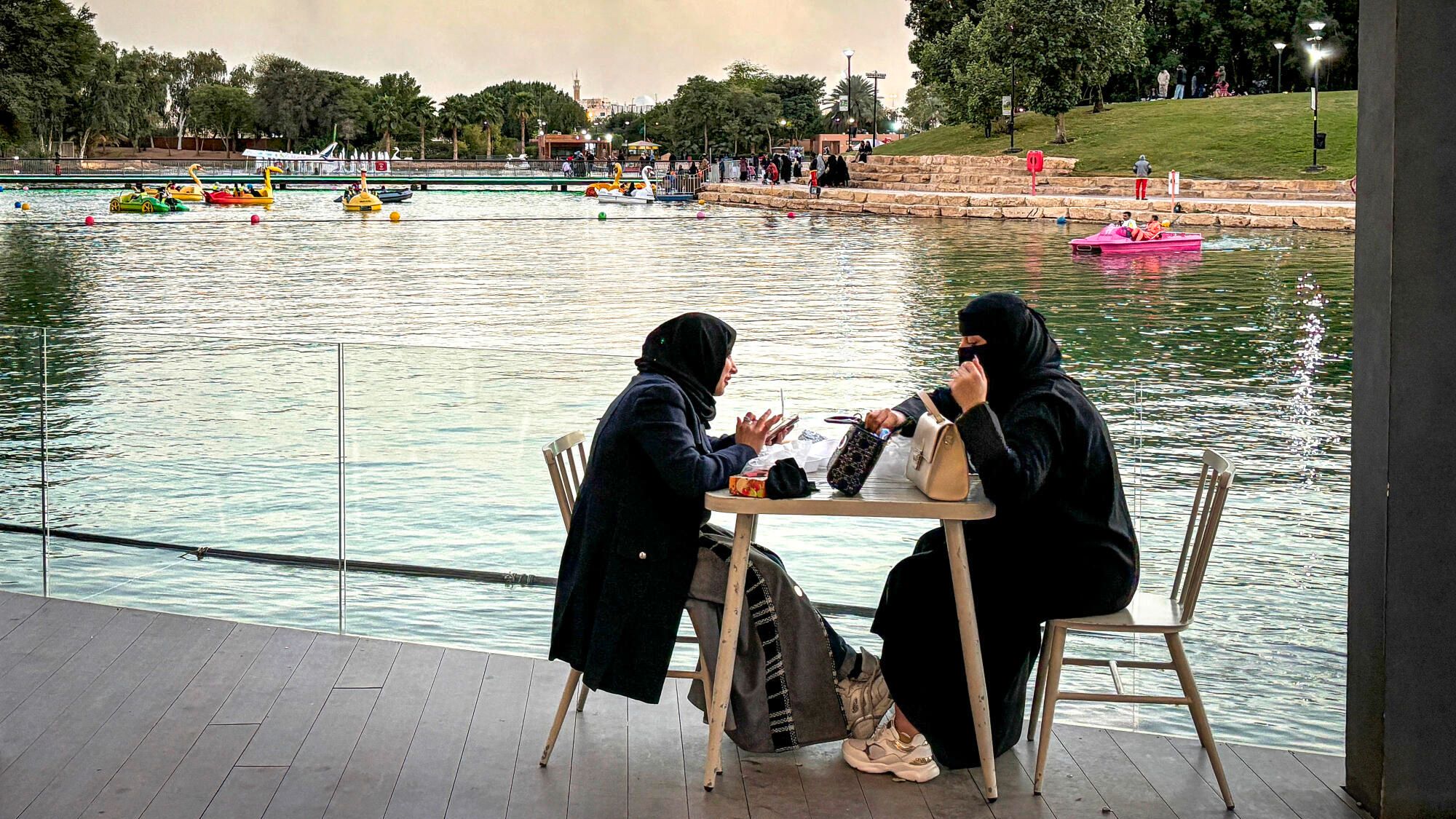
In Riyadh, Saudi women emancipate themselves in secret
Five o’clock in the morning, Riyadh emerges from the night. The singing of the muezzins wakes up the Saudi capital in a mixture of hoarse and melodious voices. A sprawling city in the heart of the desert, it swallows up its eight million inhabitants in the anonymity of its major arteries. Under its sand-colored concrete eyelids rises the population.
A ballet of cars parades at the checkpoint at the entrance to the embassy district, frequented by many expatriates. This December morning, police officers in khaki uniforms peek inside the vehicles. The word “running” escapes from the cabin, whispered by female voices like a code name. The agents respond with a nod, and let them rush into these streets where the way of life is closest to a Western model. A liquor store has even just opened its doors there, reserved for the wealthiest expatriates – and above all, officially forbidden to Muslims.
A few streets further, the noise of the engines stops . Hayat, in his thirties, slams the rear door of his taxi, under the stunned gaze of the driver. It’s still dark, but he can follow her with his eyes. She finds a group of young women gathered in the street. Most are bareheaded, revealing their cascading hair. Worse, some wear leggings highlighting their plump curves. What an improbable scene in the kingdom! the taxi seems to think. Only a few years ago, they risked lashes from the religious police for going out in this outfit.
For a decade, Saudi society has been transforming. Driving license, freedom to travel, diversity… On paper, women are gaining ground. In the reality of conservative homes, however, they can only benefit from it in secret.
Tock, tock, tock… The soles strike the earth at a regular rhythm. In an alley lined with palm trees, Hayat runs with short strides under her abaya – her long black dress. The sound of her breathing is almost muffled by the niqab covering her face. Even when training, this very religious woman keeps her everyday clothes. She wants to respect the strictest religious obligations in order to feel “closer to God”.
And yet, she is breaking her conservative family morality: she is practicing physical activity – and what’s more, in a public space. For some, showing oneself like this is indecent. For three years, this physics researcher has kept her new activity to herself. Semi-freedom made possible since she lives in Riyadh, 800 km from her family. Under no circumstances should his father find out about it.
Hayat avoids provoking the patriarch’s reaction, even if it means hiding major exploits in his life, such as half-marathons. “He doesn’t need to know everything!” » she blurted out to her friends, her voice a bit mischievous. Running gives him as much carefree as adrenaline. Even at school, she would run out of class to stretch her legs during break time. Five minutes flat before returning to sit down. No sports lessons were given to young girls. Decades later, Hayat is finally taking advantage of it, like a teenager sneaking in her moves. And she’s not the only one.
With the new metro, women move more freely, without depending on a male chaperone.
At the start of the morning, Riyadh gets busy. More than seven kilometers away to the north, near a women’s university, the metro station pours out cohorts of black silhouettes every minute. This new means of transport has transformed public space: residents without a driving license move more freely thanks to trains reserved for women. Until recently, they still depended on a father or brother to go to study. There’s no way they’re alone in a stranger’s car! Unprecedented mobility is now available to them.
Even daring to turn around in front of the university entrance. Amjad, 25, a bubbly young woman, watches with concern as her friends enrolled in business studies skip class. She keeps telling them: “You’re going to repeat the grade! », “You are going to have a bad start to your career!” » Amjad comes from a very wealthy family – father, brothers and sisters travel by private jet – and she has spent half her life in the United States. Unlike her friends, who have only known this strict society and for whom attendance is the least of their worries. They already know the destiny that awaits them: staying at home to take care of their children and their home. Far from this active life we dreamed of so much. Their traditionalist families would never agree to let them work in a company where, from now on, men and women mix. These years of study thus represent an almost miraculous parenthesis of freedom.
So, once they arrive at university, they cut off their internet connection. An essential reflex, because they are geolocated by their family. They leave Amjad on the benches of the amphitheater and take the metro again. According to their phone data, they will spend the day in this sanctuary of knowledge. They will actually take the opportunity to have a good time in a trendy café in the capital.
Arriving at the university, they cut their internet connection, because they are geolocated by their family.
In this intrepid group, some dare to take off their raven-colored niqab inside the establishment. However, men are seated at neighboring tables. Precisely, they look for handsome boys, smile at them when they are seduced. All you have to do is wait for them to come and ask for their phone number. The game of seduction continues on Snapchat, a virtual refuge for Saudi youth, where the photos immediately disappear. And they are not afraid. Some will even defy a major social ban: sending naked photos of themselves, in suggestive postures. If they get on well with their interlocutor, they may have the audacity to set up a meeting. The intentions are clear: to abandon each other… There is even a well-known hangout for Saudi youth on the outskirts of Riyadh. A sort of wasteland, occupied by cars parked incognito, where everything that happens inside the cabin must stay in the cabin.
“It’s suicide,” breathes Amjad, worried when she discusses it with her friends, during a rare evening between girls. Because, at the end of the day, each of them is supposed to marry a cousin. Who could discover the deception if the young bride is no longer a virgin… And even worse: if one of them became pregnant? “It’s a dead girl,” assures Amjad, his voice trembling. Her friends shrug their shoulders and answer the same thing each time: “We prefer to die having been able to enjoy life a little.” » But it’s always with a lump in their stomach that they come home in the evening…
Meanwhile, Riyadh is boiling. Away from the intense activity of the capital, fascinated by its ephemeral and brand new freedom, these young people do not see the day slip by. It’s after 9 p.m. In an apartment in a residential area, a mixed group of friends in their twenties meet. Sitting cross-legged on an embroidered red carpet, Fadi* sets the mood by playing the oud – a type of Arabic guitar. Inhabited by the rhythm, Sumaya* and Reem* go there with their most sensual sways under the amused gaze of the rest of the group. By their mere presence, they bring life to this living room devoid of any decoration. The dining table is swamped with dishes, while abandoned paperwork is scattered across the furniture.
“Guys, shh!” » Sumaya suddenly shouts when she hears her phone ring. His mother appears on the screen. She is in pajamas, her hair slightly disheveled. Everything that is most normal for a weeknight. For her part, Sumaya displays her most candid expression, and presents herself drinking tea at a friend’s house. No hint of male presence in the camera’s field of view, even if they are just friends. The mother hangs up, all smiles. The music can resume and the tension drops… With the same stratagem, Sumaya and Reem were able to go on vacation to Portugal! Meanwhile, their respective families believed they were at work. Even if they no longer need their fathers’ signature to travel, they forbid them from leaving the country alone.
If Sumaya enjoys life to the fullest, she constantly fears that this double life will be unmasked. It happened to her friend Lamia* a few months ago. From one day to the next, this dental student no longer gave any sign of life. His father had been warned by the mother of another friend who had discovered photos of drunken parties. This mother also called Sumaya, threatening her to do the same thing. Since then, she has been consumed by anxiety and can no longer sleep.
Lamia’s boyfriend, Fadi, the oud player and computer scientist, didn’t hear from her for four months. Under her charming black curls, her eyes bathed in tenderness reveal a deep love. Worried to death, he went to Lamia’s father and asked for her hand. The patriarch initially refused before giving in to the young lover’s perseverance. Or did he choose this solution to accommodate his daughter who he considered disgraced?
When the two lovers were finally able to meet again, Lamia wore a white dress, he a suit. The newlyweds spent their honeymoon in Bahrain, popular with Saudis for its beaches and nightlife, dancing until morning. As if by provocation and to celebrate their release after this sequestration. In the group of friends, it is rumored that Lamia was tortured, in this case forced to drink acetone, a toxic solvent. At home, neither her mother nor her siblings tried to save her. “For them, I am the bad daughter of the family,” she confides in an emotionless voice. If she can now live her life as she wants, Lamia knows well that this is far from being the case for everyone. Even though they are little documented, honor killings still exist in Saudi Arabia.
The night is in full swing. About thirty kilometers from Riyadh, the Soundstorm music festival makes bodies vibrate to the rhythm of DJs. For a youth eager for freedom, each burst of light is a transgression. It is not good for one’s reputation to be seen at this event, considered by many to be a place of debauchery. “I’m at the restaurant with friends this evening, I’m going to come home late…” Anouar* warned, greeting his family before leaving. This real estate agent is however approaching forty. Around him, couples dance body to body, homosexuals included. They let go more and more as the hours go by… and sips of alcohol. The most daring – or unconscious – managed to enter with this type of drink hidden in a water bottle. A spectacle unlike the concerts in the heart of Riyadh. There, the public must sit in their dedicated section: families and women on one side, single men on the other. At the festival, the party ends shortly before daybreak. At this time, Riyadh wakes up to the singing of muezzins, with its well-kept secrets.
* First names have been changed.
Saudi Arabia: historical landmarks
- 1932. Foundation of the Kingdom of Saudi Arabia by King Abdulaziz ben Abderrahmane Al Saud.
- 2016. Launch by Mohammed Ben Salman of the Vision 2030 plan, a series of reforms to prepare the economy for the post-oil era.
- 2018-2019. Women successively obtained the right to drive, then to travel alone.