These women who explore theology
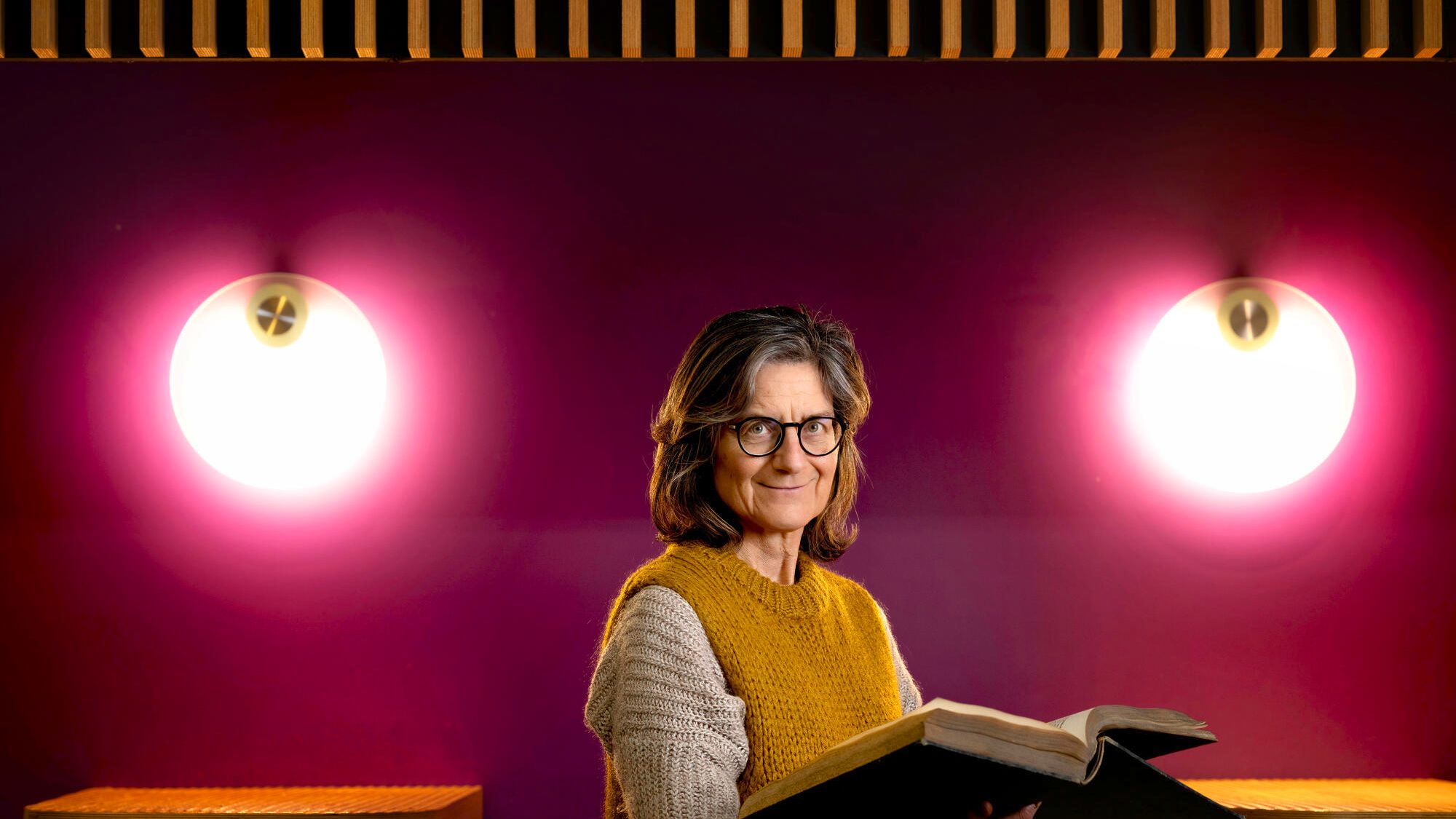
Former senior executive at SNCF, Dominique Serra-Coatanea did not imagine becoming a doctor of theology. However, at 62 years old, here she is a professor at the Loyola Faculties, the Jesuit university in Paris. Woman, laywoman, mother: not exactly the image associated with this discipline which studies God and the understanding of faith, long reserved for priests or religious.
Lay people, for their part, and especially women, tend to follow training in parishes. But some engage in academic theology courses, validating the same diplomas as seminarians, even though they are not called to the priesthood.
“A universe then opened up to me. Theological disciplines fascinated me. »
Dominique Serra-Coatanea
Thirty years ago, Dominique completed diocesan pastoral training. Encouraged by her priest, she joined the Catholic Institute of Paris (ICP). “A universe then opened up to me. Theological disciplines fascinated me,” she says.
Enthusiastic, she left the SNCF and obtained a canonical baccalaureate in theology (validating five years of study), then a license (two additional years). This diploma allows him to teach, and confers on him, in practice, the title of “theologian”. Five years later, she defended her thesis at the Center Sèvres, today Facultés Loyola Paris.
“The Church is woman. “Church” is a feminine word. There is no theology possible without this femininity. »
Pope Francis, in June 2014, in Il messaggero.
A thesis will perhaps also be a question for Marie-Charbel. This Parisian is one of the “increasingly numerous secular women in theology, even if their number remains modest for long courses”, believes Dominique Serra-Coatanea. The 41-year-old young woman is currently completing her canonical license at the Collège des Bernardins in Paris. She got involved in 2019, “driven by a long-considered inner impulse”: these subjects fascinate her, and she was told “that we need women in theology”.
The spinster begins to study dogmatics, patristics, canon law, morality, exegesis, etc. (read box at end of article) . Fifteen hours of lessons per week, but “double, even triple, personal work. At first, I was so passionate that I spent almost all my time studying. But theology must be in touch with life, not cut us off from the world. »
In 2021, Diane, now 32, sets out to answer her questions about the Church: “A certain clericalism, particularly during homilies, worried me. I wanted to understand how priests were trained, and not leave men the monopoly on reflection,” she explains. The young woman, then an advisor in international relations and diplomacy at the National Center for Space Studies (Cnes), enrolled at the ICP, in evening classes, in order to reconcile this training and her profession.
“My fellow priests find it very enriching to have my perspective, and I theirs. »
Marie-Charbel
Studies to finance yourself
They all evoke the same difficulty: material constraints. “The lives of seminarians are organized to allow these studies, which are financed for them. I have to find the resources,” explains Marie-Charbel, who works part-time in school ministry.
Since the start, she has spent around 16,000 euros. “Rare dioceses finance such long studies,” explains Dominique Serra-Coatanea. The bishops are happy to see lay people being formed, but do not necessarily have the energy and resources to invest. »
Added to this is the scarcity of theology faculties: only nine, including three in Paris. From her village near Dreux (Eure), Nadia travels three and a half hours three to four times a week to follow her studies at Loyola Faculties: “My husband supports me materially, otherwise it would be impossible,” confides this artist photographer. Dominique Serra-Coatanea notes, however: “Having financed my studies alone allows me to feel very free towards the institution. »
The Church has not always been open to women who wished to pursue such a course. Professor of theology since 1986, Anne-Marie Pelletier, 79 years old, testifies that, “in the minds of a majority of representatives of the institution, priests, but also lay people, it is not completely natural for a woman to teach theology”.
A tradition, strengthened in the 19th century, distinguished between the teaching Church and the taught Church, namely those who know – the pope, bishops and priests – and those who learn – the simple laity. “The texts of the magisterium encourage lay people to train,” says Marie-Charbel. But being called neither by a community nor by a diocese with a view to a specific mission, my path in theology is more uncertain. »
Diane ended up giving up after three years: “When the Pope, in 2025, closed the door of the diaconate to women, it was the final blow. When I heard the news, I realized that I was hoping for this opening. I have the impression that women are invited to listen to the teachings, but not to speak afterwards. » For Anne-Marie Pelletier, the only way to recognize that we are all destined to teach each other is for women to preach during masses.
A beneficial complementarity
Women have already carved out a place for themselves in the world of theology. Particularly due to the vocations crisis: it is difficult to mobilize priests outside their parish to teach. Women have taken over and “everyone sees that this recomposition of the student and faculty body is beneficial,” underlines Dominique Serra-Coatanea.
For lay women, studying with consecrated persons “is learning to think together, to consider themselves as partners in the mission of the Church”. A “complementarity” that Marie-Charbel also enjoys: “My fellow priests find it very enriching to have my perspective, and I theirs. This matters because theology must speak to everyone. »
From there to speak of a particular contribution of women in theology? “Men and women share the same baptismal dignity, the same vocation,” recalls Anne-Marie Pelletier who warns against a discourse on the specifically feminine. “But I notice, particularly in moral theology, that women are more inclined to maintain the complexity of the discourse. »
For Nadia, “it’s the dialogue that’s interesting. Certainly, as a woman, but above all as a person.” That theology is carried by women above all allows us to show that it is not reserved for certain people. “We need well-trained lay people to live a fair synodality, that is to say the participation of all, and to answer the questions of today’s society,” explains Marie-Hélène Grintchenko, director of the Higher Institute of Religious Sciences of the Collège des Bernardins.
While receiving the International Theological Commission – a body of the curia responsible for theological questions – Pope Francis was concerned about the presence of only five women out of twenty-eight members. The group must be renewed in 2026. Will the curia take into account the acquired skills that women want to put at the service of the Church?
What subjects are studied during the three years of theology?
After two years of philosophy, canonical baccalaureate students devote three years to strictly theological disciplines.
- The study of the Holy Scriptures and their exegesis, that is, their explanation and interpretation.
- Fundamental theology, who seeks the foundations of faith in God.
- dogmatic theology, what the Church considers to be essential truths.
- Morality, who studies human actions to order them to the will of God.
- The pastoral relating to the practical way in which the Church carries out its mission.
- The liturgy, on how to worship God in the sacraments or common prayer.
- The history of the Church.
- Patristics, dedicated to the Fathers of the Church, those authors of the first centuries who contributed to formulating Christian doctrine.
- Canon law, or the law of the institutional Church.