
In Occitania, pastel blue dyeing regains color
A linen shirt, a cotton sheet, a jute bag, lace underwear… The trainees brought fabrics and clothes. Objective of the day: to transform them in the Bleus pastel d’Occitanie dyeing workshop in Roumens (Haute-Garonne), a village of 250 souls, located in the heart of Lauragais, an hour south of Toulouse.
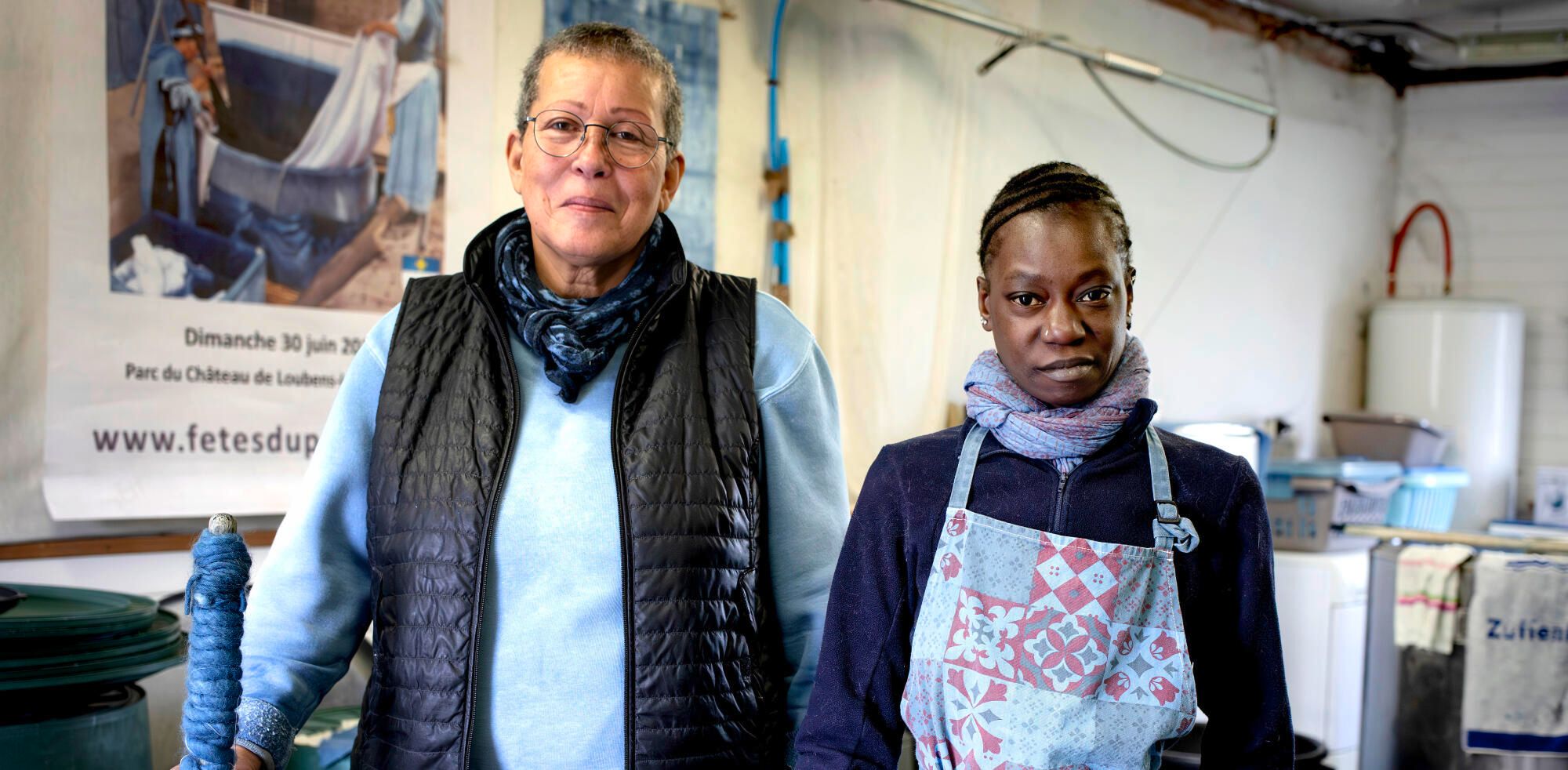
This is where master craftsman and finisher Denise Lambert and her daughter Mariam share their knowledge of “blue gold”:isatis tinctoria or dyers’ pastel, a plant whose crushed leaves are put into balls, or cocagnes, so that they can dry and be sold. Reduced into lumps and fermented, they give a blue-gray powder which will be used for dyeing: agranate. The expression “land of plenty” testifies to the prosperity that this craft brought to the region at its peak, in the 16th century.
“We receive crushed pastel from Tuscany and Ireland,” explains Mariam. In the mother tank, I put six tablespoons, with six of indigo, a cap of fructose and another of ammonia, then I pour the mixture into tanks of cold water which I leave to rest for forty-five minutes before use. »
Denise demonstrates how to gently soak fabrics for two to three minutes, avoiding air bubbles, which can create stains. With a stick, she pulls the fabric towards her. At the first bath, it’s the greening: the clothing turns yellow then green. “You have to wring it out, then spread it out. The multiplication of baths causes the blue of the fabric to increase in intensity. »
A natural pigment
Denise Lambert has refined these techniques over thirty-three years in the business. In 1993, she and her husband Henri left Belgium to buy a former tannery in Lectoure (Gers). Intrigued by the blue of their shutters, they set out to revive this Marian and royal color with thirteen shades. They found the seeds at the Milly-la-Forêt conservatory (Essonne). Then grew them on half a hectare.
Thanks to a collaboration with the University of Toulouse, countless experiments and a treatise on pastel under Napoleon, they rediscovered the production method. “We colored an airplane cabin, a racing car with the Nogaro automobile school (Gers), the tablecloths from the Cannes festival dinners…”
In 2010, Henri Lambert died. The weaving industry is deconstructed, the cultivation and extraction of woad stops. Denise sold their company Bleu de Lectoure in 2016. But her professional clients asked her to continue.
In 2018, she moved to Roumens, to transmit her know-how through conferences and internships to fashion school students, artisans and individuals. “I can accommodate six interns per day. They come from Europe, the United States, even Asia. This created vocations. Six former interns started dyeing. » Denise also provides costume demonstrations at the d’Artagnan festival in Lupiac (Gers) and at the Renaissance festivals of the King of the Bird in Puy-en-Velay (Haute-Loire).
“Pastel brings joy. It attracts people, it makes you beautiful. »
Denise Lambert Artisan and founder of Bleus pastel d’Occitanie
High-end customers
With a professional baccalaureate in fashion professions – clothing and having been immersed in pastels throughout her childhood, her daughter Mariam joined her in the Bleus pastel d’Occitanie workshop. She processes dye orders for medium to high-end ready-to-wear. “I just received two cotton sweaters. I also have revamped work jackets, t-shirts, breeches and bamboo socks. » Mariam also works for artistic institutions, wedding planners, B&B managers and individuals. “One of them just brought us covers from the beginning of the 20th century. » Many people want to embellish, or rather “embellish”, tablecloths, napkins, sheets, ornaments or curtains.
The trainees end the day delighted. “I should have brought more clothes,” they enthuse. Denise Lambert is not surprised: “Pastel brings joy. It attracts people, it makes you beautiful, it highlights the grain of linen and hemp. Pastel is brighter than indigo. It doesn’t vibrate. I say he has a soul. It’s a blue that goes with everything and everyone. »
Recipes for success
Ancestral knowledge. Pastel blue dyeing was included in 2021 in the Inventory of Intangible Cultural Heritage of France.
Diving into the bath. Some trainees have returned several times, like Mathilde, who believes that “Denise shares her knowledge magnificently”.
Multiple virtues. In addition to being a blue that does not bleed, woad serves as a fungicide to protect agricultural tools and woodwork, and repels mosquitoes and flies.


