“Although ultra-minority, the Algerian Church is universal”
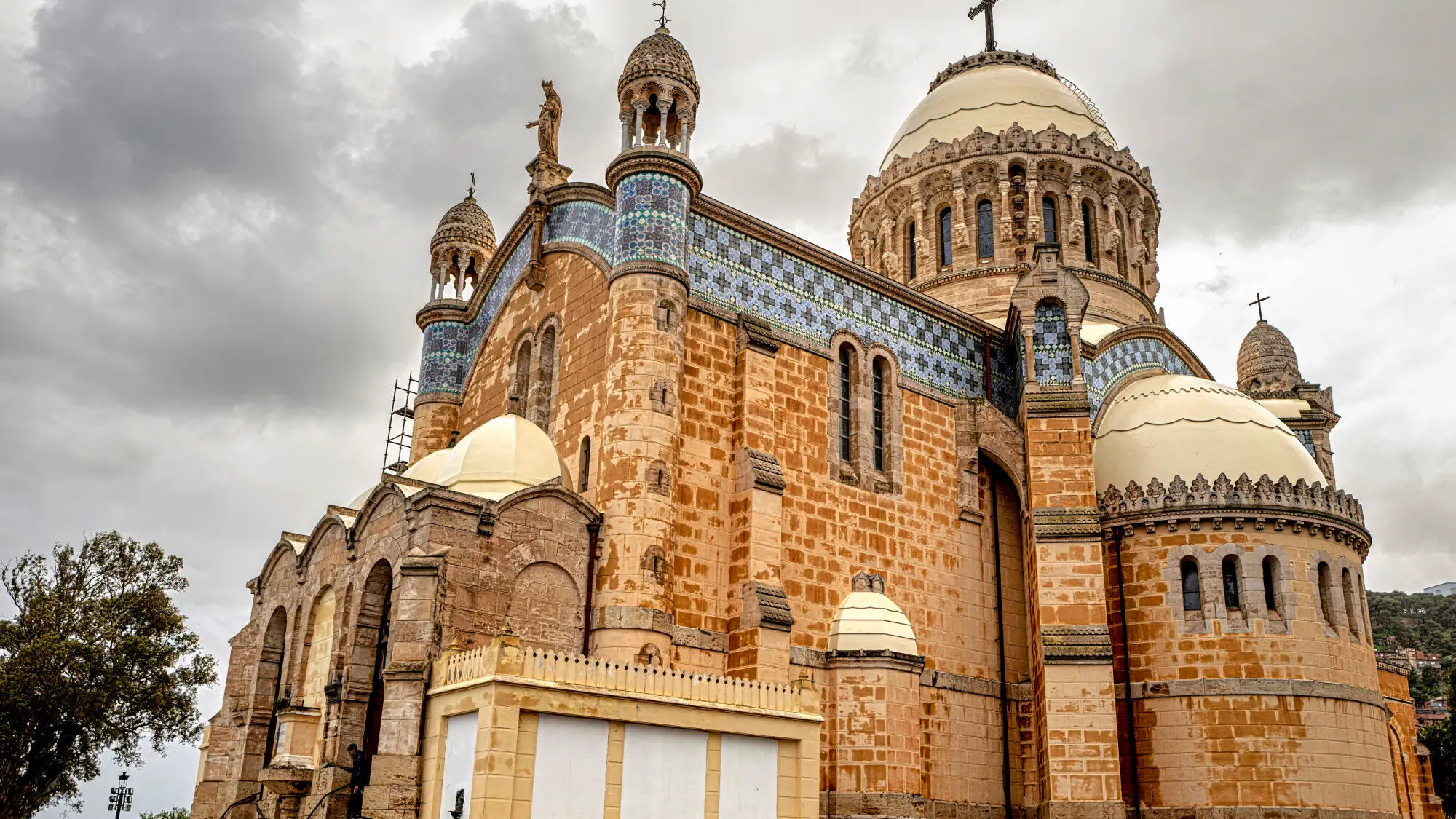
The wind is blowing across Algiers on this Palm Sunday. While the storm threatens, a handful of people advance into the vast Notre-Dame-d’Afrique basilica, palm branch in hand. A few expatriates, around ten foreign priests, as many nuns from elsewhere, and only one or two Algerians. Sparse, the assembly is a reflection of the local Catholic community: 8,600 people among 47 million inhabitants, almost all Muslims, but a country with Catholic buildings inherited from the colonial period. In the apse of the basilica, a sentence inscribed in mosaic fully captures this reality: “Our Lady of Africa, pray for us and for the Muslims. »
“We are a Church with and for the Algerian people,” considers Mgr Davide Carraro. An Italian missionary, he has been at the head of the diocese of Oran since 2023. “We are a minority who know that God is present and we try to accompany the people,” adds the bishop.
Accompany: the word is essential when we talk about the mission of Sister Lourdes. Arriving in 1972, the Spanish Augustinian nun still lives in the heart of Bab El-Oued, on the outskirts of Algiers. A long-time nurse in various hospitals, she was often the only Christian there. “It was essential to be there: the presence breaks down barriers, allows meetings and shows that we are working for peace,” she says. Today, with the sisters of her community, she runs a reception and friendship center, which Léon XIV will visit off camera.
The place has become a landmark for the inhabitants of Bab El-Oued: children find academic support there, sub-Saharan migrants find lessons to make the most of their time spent in Algeria, women from the neighborhood find sewing or jewelry workshops. “Here, I can talk about my story and learn a lot of things, instead of staying bored alone at home,” says Samira (first name changed), a retired lawyer.
Carried by their spiritual strength
In half a century in Bab El-Oued, Sister Lourdes will have gone through almost the entire history of the country since its independence, including the terrible black decade (1992-2002), which left more than 150,000 dead. Among them, nineteen Catholic religious sisters beatified in 2018, including two Augustinians from her community, Esther and Caridad, murdered in 1994 a few steps from her.
“A few days earlier, we had had a deep discernment with our superiors, who had come especially for this. Freely, each person made the choice to stay, Sister Lourdes remembers. We did not want to abandon our people in the midst of these darkest times. » “As long as you are with us, there is hope,” the population told them. “It was better that we die to allow the people to rise again, than to flee and destroy the hope of another future,” continues the nun, drawing inspiration from a reflection by Mgr Pierre Claverie, assassinated in 1996 while he was bishop of Oran.
“These believers went to the end of their mission, carried by their spiritual strength”: although not sharing their religion, Nabil (first name has been changed) greets with admiration the decision of the blessed martyrs of Algeria to remain until the end, even though the possibility of leaving for Europe was always offered to them. He himself admits to having “barely escaped” two attacks, one during the dark decade, the other in December 2007. For this thirty-year-old, the visit of Leo XIV will also be an opportunity to show that the page of this period is “well turned”.
A native of Algiers, this doctor also benefited from the presence of Catholic religious figures within the Algerian population. During his studies, he visited the library of the University Cultural Center of Algiers, run by an “adorable and caring” Jesuit, Pierre Lafitte – whose funeral in 2010 was celebrated in the presence of hundreds of “his” Muslim students.
“For the local Church, libraries like this represent places of culture and meeting,” analyzes Oissila Saaidia, researcher and author of Catholic Algeria, 19th-21st centuriespublished by CNRS editions. Here, the clergy and religious agreed to lose their autonomy and their visibility as a Church in order to remain with the Algerians. »
This presence is not limited to large cities. White Spanish father, José Maria Cantal is a missionary in Adrar, located in the middle of the Sahara, 1,400 km – and twenty-two hours by bus – from Algiers. Another white father, two students from Burundi, a few imprisoned migrants, three nuns whose house is 200 km away: the Catholic community is reduced to the bare minimum.
“We can’t do more among Muslims,” laughs the missionary. However, he guarantees, “our mission is not a waste of time! We show that Christ is not disinterested in the inhabitants of this region because they are of another religion.” As Oissila Saaidia explains, the main thing for these religious people is to “stay close to the Algerians”.
The forced silence of converts
However, if “the Catholic Church in Algeria is a Church of burial,” she continues, “it is by theological choice but also by social constraint.” Proof of this is that, although it has recently demonstrated gestures of openness – such as the invitation to Leo
At the end of 2022, Caritas Algeria was closed by the authorities, officially because it was an “undeclared” organization. Rather because of “the excessive visibility of its social projects for the benefit of sub-Saharan migrants, most often in an irregular situation”, the media Africa Intelligence believes.
For Algerians who choose to join Catholicism, this restraint often turns into a real screed. Born in Constantine and from a pious Muslim family – “my sisters are veiled, I said five prayers a day with my father” – Sébastien (first name has been changed) is one of these converts.
As a teenager, he helped nuns in his neighborhood in their activities with young people. “As I approached my twenties, I moved away from the Muslim faith,” he recalls. I met a priest to whom I was able to ask questions and I discovered Christ the savior. »
Over time, the young man began the process of requesting baptism – which he received while studying abroad. “I first kept it from my family, who still don’t accept it,” Sébastien continues in a low voice, for fear of being heard. We, the converted, live in secret, because we are seen as infidels. » For a good specialist in Algeria – who also insists on remaining anonymous – “the question is not so much linked to the country as to the social conception of Islam, which is defined within the framework of the community (the umma). A conversion is therefore seen as a denial of her and her family.”
Ultra-minority and universal
Staying with his parents in Constantine, Sébastien goes to mass discreetly even today. And there is no question of discussing Leo XIV’s trip with his loved ones, even if he intends to participate in different events. “I hope that the pope’s visit will open a path of dialogue also in our families. » And yet, he certifies, “all this is worth it, for the great interior freedom offered by the Gospel and the promise of salvation granted by Christ”. His choice is all the more courageous because the consequences are not only social, but also legal: “Certain positions in the administration are forbidden to us and we can be disinherited. »
“Although ultra-minority, the Algerian Church is therefore universal”
Father José Maria Cantal Spanish priest, missionary in Adrar
“In Algeria, religious proselytism is prohibited,” underlines a field worker who prefers to keep his name quiet. We answer the questions of those who approach us with a thirst in their hearts; who had a personal encounter with God and Jesus. There are a few conversions, but it remains in the order of a few people, no more. » Often, the first discovery of Christianity is made through social networks or evangelical radio broadcasts, broadcast from abroad. The link, more specific with Catholicism, is generally made subsequently through personal encounters.
For around fifteen years, a new situation has also changed the balance between the Catholic Church and the Algerian State: the greater presence of sub-Saharan migrants, whether they are students with visas – according to an attractiveness strategy desired by the authorities – or present illegally, most often in transit to Europe. Of the several thousand Catholics in the country, three-quarters of them come from sub-Saharan Africa.
There are also missionaries and workers – particularly in oil-producing regions – from Asia and Latin America. “Although ultra-minority, the Algerian Church is therefore universal,” affirms Father José Maria Cantal. From there to affirming that Algerian Catholicism has turned the page on the European colonization which saw its birth, there is only one step.
How many Catholics in Algeria?
8,612. This is the number of Catholics in Algeria, according to the 2024 edition of the Pontifical Directory.