
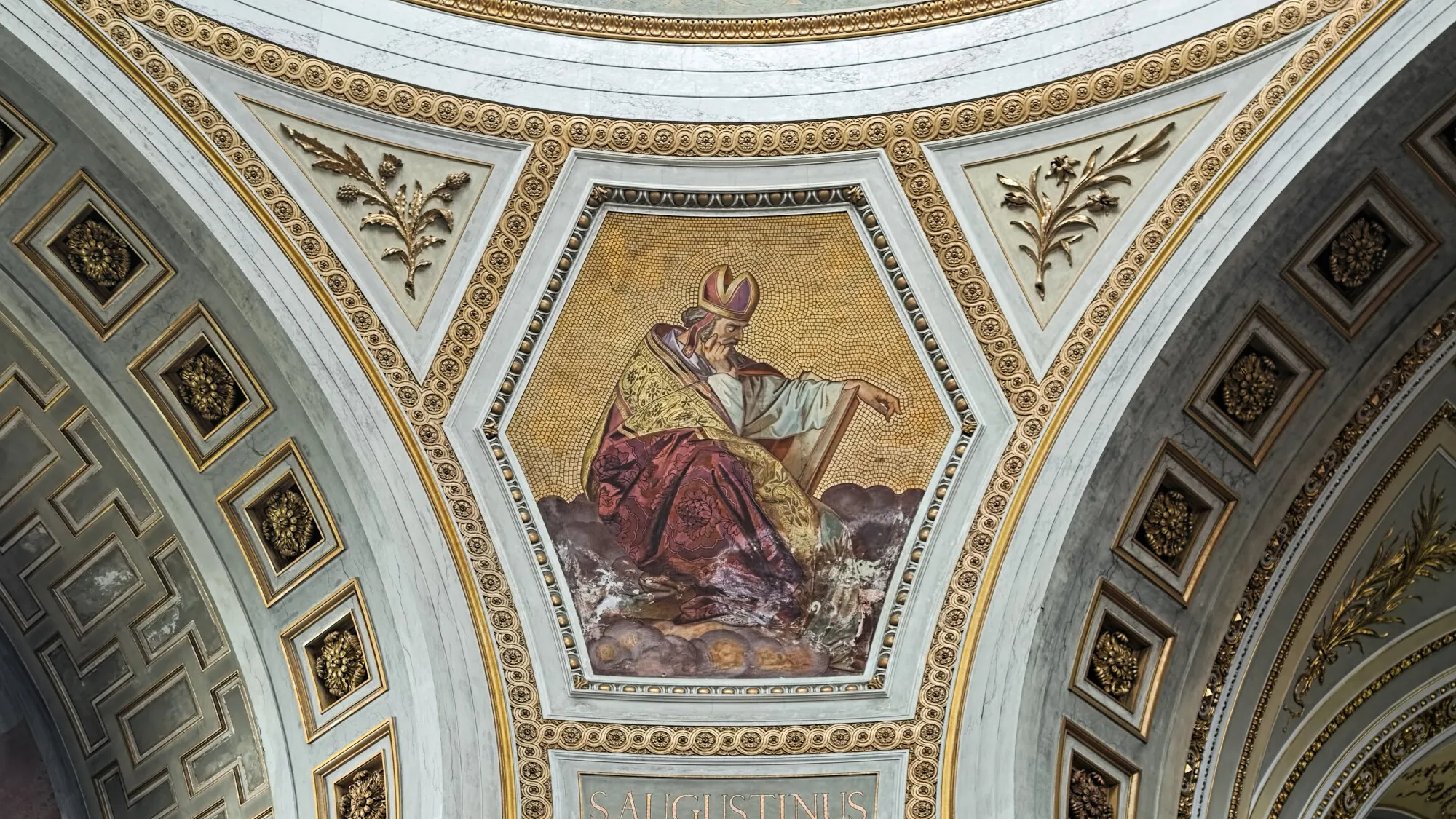
Augustine, a universal saint
1 – Humility, path to God
For Augustine, one cannot live with God without adhering to Christ and one cannot adhere to Christ without humility. “Since it was through pride that man fell, (God) used humility to heal him. » (Christian doctrine). “This is the path traced; walk in this path of humility to reach happy eternity. Christ our God is the homeland to which we aspire, and Christ become man is the path that leads us there. Through him therefore we go to him; what do we fear about going astray? » (Sermon 133)
2 – At the school of Christ
This conversion to humility can be read in the Scriptures. Leaving the posture of the knower, Augustine reads the Bible to put himself to the school of Christ: “It is the interior Master who instructs, it is Christ who instructs, it is his inspiration which instructs. » (Commentary on the first epistle of Saint John ) To adhere to Christ is to rediscover the source which vivifies and unifies us: “Do not let my dark side speak to me (…) I got lost and I remembered you (…) Now, I am returning to your source. » (The confessions)
3 – The Church, a ferment of unity
This union with Christ passes through the Church. For Augustine, its vocation is to bring people together in the charity that God makes grow in their hearts when they open themselves to him, and to each other. The motto of Pope Leo XIV recalls this: “In the one Christ, we are one. »
(Commentary on Psalm 127) This unity is received from Christ and is built through our bonds. Augustine sees this unity at work in each Mass: “O sacrament of love, sign of unity, bond of charity. He who wants to live knows where to live and where this life comes from. Let him not despise being united to the members, let him adhere to the body, let him live in God, of God. » (Sermon 271)
4 – From the earthly city to the heavenly city
Augustine lived in troubled religious and political times. Is God absent from History or our stories?
No: it constructs a reality of communion. “Two loves made two cities: the earthly, it is attachment to oneself to the point of contempt for God; the celestial is the attachment to God to the point of self-contempt. » (City of God) No human institution can claim to embody this celestial city. In the Church, we learn to live from the action of Christ in us – his grace – and to cooperate in the work of God.
Biography
→ 354: was born in Thagaste, in Numidia (present-day Algeria), then a Roman province. His father is pagan, his mother, Monique, Christian.
→ 386: converted to Christianity.
→ 387: baptized by Saint Ambrose in Milan.
→ 396: bishop of Hippo (Algeria), port city.
→ 410: sack of Rome.
→ 430: dies in Hippo.


