a “valley of frescoes” to explore history
It is first of all a shock of colors: in the abbey church of Saint-Savin-sur-Gartempe (Vienna), the decoration of the pillars of the nave immediately catches the visitor’s eye and astonishes with its almost psychedelic modernity. And yet, these exceptional mural paintings which also cover the vaults and walls date from the end of the 11th century.
In yellow, red-brown and green tones, over 460 m long, the main scenes from the Apocalypse and Genesis in the fashion of the Middle Ages are represented with precision: craftsmen build a Tower of Babel that looks like a fortified castle, while Noah’s ark resembles a longship…
A language to explain
Their authors, high-level artists, knew how to imagine original solutions: “To represent the seven-headed dragon of the Apocalypse, the painter did not have much space under the porch of the church. So, he drew six little heads behind the main one,” laughs Jean-Luc Dorchies, director of the public establishment which manages this jewel of Romanesque art, rediscovered by Prosper Mérimée in the 19th century and listed as a UNESCO World Heritage Site in 1983.
“These coded images were not intended for the population, but to enrich the meditation of learned monks, perfect connoisseurs of biblical texts. No doubt they also served to edify their novices,” he remarks.
“Thus, all the “positive” characters – Abel, Abraham… – look towards the east, towards the choir where the Eucharist is celebrated, while Cain or Noah, when he is drunk, look towards the west, symbol of darkness. » This language rooted in Christian history and theology must be explained to today’s audiences. This is the role of the exhibitions presented next door, in the only existing convent building (read box below).
If Saint-Savin is considered the “flagship”, the bucolic Gartempe valley, east of Chauvigny, conceals other little-known places where images also play a major role. In the beautiful Notre-Dame church in Antigny, four kilometers away, and in the modest Sainte-Catherine funerary chapel, in Jouhet, a little further south, later frescoes, from the 15th century, decorate the walls.
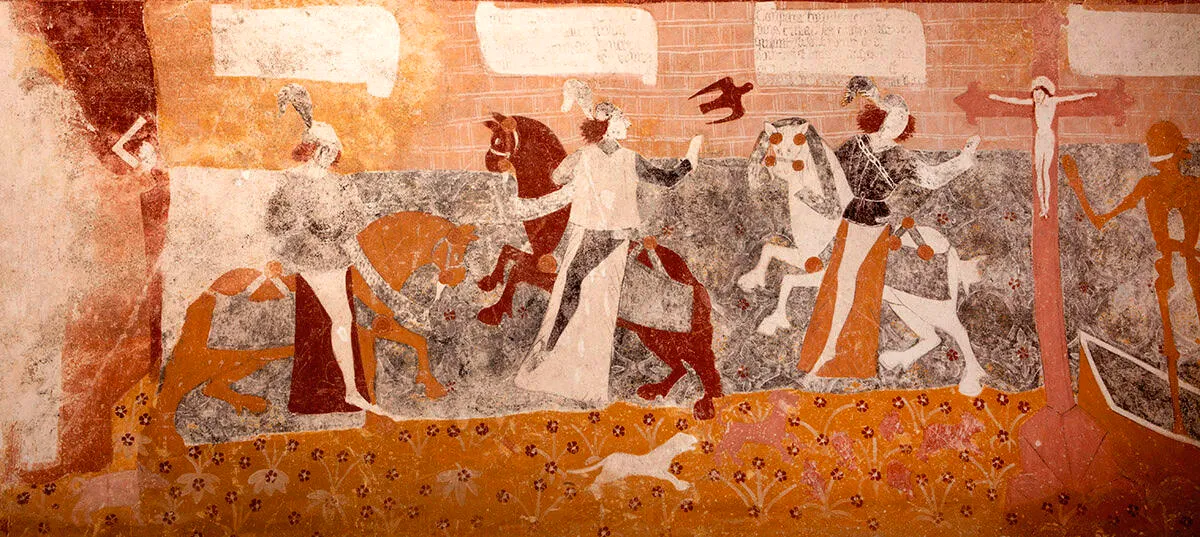
In these two buildings, a panel illustrates the legend known as “the three dead and the three alive”, where arrogant young gentlemen are challenged by the skeletons of other lords who present to them what they will soon become… (see photo above)
This original “vanity”, which can also be found in a neighboring castle, testifies to the links between the sponsors. The influence of these painted churches was felt until the 19th century: in Saint-Germain, which adjoins Saint-Savin, or in the majestic Saint-Laurent church in Montmorillon, neo-Romanesque artists skillfully followed in the footsteps of their predecessors.
But the “valley of frescoes”, as the tourism managers of this heritage circuit have named it, still offers other treasures of images of a very different kind and yet, also, of primary importance.
In Lussac-les-Châteaux, in 1937, during an excavation, limestone plaques revealed more than a hundred engraved human representations. Some of them are now on display in the town’s very educational prehistory museum.
Difficult to read with the naked eye, the drawings they reveal thanks to special lighting are disturbing. A little boy with his bangs, a pregnant woman, a man wearing a hat… suddenly emerge from a distant past.
“These are sketches from life more than real portraits,” says François Debrabant, head of the museum. But they are among the very rare images in the world showing real people, living 15,000 years ago, in the Upper Paleolithic. » Other human representations from this period are more stylized and faceless.
A farandole of animals
Animals, on the other hand, are often depicted with naturalism. 40 km further north, going down the Gartempe, prehistorians discovered in 1950, near the magnificent village of Angles-sur-l’Anglin, a 20 m long frieze depicting ibexes, horses, bison and felines… sculpted with great virtuosity.
The Paleolithic site of Roc-aux-Sorciers is closed because it is still under excavation, but a life-size reproduction, in the interpretation center of the same name, allows you to appreciate the quality of this masterpiece and its force of impact still intact over the millennia. To bring together so many astonishing and original images, the “valley of frescoes” definitely lives up to its name.
Noah’s ark in majesty
The ground floor of the convent building exhibits the history of Saint-Savin Abbey. On the first floor, the twelve monks’ cells are set up for a temporary exhibition which will last two years.
The first, which introduces the scene, deciphers the biblical story of Noah, its Mesopotamian origins and its universal impact. Around thirty contemporary artists – ceramist, painter, illustrator, etc. – present work that echoes this founding story.