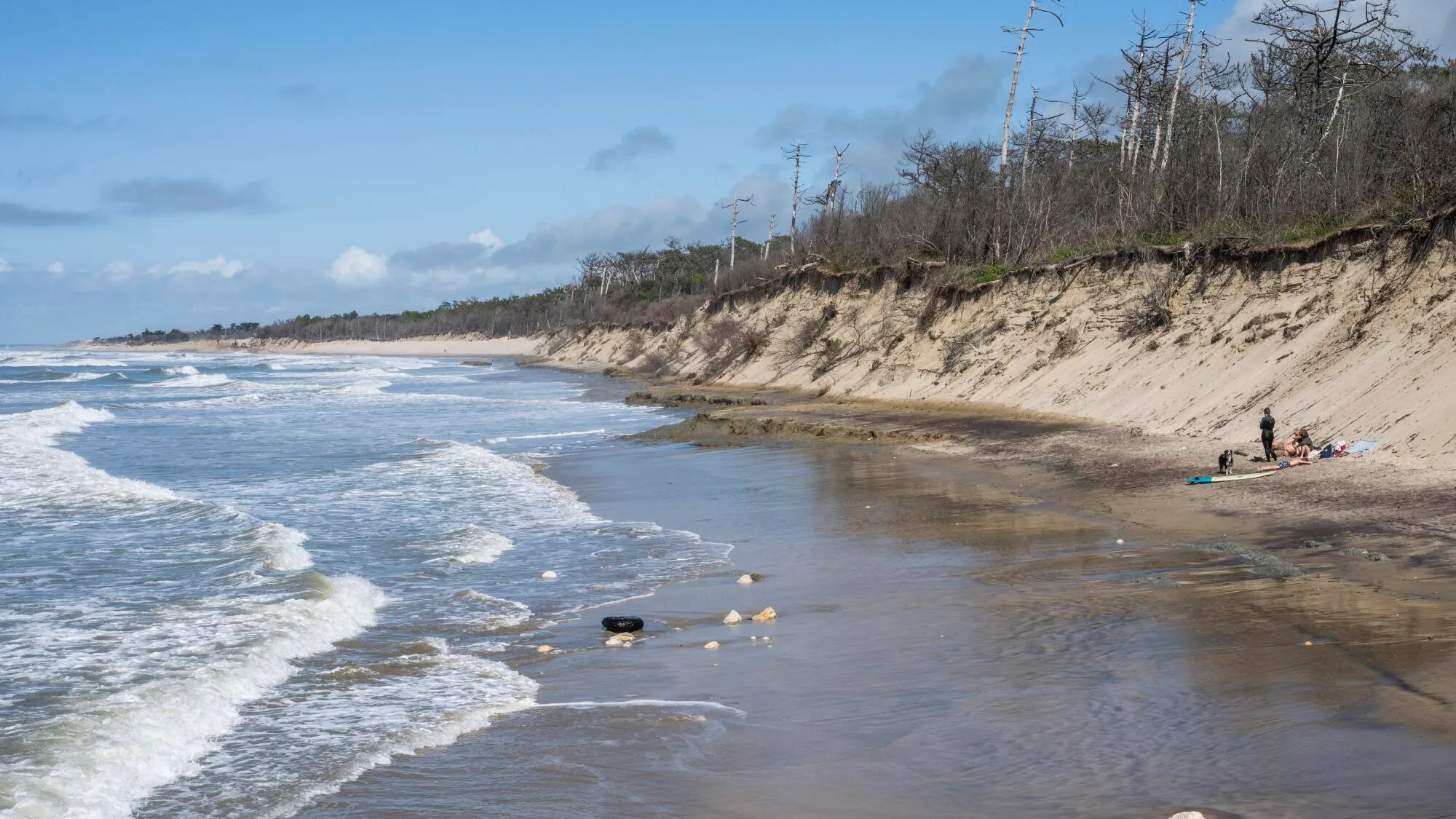
In Soulac-sur-Mer, the countdown against erosion has begun
On a beach in Soulac-sur-Mer, at the entrance to the Gironde estuary, a strange scene unfolds. In the background, the ocean, a troubled sky and the Cordouan lighthouse. Closer, under the watchful eye of a delegation of Danish engineers seated in deckchairs, a large pipe several hundred meters long spits out a fantastic geyser of water and sand.
This sand was pumped 20 km from the coast, in the estuary, the bottom of which is dredged every year to allow boats to enter. After years of negotiations with the authorities, the town of Soulac obtained that the precious sediments be released onto its beaches. “We are going to put 200,000 m3 of sand in three weeks, compared to 100,000 m3 in eight weeks when we move it by truck,” rejoices Vincent Mazeiraud, who is leading the project.
Until the end of April, Soulac therefore serves as an open-air laboratory. If the trial fails, millions of euros will have been swallowed up. If it succeeds, a new method could be reused and used in some of the 500 French municipalities threatened by coastal erosion.
The Danish example
The first resanding operations took place in 2014. Since then, every winter, trucks transport sand from the main beach, less affected by erosion, to those which suffer the most. For this new work, the municipality called on a company from Denmark, a nation with expertise in defending land against the ocean. Because, in Soulac as in Copenhagen, the fight against the elements is perpetual.
The coastal currents constantly tear away the sand. The wind pushes the dunes backwards. The crashing waves are gradually devouring the beach. Some winters, in places, storms cause the coastline to recede by 20 m. However, since the Neolithic period, humans have inhabited these lands, nourished by the ocean which now eats them. The 3,100 inhabitants know it: in the 18th century, the Romanesque basilica of Notre-Dame-de-la-End-des-Terres was buried by sand. Only the end of the bell tower protruded, from which it is said that the rings hanging there were used to hook donkeys.
In 2026, the Soulacais still live from the ocean. In April, the first tourists walk the streets with their picturesque villas. There will be up to 50,000 this summer. The seaside resort appeared in 1874 with the arrival of the railway. At this time, the fight against erosion intensified, dikes were erected: it was no longer possible to move back according to the movements of the beach. A risky choice nonetheless. “A beach normally needs space to move back and forward. When urbanization stabilizes the landscape, it becomes more fragile in the face of erosion,” explains François Longueville, geologist engineer, member of the Nouvelle-Aquitaine Coast Observatory.
With climate change, the fight becomes even more unequal. Waters are rising, winter storms are intensifying. “I have moved my school back three times since 2012,” says Marco, a surfer and instructor for thirty years on a beach south of Soulac. In 2014, after a terrible winter of storms, a building named Le Signal found itself 20 m from the coast. “I remember the 200 m of dunes in front of the Signal when I was a kid,” confides Benoît Duverger, retired and president of a local association for the fight against erosion.
Sisyphean work
Among the Soulacais, erosion is a major subject of discussion. Every day, onlookers park on the dune and observe the progress of the work through binoculars. Opinions are divided. “As a trader, I am happy with the work, because we must preserve the coast for tourists. But at what cost? », asks the manager of a bistro near the basilica.
This year, it will be 3.5 million euros, largely financed by Europe, the region and the State. “The success of this project is fundamental, because it opens up perspectives,” explains Vincent Mazeiraud. Because behind Soulac, a whole national strategy could develop. The method, imported from northern countries, could be used in other municipalities which have an offshore sand reserve. But here, the inhabitants know this Sisyphean work well: the sea always ends up taking back the sand. “We don’t fight against nature forever,” says Xavier from his veranda, where he is enjoying happy days for the moment.