
“Caregivers give everything,” says Philippe Croizon
Initially, the film For the best, which comes out on April 22, 2026, was to tell your sporting exploit: swimming the English Channel in 2010. Ultimately, it tells a much more intimate story…
Yes, because when the director Marie-Castille Mention-Schaar came to the house, she understood that my story could not exist without that of Suzana, my partner. Marie-Castille stayed with us for a week. She saw our daily lives, our functioning, our balance… And she said: “This film is about you two. » From there, we were no longer just in a story of an exploit, but in a story of life, with all that that implies.
Suzana therefore occupies a central place in the film. Why was this essential?
Because without it, my journey has no meaning. The film talks about what it is to love an addicted person, to help them on a daily basis, sometimes to the point of forgetting yourself. Suzana is not “the wife of”. She is a woman with her story and her wounds. It was fundamental that it existed on screen.
During my crossing of the Channel, Suzana is omnipresent… She carries the project as much as I do. She supports, organizes, accompanies, reassures. His health, his fatigue, his needs take second place. This is a reality that many caregivers experience.
The film also shows the consequences of this total commitment…
At one point, it breaks. When we forget ourselves for too long, we become exhausted. In the couple, this creates tension and incomprehension. For my part, I didn’t always understand what she was going through. It was writing that changed everything. His book My life for two was an outlet (read box at end of article). By putting words to her experience, she took back her place. And I, reading what she had written, finally understood. It was a key moment for our relationship.
Can we say that For the best proves to be a tribute to caregivers?
Yes, fully. To their courage, to their love, to their ability to hold on. But also to their limits. Caregivers are not inexhaustible. Suzana embodies this with great accuracy: a woman who has fought all her life and yet continues to move forward and love. It was important that this film addressed the issue of caregivers, who are very little visible in our society. In France, there are 11 million caregivers. They hold everything, carry a lot, but we see neither their fatigue, nor their mental load, nor their wear and tear. Their life expectancy is even shorter, because they give so much.
Despite the seriousness of the subjects, the humor is very present…
Humor is vital. Without him, we can’t survive. With the director, we agreed: we absolutely must not fall into pathos. As soon as a scene became too heavy, we looked for a breather. Humor allows you to tackle tough subjects without overwhelming the viewer.
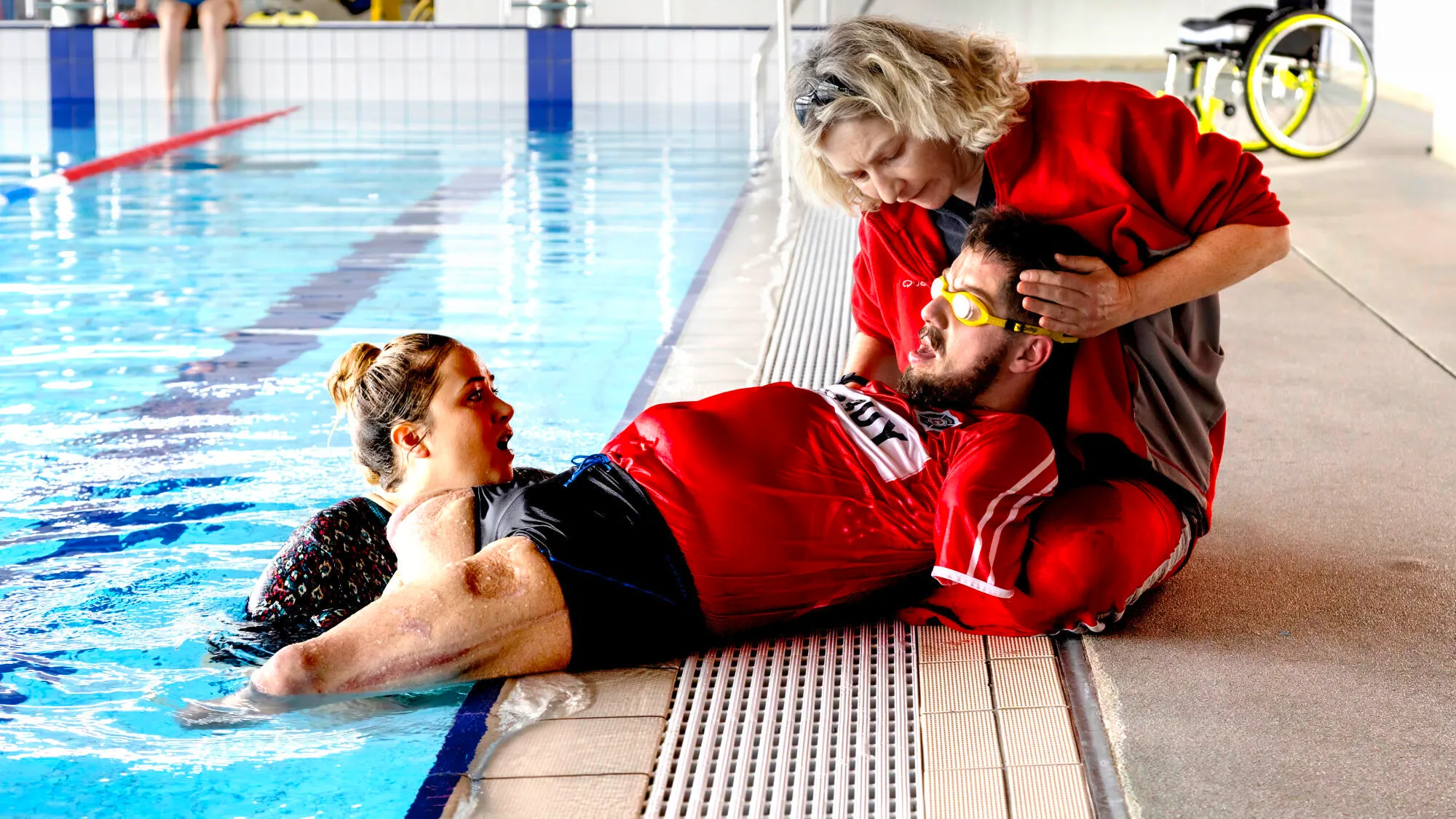
You are played on screen by Pierre Rabine, a quad-amputee swimming champion. How did this meeting go?
Very naturally. Pierre experienced an accident similar to mine: an electrocution, an amputation, then reconstruction through swimming. He is not an actor, it was his first role. He took on an immense challenge. He was prepared and coached at length. Sometimes, on set, we told him: “Be careful, there you become Pierre again, you have to play Philippe. »
And Suzana is played by Lilly-Fleur Pointeaux…
This actress is overwhelming. With Suzana, during filming, we sometimes looked at each other behind the control screen and said to ourselves: “But it’s you…” Playing a living person, present on the set, is enormous pressure. But the public feels it: at each preview, she receives a standing ovation.
Other strong figures complete the cast…
Yes, Sandrine Bonnaire and Corinne Masiero are fantastic. Corinne plays my coach with great strength. My real coach told me when she saw the film: “I wasn’t that tough. » I replied: “Yes, it was worse!” » Sandrine plays my caregiver, who shared my life for more than twenty years. It brings remarkable gentleness, sobriety and kindness.
Alongside the film, you published a story entitled Foolproof. How do the two complement each other?
The film gives the emotion, the momentum. It touches, it conveys strong messages, but it is necessarily condensed. The book allows you to go further. I tell in detail about my accident, the reconstruction, the crossing of the Channel… but also everything that is around, everything that we cannot show on the screen. It was essential. The film opens a door. The book allows you to really enter into the intimacy of my journey.
Precisely, today, with hindsight, at the age of 58, what is the situation?
That you never gain anything alone. We often talk about my exploits, but behind it, there is always a team, and above all people who give a lot. I often say that I died in 1994, during my accident following which I had my arms and legs amputated. So everything I experience today is a bonus. A bonus that I would never have had without the others.
What message do you want to send to caregivers and people with disabilities?
Dare! And above all, don’t be alone. For a long time I waited for help to come to me. Then I understood that it was up to me to reach out to others. Every time I ask for a helping hand, something happens: a smile, an exchange, a connection. And that’s often where it all starts. And to the caregivers, I want to say: think of yourself. Don’t forget yourself. To help, you also have to protect yourself.


