how our regions imposed themselves
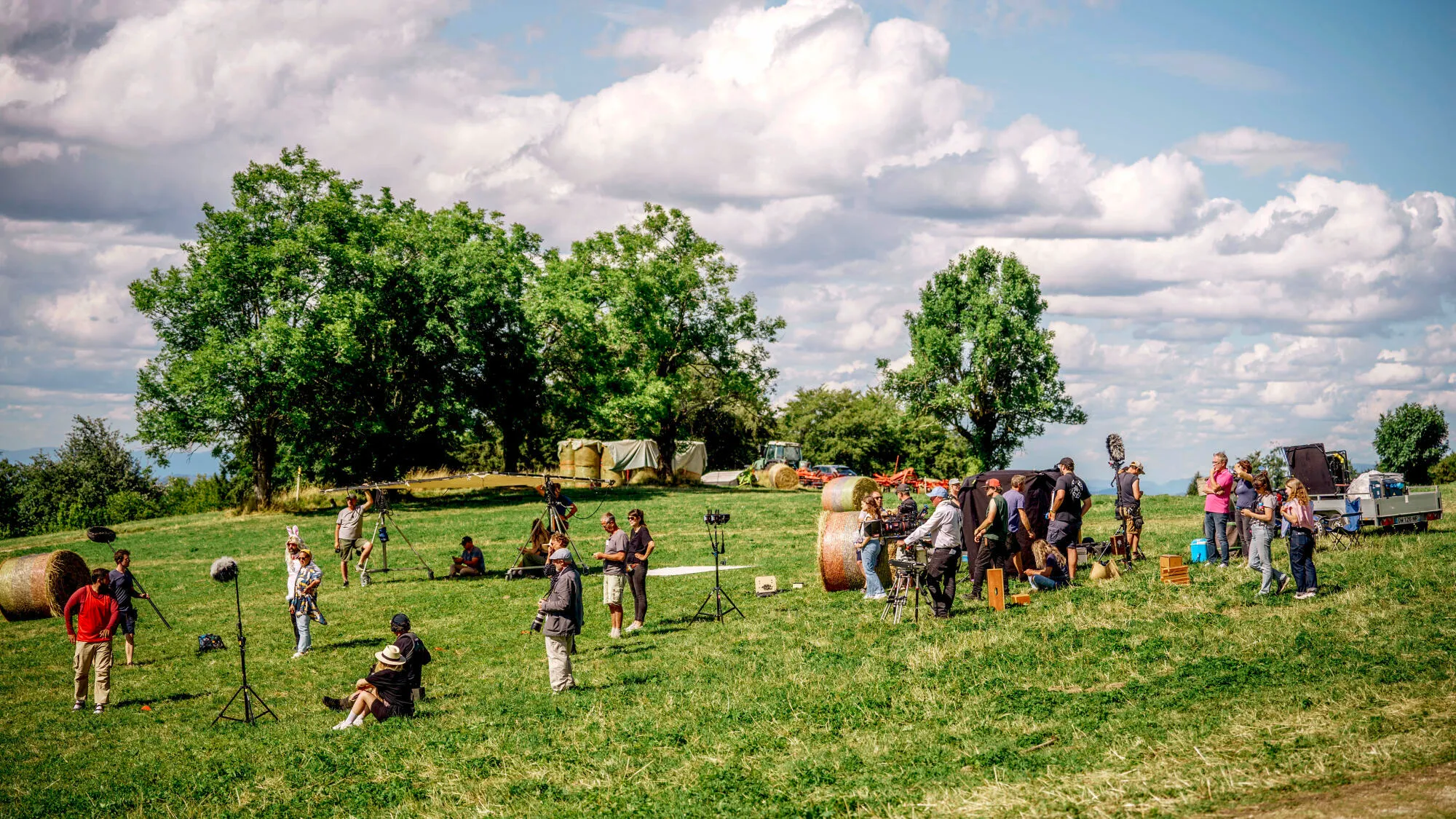
“It was the mayor of the neighboring town who transported the equipment with his tractor to the filming location, because the production truck did not pass on our steep paths,” remembers Alain Menant, vice-president of the rowing club of La Sône, one of the towns of Saint-Marcellin Vercors Isère Community, where the film was filmed. A little something extra.
Two years after the sensational release of the film with 10.72 million admissions, which remained at the top of the box office for several weeks in 2024, the local impact of the filming can be assessed. “Total expenditure, which represents revenue for the territory, amounted to more than 1.5 million euros, almost half of which was payroll. We supported this work with 270,000 euros. The filming therefore generated almost six times the amount committed by our regional support fund*,” explains Marie-Anaïs Angelier, general secretary of Auvergne-Rhône-Alpes Cinéma, which supports film and audiovisual production in the region.
Accommodation, collective catering, purchase of equipment and direct employment of local technicians and artists: in a municipality, the shooting of a film has an immediate economic impact and indirect effects on the influence of a territory. Spin-offs which push regional elected officials to promote theirs with the support of several dozen film commissions which provide them with logistical support throughout France.
“Born in Clermont-Ferrand, I am proud to promote my region, a pioneer in supporting cinema. »
Marie-Anaïs Angelier General Secretary of Auvergne-Rhône-Alpes Cinema
A political choice
It is no coincidence that all regions have kept the amount of their support funds the same in 2026, with the exception of Pays de la Loire, which decided to reduce theirs by 35%. “Continuing to help this sector in difficult times for local authorities is a real political choice,” declares Jérôme Sion, president of the Unique Occitanie Agency. We are a little tired of hearing that culture is expensive for the regions. The facts say otherwise. »
If Île-de-France hosts the greatest number of filmings, the PACA, Occitanie and Auvergne-Rhône-Alpes regions are among the most dynamic in terms of jobs linked to cinema and series. Each has made a specialty.
A pioneer in supporting cinema and co-producer, Auvergne-Rhône-Alpes has been banking on animation for a long time: “It is in this sector that the economic benefits are the most significant,” emphasizes Marie-Anaïs Angelier. The prestigious studios of Annecy (Haute-Savoie), Valence (Drôme) and Lyon (Rhône) attract professionals who settle there, generally between three and four years. »
The secret of the tits is a good example of this. Supported by the support fund since 2018, this animated feature film made in Valencia (Follimage studios) was released seven years later. For 330,000 euros invested, the total impact was 2.6 million euros. Which does not prevent the region from also experiencing great success with fiction, such as Anatomy of a fall (Palme d’Or 2023).
Relocate filming
How can we explain such dynamism in the local audiovisual sector? At the beginning of the 2000s, cinema professionals alerted the public authorities to a worrying observation. Large French productions then massively relocate abroad, particularly in Eastern countries, where costs are four to five times lower than in France. Which then poses major employment problems for the sector.
The trend is being reversed thanks to the famous “1 for 2”, implemented in 2004. The system is simple: when a region puts 2 euros into a film or series, the National Center for Cinema and Animated Images (CNC) matches 1 euro in financing. From then on, 1 for 2 leads to decentralization of the sector, while relocating production to France.
This system gave a strong boost to the support funds set up by each region; the revaluation of tax credits in 2016 did the rest. These are granted to production companies locating the majority of their expenses in France. An effective tax measure according to a recent CNC report.
Apart from Île-de-France, it is in Occitanie and PACA that the cinema and television series industries combined create the most wealth. “Thanks to its three daily series (Such a big sun, Tomorrow belongs to us And Here it all begins)Occitanie alone accounts for 30% of filming days for French TV fiction. Technicians, artists and specialized companies in technical industries, there are more than 10,000 professionals who work for the sector,” explains Marin Rosenstiehl, head of the Occitanie Film Commission. The series Candice Renoir made the region take off in this area.
In twenty years, a sustainable employment pool has developed there. “As the series take place over several seasons, they are a real asset for Occitania. All sectors combined, the audiovisual sector creates between 90 and 100 million in expenditure for the territory each year,” specifies Marin Rosenstiehl.
“In twenty years, with my teams, we have created a professional pool. »
Marin Rosenstiehl Head of the Occitanie Film Commission
Lille, showcase of the series
Despite these good results, the future is never 100% guaranteed. The year 2025 was marked by the arrival and then the sudden disappearance of the daily series New Day (M6/SND). “An industrial accident which led to an undeniable loss of income. But another question remains unanswered: France TV, one of the biggest sponsors of series, has seen the amounts of its latest allocations considerably reduced. This could affect audiovisual creation and therefore local employment,” worries Jérôme Sion.
A concern that is not felt in Hauts-de-France. These position themselves as the showcase of French creation internationally. Since 2019, Lille has hosted the Séries mania festival, the largest event dedicated to television series in the world, bringing together more than 100,000 festival-goers. The opportunity to remember that the region is home to series, as shown by the creations Sambre, Disenchanted, Of the Living (France TV), and The fighters (TF1).
“We welcome around 230 filming projects per year, all genres combined, including Family flair (France TV). Each year, Hauts-de-France entrusts us with an envelope of 8.6 million euros to support the creation of feature films, series, documentaries or even video games,” reveals Godefroy Vujicic, director of Pictanovo, an association responsible for the region’s cinematographic and audiovisual policy.
On average, for 1 euro invested, this records 4.40 euros in benefits. His great success? The series HPI, with actress Audrey Fleurot, co-produced by Pictanovo, which generated 3.5 million euros per season in the territory. Sold in around a hundred countries, it recorded the highest television audiences for twenty years in France.
“Our compass: never sacrifice artistic quality for the benefit of economic impact. »
Godfrey Vujicic Director of Pictanovo, the regional center of excellence in charge of cinema and audiovisual in Hauts-de-France
Professionalized cities
To facilitate the arrival of teams, film reception offices, responsible for meeting the technical needs of productions, have sprung up like mushrooms in France. Thus, for Hauts-de-France, 19 cities are grouped within the “Film Friendly” network. Tourcoing, which is one of them, has become one of the reference filming locations.
The trigger? The reception of the teams of Little Murders by Agatha Christie . “They filmed here for ten years for the needs of the three seasons,” says Peter Maenhout, city culture deputy, “and they had very specific needs. We have learned to centralize these requests to best respond to them. »
This is the mission that falls today to Elsa Escudié, the city’s filming referent. “My role is to welcome and guide the teams,” she explains. I can help find a building of particular architecture or local decor companies. »
And it’s not an easy task: “Outdoor filming requires municipal decrees to be issued, in order to close streets or parking lots,” continues Elsa Escudié. City services must also prune gardens and parks upstream or remove posters likely to appear in the field of vision of the cameras. »
Tourcoing attracts numerous productions. In 2024, she was requested for 38 filming projects. An activity which allowed him to collect 2.5 million euros, between catering for professionals, hotel nights, equipment rental, road fees and salaries. “The filming brings local life to life,” rejoices Elsa Escudié.
Beyond the direct economic benefits, they stimulate tourism. Thus in the Vercors, where “since the release of A little something extra and the election of one of our municipalities as the French people’s favorite village, our intermunicipality gained 18,000 additional nights in one year,” indicates Nicolas Bontoux, director of the tourist office.
“These filmings mean a lot to the residents as well as to me. They help change the image of the city. »
Elsa Escudié Filming representative in Tourcoing
Tourist craze
One in four French people decide to visit a filming location after watching a film or series. A trend that has recently been exploited. In the Lille metropolis, the first thematic tour created in 2021 offers visits to the exterior filming locations of the series The Little Murders of Agatha Christie.
The catalog has expanded with the “Ciné tour”, a visit dedicated to series HPI And The invisible ones. Finally, once a year, a “Fan tour” is also organized, as part of Séries mania. On board a bus, around thirty visitors return to the traces of the filming of several films and series, including Black Baron, Germinal, Phew Love And Les Tuches in Lille, Roubaix and Tourcoing.
There are multiple visitor profiles: “I remember a 10-year-old who had already read all of Agatha Christie’s novels,” says Nicolas Descamps, guide-lecturer at the Tourist Office of the European metropolis of Lille. Or even from a woman who knew the Wikipedia page for the series almost by heart. »
A collective enthusiasm around audiovisual creation, both among elected officials and spectators, which, as the character of Buzz Lightyear says so well in Toy Story, could well lead the regions “towards infinity and beyond”!
* Association which acts on behalf of the region regarding its audiovisual policy. In the Auvergne-Rhône-Alpes region, it is a limited company.
The great image factory 2030
After the United Kingdom, Germany and Hungary, France has the 4th largest studio space in Europe. To improve this score, which is too low in the face of competition, the National Center for Cinema and Animated Images (CNC) launched a call for projects in 2022: The Great Image Factory 2030. Endowed with 350 million euros, it made it possible to label 68 projects in 12 regions. Objective: to make France the leading country for filming in Europe, and more broadly in the production of films, series and video games, as well as in post-production and training for professions in this sector. The surface area of film sets will be doubled, while that of permanent exterior sets should be quadrupled. This operation should reposition France in the leading pack, provided that the new projects are there.
What are the 5 French regions that focus on audiovisual?
1er Île-de-France
- €16.7 million invested by the support fund in 2025.
- 186,000 jobs in audiovisual/cinema in 2021.
2e Hauts-de-France
- €8.6 million.
- 4,200 jobs.
3e Provence-Alpes-Côte d’Azur
- €7.4 million.
- 12,500 jobs.
4e New Aquitaine
- €7.1 million.
- 8,200 jobs.
5e Auvergne-Rhône-Alpes
- €7 million.
- 9,500 jobs.
Sources: French film and CNC.