a path of peace?
Was it necessary for the excesses of Donald Trump to allow the pontificate of Leo XIV to take its full dimension? Nearly a year after donning the white cassock, the Pope experienced his first “viral” sentence on April 13, 2026, aboard the plane that was taking him to Algiers.
Asked by a journalist about the American president’s statements accusing him of being “weak” and of owing his election to him, he responded with a few simple words: “I am not afraid of the Trump administration or of telling the message of the Gospel. » As soon as it was pronounced, the sentence went around the world, giving Leo
If the sequence had obviously not been imagined in the Vatican, its temporality does not surprise those close to the man who will celebrate his first anniversary as Peter’s successor on May 8, 2026. “Arriving in Chiclayo, Bishop Prevost took a year to observe and listen. He will do the same in Rome,” predicted the day after the conclave, Janina Sesa, director of the Caritas foundation of this Peruvian diocese when the Augustinian monk was its bishop. This is exactly what the new pope did.
“Leon He takes his time, he doesn’t let himself be rushed. »
Restore Unity
However, beware of those who believe that the pontificate started in a certain wait-and-see manner, suspended on an event which would give it its real kick-off. To understand it fully, we have to go back, to April 21, 2025. That day, Pope Francis died. Behind him, he leaves a Catholic Church shaken by twelve years of a pontificate carried out at full speed.
“In Rome, the staff of the dicasteries complained a lot about the harsh and brittle governance of Francis, with decisions that were difficult to accept,” recalls a regular at the Vatican offices.
Entering the conclave two weeks later, the 133 cardinal electors were well aware of the strong tensions running through the Catholic community. “At each election, the cardinals are guided above all by the duty to maintain unity,” explains Bernard Lecomte, author of numerous works on the papacy*.
After the upheavals wrought by the Jesuit pope, Robert Prevost appeared to be the desired synthesis: “Both a missionary and a senior official in Rome, both a man from the North, since he was originally from Chicago, and from the South, with his Peruvian nationality, he ticked a lot of boxes. »
The primary mission entrusted by the conclave to Leo XIV was thus to reestablish a harmony which had faded. “Restoring unity was his immediate concern,” analyzes Romilda Ferrauto. His words were therefore thoughtful, so as not to divide, but on the contrary to bring together, to appease, to reconcile. »
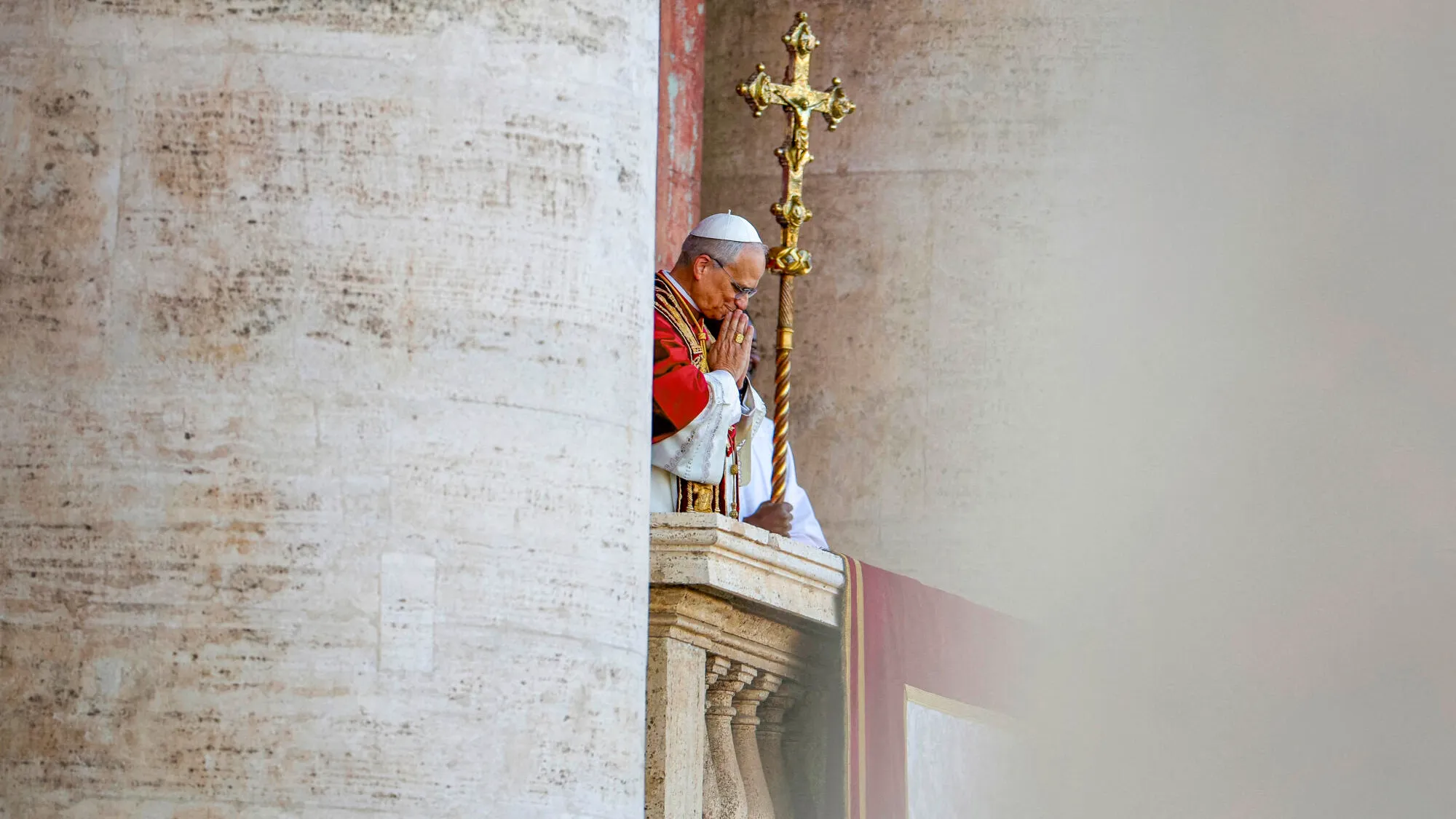
According to those who know him well, the Bishop of Rome did not have to force himself for this. “As a good canonist, he weighs each of his words and rarely speaks without having put his ideas on paper first,” says a relative. Unlike his predecessors, the first North American pope had thus prepared in writing the text spoken in front of cameras around the world during his first appearance on the balcony of Saint Peter’s.
Finesse, calm and serenity
In his movement to pacify the Church, the Bishop of Rome did not hesitate to draw on a wide repertoire of tools with a strong symbolic charge. He takes out the red mosette (short cape) from the cupboards, leaves the Sainte-Marthe residence to settle in the private apartments – which are in no way excessively luxurious – of the Apostolic Palace.
By thus resuming the papal attributes, he reassures those circles attached to the solemnity of the papal function. While in Francis’ time, cassocks – which he had little appreciation for – remained discreet in Rome, they are now openly worn without Leo XIV seeming to take offense. In the fall of 2025, the Pope even authorized the celebration of a Tridentine Rite Mass at the Vatican.
“It acts with a finesse that gives calm and serenity. However, he is in no way seeking to appear as a break with his predecessor,” nuance Mgr Patrick Valdrini, canonist and canon of the Roman cathedral of Saint John Lateran.
The United States, where, perhaps more than elsewhere, divisions under Francis’ pontificate have been sharp, constitutes a striking example. “Leon XIV succeeded in rallying the American bishops on positions of the social doctrine of the Church, such as proximity to migrants. Considering their divisions during the previous pontificate, this is a remarkable feat! », laughs Mike Lewis, Catholic blogger and former employee of the local episcopal conference.
“The Church must be a poor Church for the poor, a Church that expands, a Church that takes risks, a courageous, prophetic and joyful Church! »
Speech to popular movements, October 25, 2025.
Would Leo On the plane that brought him back from his pastoral tour in Africa, he thwarted this reading made by observers who were sometimes impatient to see him assert himself more. Asked about blessing same-sex couples, he said it was “very important to understand that the unity or division of the Church should not revolve around sexual issues.”
Before specifying: “The Holy See has made it clear that we do not agree with the formalized blessing of couples, in this case homosexual couples (…) or couples in an irregular situation, beyond what has been specifically authorized by Pope Francis. »
Without going too far, he preferred to broaden his remarks, calling not to forget “much larger and more important questions, such as justice, equality, the freedom of men and women, religious freedom”.
For the Bishop of Rome, the state of the world is in reality so worrying – he did not hesitate to describe it as “dramatic” in front of the ambassadors to the Holy See – that the Church has no right to disunity. Indeed, how could she be the advocate of the “disarming and disarming peace” preached by her highest official if she does not first put it into practice within herself?
“As a spiritual son of Saint Augustine, as he defined himself, Leo XIV considers the Church not only as a place of unity by nature, but also as a factor of unity,” explains Mgr Valdrini.
Embody a third way
“The pope is entirely aware of the realities of the world and of Catholicism,” assures Bernard Lecomte, recalling that Robert Prevost traveled extensively across the planet when he was superior of the Augustinians. “He knows that the shift is taking place towards the countries of the South, where the youth of the world and the Church are found,” continues the Vaticanist. To them, he wants to make it clear that Christian values are not on the side of predators and imperialists: he embodies a third way between American brutality and the authoritarian Chinese and Russian regimes. »
“Enough with the idolatry of self and money!” Enough with the show of force! Enough with the war! »
Prayer vigil for peace, April 11, 2026.
To propose it, Leo XIV did not hesitate to have clear words. Like during his recent trip to Africa, where he raised the problems of “corruption” and the control of “tyrants” – a term used several times. “The clarity of her words strikes me,” insists Romilda Ferrauto. His words are courageous, balanced: he has faith in what he says and he says it in an extremely direct way. »
Another particularity of the sovereign pontiff: having English as his mother tongue. Although rare, his interventions are thus more directly understood throughout the world, particularly by American voters. This is also partly what explains Donald Trump’s ire towards him.
Handle urgent matters
Francis thought his pontificate would be short (“I know, it will last a short time, two or three years, and then, to the Father’s house!” he said, bravado, in 2014). Leo XIV knows that his mandate will be long-term. He thus took the time to write his first encyclical, which often serves as the programmatic text of the pontificate. This should appear soon and will focus on human dignity in the age of artificial intelligence.
“It would be scandalous not to continue working to overcome our differences, however insurmountable they may seem. »
Audience with Archbishop Sarah Mullally, Primate of the Anglican Communion, April 27, 2026.
But if this time allows him to enjoy a certain state of grace and restore unity, will it not end up working against him? Sooner or later, the pressing questions of the time will demand answers. How will Leo XIV position himself in the face of the demands of the traditionalist world, which demands to celebrate according to the rite before the Second Vatican Council? How will he react to the ordinations of bishops that the Lefebvrists intend to carry out in Switzerland in July 2026? Will he be able to revive the synodal dynamic, which seems to be getting bogged down?
He knows it, he will not be able to avoid tackling such burning issues as questions about the place of women in the Church or the reduction in the number of priests in the West. Finally, how will he make his voice of peace heard if one day nuclear weapons were to be drawn? History will take care of pressing Leo XIV to provide answers. But it is in the light of the long term that his role as a man of peace can truly unfold.
* Latest work published : France-Vatican: two centuries of secret war, Ed. Perrin.
What is Pope Leo XIV’s program in 2026?
- May 8, 2026: first anniversary of the pontificate, pastoral visit to Naples and to the Marian sanctuary of Pompeii.
- From June 6 to 12, 2026: visit to Spain with stops planned in Madrid, Barcelona and the Canary Islands. This trip takes place in particular on the occasion of the 100th anniversary of the death of Antoni Gaudi, architect of the Sagrada Familia.
- July 4, 2026: travel to the Italian island of Lampedusa, symbol of the migratory drama in the Mediterranean.
- August 6, 2026: meeting with young Europeans gathered in Assisi for the 800th anniversary of the death of Saint Francis.
- Last quarter 2026: several trips outside Italy are mentioned, notably in Latin America. A visit to France is also under consideration, with a visit to Paris and Lourdes.


