Solar eclipse in Spain boosts tourism in little-known rural region
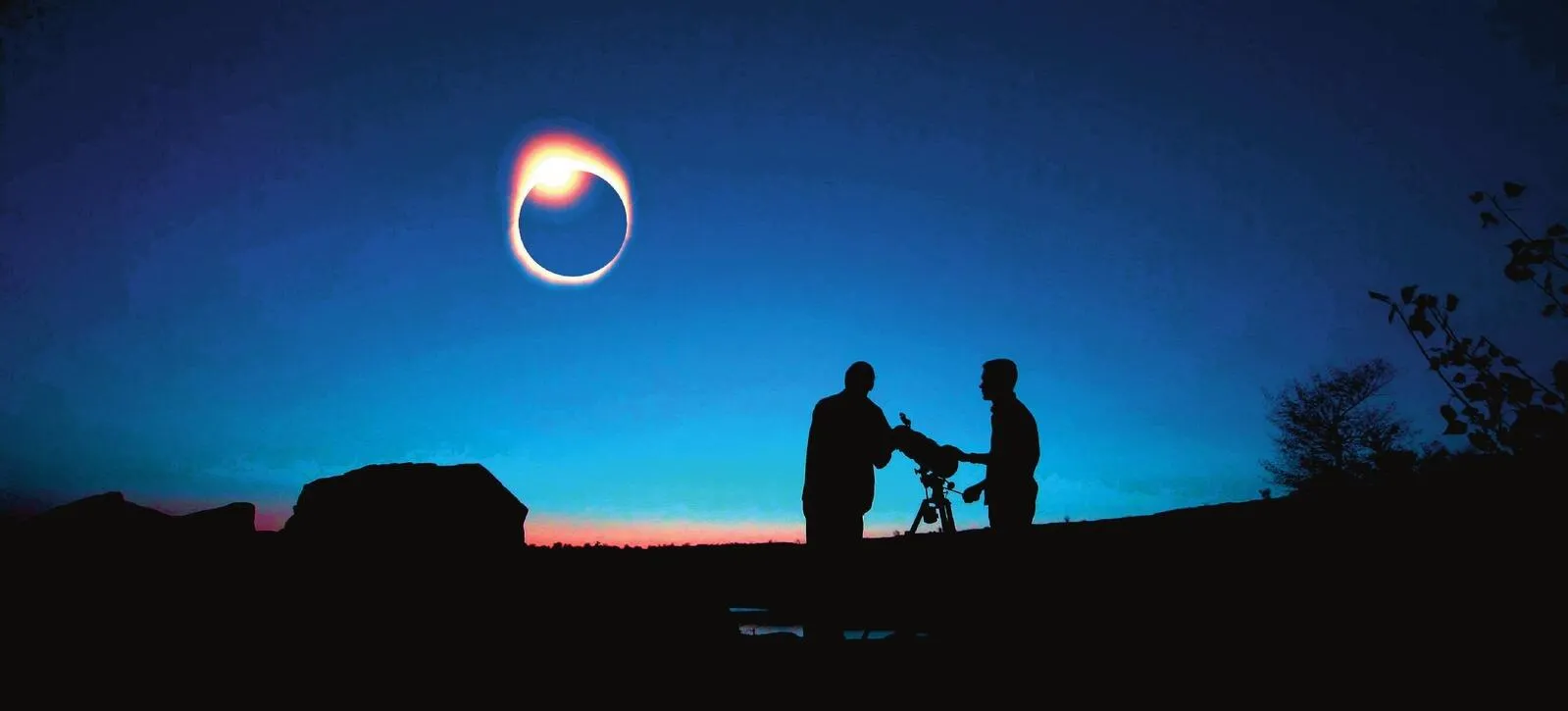
“There, that’s the Big Dipper. And if you follow these two stars on its edge, you will come across the North Star. » Armed with a laser pointing at the celestial vault, a funny Galileo in breeches and a puffy shirt explains to an attentive audience the layout of the sky.
In France, although neighboring, the spectacle will be a little more frustrating. In Biarritz, the Sun will be 99.5% obscured. In Toulouse, 98%… But these tiny percentages change everything: only a total eclipse transforms a few minutes of day into total night. The French still remember it, they who experienced such a spectacle on August 11, 1999. It caused a vast rush towards the north of France, the best point of observation of the phenomenon. “I managed to jump on a train from Paris to Fécamp, in Normandy. The station was crowded and a lot of people hadn’t had the chance,” recalls Philippe Cotte, 23 years old at the time.
“I would have dreamed of being able to attend,” confides Xuasus Gonzalez. This year’s, which I first heard about in 1995, was ages away. And now here it is. I’ve been waiting for this for thirty years! » And this is only the beginning: in the space of eighteen months, Spain will experience three total eclipses. After next week’s, another will be visible in August 2027 from the south of the country, then a third in January 2028, this time for an annular eclipse, in the southeast. Enough to put the entire Iberian Peninsula in turmoil.
This summer, 17 million people are expected in the planned observation areas, including 5 million foreigners, according to estimates by the National Commission of the Trio de eclipses, coordinated by the Spanish government. From Belgium, where he lives, Philippe Cotte did not hesitate long before deciding to make the journey.
“The 1999 eclipse shook me to my core. I took my breath away, I felt in symbiosis with nature…” At the time, this native of Ardéchois even thought of becoming an eclipse chaser, like the enthusiasts who travel the planet in search of these fascinating phenomena, sometimes visible from very inaccessible areas. Due to lack of means, he gives up. “But this one is in Europe. It’s sure, taking a week’s vacation for two minutes of eclipse is a bit crazy. »
A heavenly manna
Eclipses attract well beyond just “astrotourists”, those enthusiasts who use their vacation time to discover the treasures of the sky around the world. “Astrotourism experienced a turning point from the years 2000-2010, without becoming mass tourism,” explains Bruno Charlier, lecturer at the University of Pau and specialist on the subject. But exceptional events like the Northern Lights, showers of shooting stars or total eclipses generate considerable flows of people. »
This is the case of Paul, a 30-year-old Parisian engineer. “A friend of mine is passionate about astrophysics, and has already seen several eclipses. A year ago, he suggested that I and some other friends go to Spain. » So, this summer, they found themselves in an Airbnb in Ayllon, a remote village in Castile and Leon. “The only one in the area who hadn’t raised his prices. But you had to book well in advance. »
Because the Spanish tourism sector has understood the economic opportunity of such an event. “The city’s hotels have tripled their prices,” confides Karin, a bookseller in Leon, as she arranges books on eclipses published for the occasion on her shelves. A few streets away, the Barcelo Leon Conde Luna hotel has also spotted the opportunity and is offering an “eclipse-dinner” evening for 80 euros on the terrace. An immediate hit.
Individuals are not left out. Martin Mendez, a restaurateur in the center of the city, decided to rent his two apartments via Airbnb for the occasion. And what does it matter if on the platform the owners tripled the prices on the days surrounding the eclipse. “Everything has been booked for several months. Americans, Chinese… I had never seen that in Leon,” smiles the trader.
More broadly, it is the whole of Espana vaciada (“empty Spain”), which hopes to benefit from this astral manna. A huge hinterland abandoned in favor of the coasts, inland Spain, whose situation is reminiscent of the diagonal of the French void, has suffered for decades from demographic decline, confidential tourism and a feeling of abandonment.
So, the Spanish government is banking on August 12, especially since it is this part of the country that will offer the best locations for observing the eclipse. He therefore embarked on intense preparations for a year, declaring this day an “event of exceptional public interest” by royal decree. From July 2025, an interministerial commission, called Trio of eclipses, set about organizing this triple meeting, bringing together regions that are attached to their autonomy and the decentralization of skills.
A region in orbit
Ambitious, the device has however suffered some criticism. In addition to a program of local events revealed late, Noemi Perez, manager at the Barcelo Leon Conde Luna hotel, is annoyed by these political leaders who “only turn to our region when an important event is happening there, and neglect it the rest of the time”.
Mid-May, the national daily El País also noted communication difficulties between administrations and organizational delays. And in recent weeks, it is especially the fires ravaging the country which are worrying: “The forests have not been maintained, storms Noemi Perez. What will happen if the fires last until August 12 and obstruct the visibility of the eclipse? »
A concern shared by Antonia Varela Pérez, president of the Starlight Foundation, who advised the government on the preparation of the event. “We hope that they will be extinguished by then… And that this will also increase vigilance on the prevention of forest fires,” she admits. The astrophysicist is nevertheless delighted with the general mobilization.
“The risk is that too many Spaniards decide at the last moment to join the total gang, clogging up the roads. Foreign tourists will anticipate,” she notes. For its part, the municipality of Leon is nevertheless pleased: “This is a wonderful opportunity to promote our city and its heritage,” assures Mercedes Escudero Perez, municipal councilor responsible for tourism. We were even chosen by the European Space Agency to be their eclipse observation location! »
Shopkeepers, monument curators, restaurateurs… The people of Leon enthusiastically await the influx of tourists. Even pharmacists, who are already seeing their stocks of protective glasses robbed. “Grandmothers buy them in packs of twenty, for the whole family! » says Claudia, pharmacist in the historic center.
It is impossible to know whether these three successive eclipses will permanently change the destiny of internal Spain. One certainty, however: they will have already introduced millions of visitors to the sky. Something to rejoice Xuesus Gonzalez: “For me, the important thing is above all that people take the opportunity to discover astronomy. When I was little, I looked at the sky without knowing anything about it. But when you start to understand, you don’t want to go back. »
And in France?
If the eclipse of August 1999 had moved the crowds to France, this is not the case for this Spanish eclipse, although it was so close. In certain places, such as Biarritz (Pyrénées-Atlantiques), the solar disk will be 99.5% obscured. But the missing 0.5% changes everything about the intensity of such a spectacle.
On the other hand, the Nights of the Stars, which will be held from August 7 to 9 during the maximum visibility of the Perseids (this swarm of meteors resembling shooting stars), will be the occasion for 500 events organized by 350 clubs, associations and local authorities. In France, astrotourism is booming, and more and more sites benefit from labels recognizing the quality of their starry skies, issued by important institutes such as the Starlight Foundation. A certification which notably allows these spaces to be protected from light pollution.
The enigma of Golgotha
Would the death of Christ have caused an eclipse? “Darkness fell” during the Crucifixion, lasting three hours, describes Luke (23.44). From the first centuries, the idea of solar eclipse spread. The historian Sextus Julius Africanus (3rd century) reports that Thallus, a Greek historian probably contemporary with Christ, explained the phenomenon in this way, before refuting this hypothesis himself. Indeed, the Jewish Passover, during which Christ dies, taking place at the full Moon, a solar eclipse was impossible (the Earth is then between the Sun and the Moon, preventing any solar eclipse). A lunar eclipse, on the other hand, is well attested on April 3, 33, the date then chosen for the Crucifixion. A remarkable astronomical coincidence, which however only lasted part of the evening and which does not entirely correspond to the three hours of darkness explained in the biblical story.