
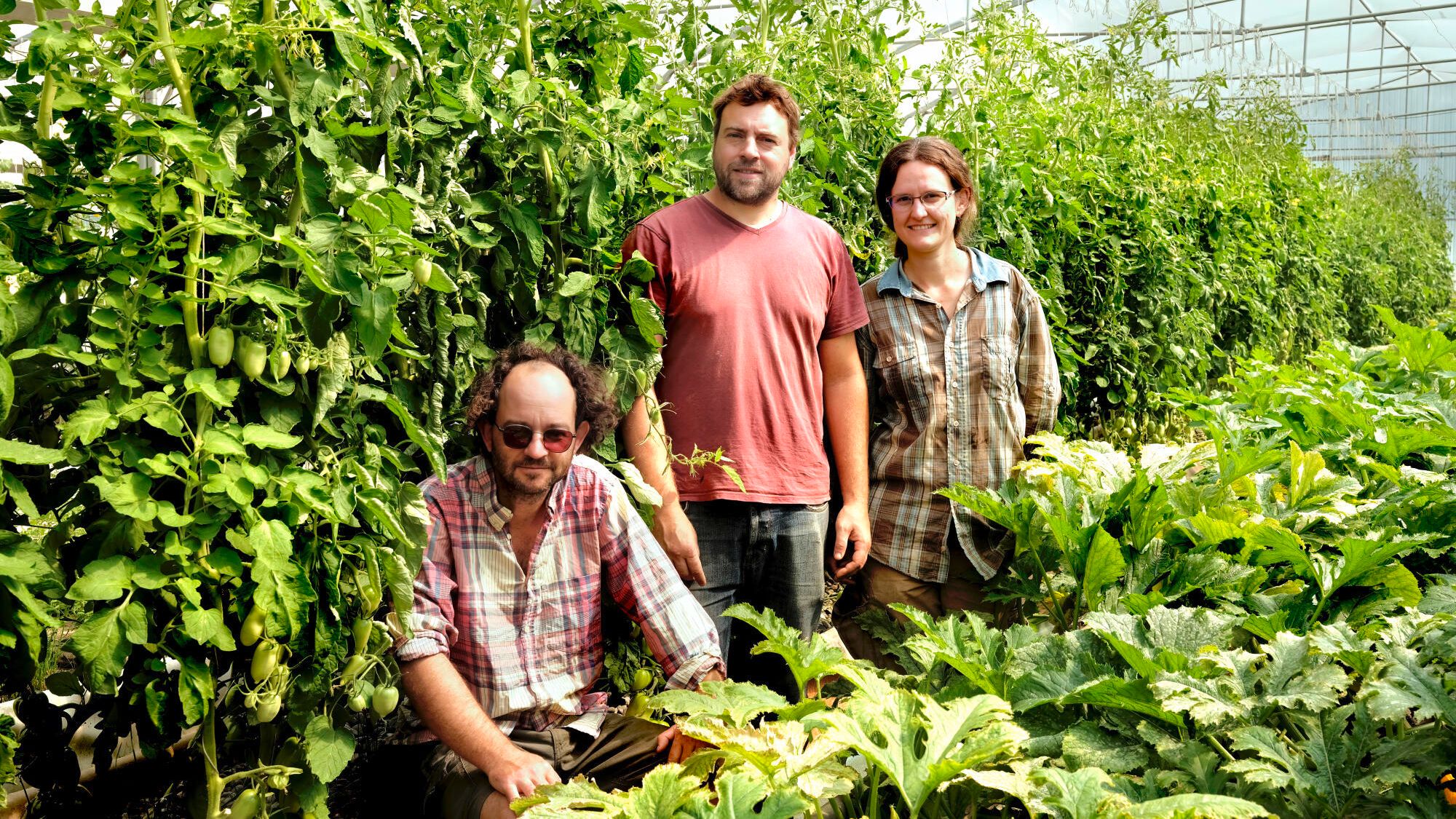
A farm combined vegetable cultivation and fish farming
Going up the course of the Garonne, the signs of peri-urbanity fade as the Toulouse agglomeration moves away. About twenty kilometers from the pink city, the town of Pinsaguel is located on the border between two worlds, between a universe of hangars wearing wavy sheets and a haven of biodiversity which resists urban expansion by the grace of a regional natural reserve.
It was in this in-between landscape that William Raux and Benoît Guénolé created an atypical farm. Adjoked to a gymnasium, bordered by hedges and the wild bed of Ariège, their exploitation extends over 3.8 ha. There are vegetables that push out of the field according to the principles of agroecology, wooden shelters to store the equipment and … a large greenhouse not really like the others.
Inside, aromatic, tomatoes, cucumbers, zucchini and other eggplants grow their feet in the water, placed on rafts or pebble beds, while, right next to it, rainbow trout and Koï carp wriggled in large basins.
Integrated aquaculture
Founded in 2019, market gardening is one of the oldest French farms to practice aquaponics, which combines cultivation of vegetables and fish farming. “It is a closed and virtuous circle,” specifies Margaux Jacober who joined the adventure in 2022, designating the pools and pipes that roam the greenhouse. 70 % of fish droppings are dissolved in water. Bacteria transform ammonia into nitrate and therefore into fertilizers, then the water is sent to the plants that will purify it before it returns to the fish basin. As for solid excrement, they are filtered and then used to amend the floors. ” In short, plants feed on the waste produced by fish and fish take advantage of plant phytoepuring power to continue their growth in cleaned water.
Known since the time of Aztecs, aquaponics is now practiced by around thirty farms in France. Still relatively confidential, this production system is not lacking in assets. “As we operate in a closed circuit, it is very economical in water and we do not reject anything in the soils or in the river. This technique is also very interesting in places where there is little space, to cultivate in flooding areas or when the floors are very polluted, ”argues Margaux Jacober.
The other advantage of aquaponics is obviously to provide both vegetables and fish, in other words two sources of income for the farmer who also becomes, by force of things, aquaculter. On the Margaux farm, William and Benoît, fish sales thus represent 40 % of turnover. On Wednesday afternoon on the Pinsaguel market as in the two AMAPs (Association for the maintenance of peasant agriculture) partners, the trio offers both vegetables from peasant varieties and fish that could not be fresh, whole or smoked and transformed on site in the small laboratory which it installed a stone’s throw from the basins.
Virtuous ecological cycle
In the aquaponics system, the whole challenge is therefore to maintain, during the year, a sufficient fish biomass to guarantee the growth of vegetables. “Until mid-June, we raised rainbow trout. When the water is at 16 ° C, their growth is optimal. From June to October, they are replaced by Koi carp which appreciate water between 23 ° C and 24 ° C, “explains William while grabbing specimens of this ornamental animal with various colors: red, black, yellow or orange.
“William, it is the man who whispered in the ear of the fish,” laughs Margaux, seeing him gently place his Koï carp in a bucket immersed in the water. “They are very fragile. You have to be careful not to hurt them. On average, a Koï carp is sold between 30 and 40 euros, but for a beautiful fish of 40 to 50 cm, some collectors can put up to 130 euros, “smiles the aquaculturer before plunging the fish back into their large basin, a few meters from the alignments of vegetables that only wait for their excrement to ripen.
Success recipes
- Double blow : Aquaponics brings together two sources of income in one space.
- Complementarity : with market gardeners, everyone has their specialty. The practice of aquaponics indeed requires the mastery of aquaculture and market gardening. The complementarity within the farm is therefore essential.
- Mastery : To limit investments, expensive in aquaponics, the trio has manufactured its greenhouse, and developed low-tech processes (low technology), thus reducing the cost of equipment by two thirds. Also beware of the electric invoice which represents 10 % of the charges.


