an exhibition on the young Charles
Two children pose in court clothes, while playing with a white goat. In 1764, the painter François-Hubert Drouais immortalized “naturally” Charles Philippe of France, Count of Artois (1757-1836) in the company of his young sister, Madame Clotilde. Excited by the game, they have red cheeks and lively eyes, full of curiosity. Much later, in 1824, the young boy would become, under the name of Charles X, a very conservative king of France.
A prince passionate about architecture and lover of luxury
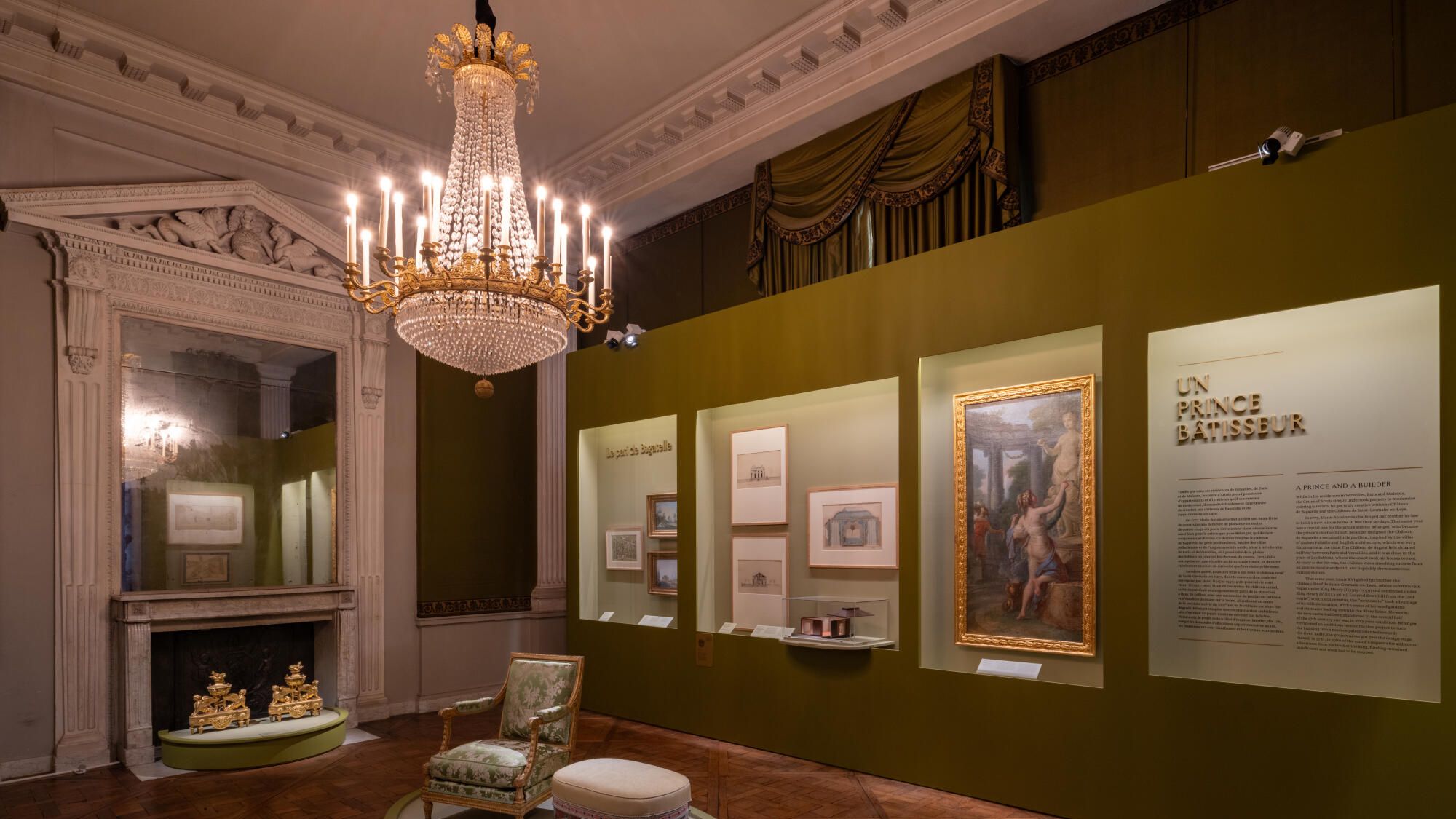
The exhibition dedicated to him at the elegant Château de Maisons, in Maisons-Lafitte (Yvelines), focuses on the first part of his life, before the Revolution which took away his older brother, Louis XVI. “The Count of Artois purchased the Château de Maisons in 1777, considered at that time a masterpiece of architecture from the previous century,” says Clotilde Roy, one of the commissioners for the Center des monuments nationaux. He was only twenty-two years old at the time, but was already passionate about the arts and architecture. » Numerous drawings, engravings and plans evoke the construction and beautification projects that he launched, and sometimes partially completed, for his various residences or to modernize districts of Paris.
In itself, Maisons is therefore already a manifesto of the prince’s very sure taste, whether it is the dining room or the stairwell, redecorated with magnificent sculptures and stucco, or a very intimate lounge with mirrors. Because the prince had the castle built by Jules Hardouin-Mansart renovated, under the supervision of the architect François-Joseph Bélanger. Its new “neoclassical” decoration combines respect for the style of Louis XIV and an appetite for ancient, Roman and Etruscan art.
Artois orders state-of-the-art decorative art objects from new creators such as cabinetmaker Georges Jacob. Astonishing gilded armchairs testify to his taste for exoticism: the count had several “Chinese” then “Turkish” lounges fitted out… He also has a library, very rich if we are to believe the voluminous catalog of his works, presented in the tour.
From revolutionary exile to the throne: the thwarted destiny of Charles
Third in the line of heirs to the throne, this blood prince, quickly dismissed from political life, without a real military career, undoubtedly found in the role of great patron an interesting diversion. While leading a high life, between hunting, his other passion, shows and courtesans… “He moves away from the closed life of Versailles and often stays in Paris,” specifies the commissioner.
He nevertheless maintained a true friendship for his sister-in-law, the young Queen Marie-Antoinette. Both launch the latest fashions. And both are in the clan of ultras who do not want any compromise on the absolutism of the monarchy… Even though the Count of Artois is riddled with debt and embarrasses Louis XVI with his lavish spending, which is increasingly unpopular.
Innovative in the arts, conservative in politics: “he is an ambivalent character,” recognizes Clotilde Roy. For example, he supported the beginnings of the painter Jacques-Louis David, even though he was about to get involved in the Revolution. »
On July 16, 1789, by order of the king, Artois left France. He will try to rally European sovereigns to the counter-revolution. “If seized, its collections will enrich national collections,” explains the curator, “and this is why we keep many of these masterpieces. »
He did not return until 1814, thanks to the Restoration and succeeded his second brother, Louis XVIII, in 1824… only to return to exile during the revolution of 1830. With the bad memory of his intransigence, he once again left behind rich artistic collections.