are the laity the future of the Church?
Dare to dialogue in the Church
“They changed the mass for us!” In 1970, when the new so-called Paul VI missal was published, many faithful admitted to being disconcerted. Others are enthusiastic. Because liturgical renewal was one of the major projects of Vatican II, completed on December 8, 1965.
Sixty years later, faithful of all ages are demanding the return of the “Latin” mass. Other decisive contributions of the council, such as the importance given to the role of the laity or to inter-religious dialogue, no longer mobilize much, or are even undermined.
Regression? Call to hear? While these tensions run deep through Christian communities, The Pilgrim wanted to offer a meeting space for Catholics of different sensibilities. Starting by returning to the source: a shared reading of the Gospel.
Mutual listening, we have experienced, gains a singular density. Because, before debating, it is first a question of recognizing ourselves as brothers in Christ. A synodal exercise, basically, to be discovered in our pages throughout Advent.
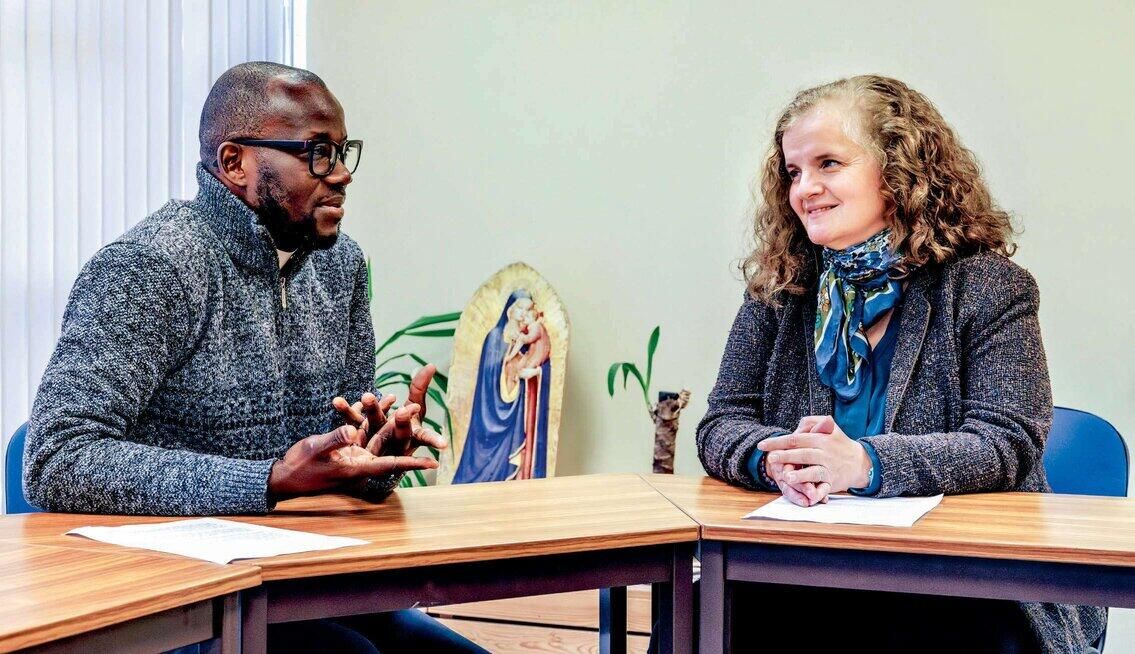
Alexandra: The texts of the council attempted to clarify the status of the laity in the Church. But above all they say what lay people are not – priests, in this case. Should we still use this word when it evokes a default status?
I fear that this will contribute to the polarization of our society. The Church can witness, on the contrary, to unity in the diversity of the baptized, who have different charisms and particular missions.
Louis Patrice: For me, the words “layman” or “cleric” are not derogatory. I remember what Saint Augustine said in the 4th century: “For you, I am a bishop. With you, I am a Christian.” The laity are indeed full members of the Church, with their own charisms.
And if there are differences, there is no discrimination since all share the same “common priesthood” offered by baptism. Fortunately the council dusted off our old ideas to remind us of this.
HAS. : I want to tell you a personal experience. As part of my commitment as a hospital chaplain, I met a woman who confided in me, as only two women can confide in one another. It was a true confession, very touching, which also invited us to prayer.
A little later, I spoke about it to the chaplain priest who came to give him the sacrament of reconciliation. He relied on what I, a secular woman, had heard. It was a great mark of confidence. But, in the end, this figure of a priest distributing the sacrament questions me…
L.P.: My experience in Ivory Coast taught me to recognize the important commitment of many lay people, called in particular by the priest. Fortunately, because the priest cannot and does not know how to do everything. And in fact, lay people are needed to call other lay people, to interest them in life in the Church.
When they are called as “extraordinary ministers of the Eucharist,” they bring communion to basic ecclesial communities. (groups of faithful who commit on the ground from the Word of God, editor’s note); and it is the lay leaders of these small fraternal communities who pass the information on to the priest, so that he can visit the sick or accompany grieving families. For me, the laity are essential transmission belts.
HAS. : If they are simply “transmission belts”, this means that it is the priest who decides!
L.P.: I wouldn’t say that. In pastoral and economic advice, the priest must work with the laity present. If he develops a pastoral project, it must be validated and worked on by these lay people, otherwise nothing is possible.
Without forgetting the know-how of lay people, for example on economic questions, which is essential. Of course, in the end, people say as a shortcut: “It was the priest who decided!” But in reality, it is a concerted effort.
HAS. : In the Parisian community of Saint-Merry Hors-les-Murs, where I am involved, we have worked a lot on the question of co-responsibility and collegiality. The priest who accompanies us is one voice among others.
When we prepare a mass, for example, we often hear: “Who is going to celebrate mass?” And we respond in unison: “All of us. On the other hand, the priest will preside over the Eucharist.”
A joke that says a lot, especially if we don’t ideologicalize things. In my opinion, the specificity of ordained ministry consists of connecting us to others other than ourselves, particularly within this institution that is the Church.
L.P.: But by presiding over the Eucharist, the priest provides the service of directing the movement, so as not to be scattered in all directions. Of course, he must not place himself in a dominant position, otherwise the sign of a shared mission between priests and laity is extinguished. The specific charism of the priest is to sanctify, through the sacraments, teaching, blessing.
HAS. : And what then to do with the laity who are now often well trained, sometimes even better than the priest himself?
L.P.: It is a grace for the Church. It is also a reminder that we are co-responsible for evangelization. However, if a layman who has a doctorate in theology lectures a priest who has fewer degrees, this can only generate conflicts.
HAS. : What bothers me in the relationship between priests and laity is that there are some who give and others who receive. I think of this priest friend who meant so much to me, Xavier de Chalendar, who recognized his opportunity to sing out of tune, because in this way he learned to ask for and receive help.
Didn’t Jesus learn to receive the gestures of the one who comes to wash his feet and pour perfume? If we do not dare to go that far, the conflict between “he who knows” and “those who wait to receive” becomes recurrent. This is why the figures of truly fraternal priests touch me.
L.P.: For me, a priest is truly a brother among other brothers. He doesn’t live apart. He is part of God’s people.
HAS. : Every man and woman is part of the people of God, since we are all called to be recognized by God. I am also surprised by the importance, in your culture, of the perspective of others; This is also true in a certain way in my family environment, which is rather bourgeois. However, as Christians, we know that Jesus does not care. He took the place of the “cursed” on the cross.
L.P.: Of course, but we also have to listen to what people say about us and act with it. If there is no fraternal concern, we cannot improve. I need someone to tell me my roman collar isn’t on properly!
At home, in Ivory Coast, dialogue with other Christians and other religions is a necessity. We are not better than others. But we go to them to share this common treasure that is our faith in God, despite our differences.
HAS. : When you told me earlier about the path to your vocation, you told me that as a child, discovering the life of the priests around you, you said to yourself: “I too want to become a priest so I can eat well!” » Well, after hearing you, I find this child’s word magnificent. Am I a believer, too, to share with others spiritual food good for our lives following Christ?
L.P.: I admire your understanding of the expression “people of God”. It is indeed a question of thinking about the salvation of all humans together. As a call to maintain the fraternity founded in Christ.
One council, one word: “people of God”
The expression, which may seem banal, has a unique history. The conciliar text Lumen gentium will give it all its importance in 1964.
After having evoked the “mystery of the Church” in its first chapter, this dogmatic constitution then evokes the reality of a Church as “people of God”, while emphasizing its biblical resonances.
Recalling Israel’s millennial alliance with its God allows us not to stick to a somewhat outdated legal definition of the Church as a “perfect society”, forged at the end of the 19th century.
“In the Church, not all walk the same path, but all are called to holiness and have received a faith which makes them equal in the righteousness of Christ” (§ 32). This equality recalls the necessary communion to be created between members who have different ministries. A challenge to keep repeating.