
At the Musée d’Orsay, the exhibition that reveals the Paris of John Singer Sargent
Confident gaze, trimmed beard, face turned towards the viewer: John Singer Sargent paints himself with almost photographic precision. In this self-portrait from 1886, which opens the exhibition dedicated to the Parisian years, each line affirms a conviction: to paint is already to tell a story.
Born in 1856 in Florence, Italy, to an American family from Massachusetts, Sargent grew up on a European journey undertaken by his parents, great art lovers. At 18, he arrived in Paris. “At that time, the official salons, the reputation of the National School of Fine Arts, the artists’ studios, the critics: everything converged towards the City of Lights,” recalls Paul Perrin, director of the collections of the Musée d’Orsay and co-curator of the exhibition.
Ten days after his arrival, Sargent joined the studio of a popular portrait painter, Carolus-Duran, on Boulevard du Montparnasse. He established himself like a prodigy student: flexibility of gesture, mastery of expressions, acute sense of textures…
A painter of intimate modernity
Surprisingly, although operating in a bustling French capital, Sargent rarely painted the city itself. This is the case with In the Luxembourg Gardens a painting in which he captures a peaceful atmosphere at dusk. In the foreground, an elegant couple walks.
“This choice reveals his interest in a modernity of leisure rather than industry,” observes the co-curator. For his leisure, Sargent frequents concerts, notably those very popular with the Cirque d’hiver. Its Rehearsal of the Pasdeloup orchestra at the Cirque d’hiver is distinguished by its black and white keys, like so many notes on a staff.
Italian influences
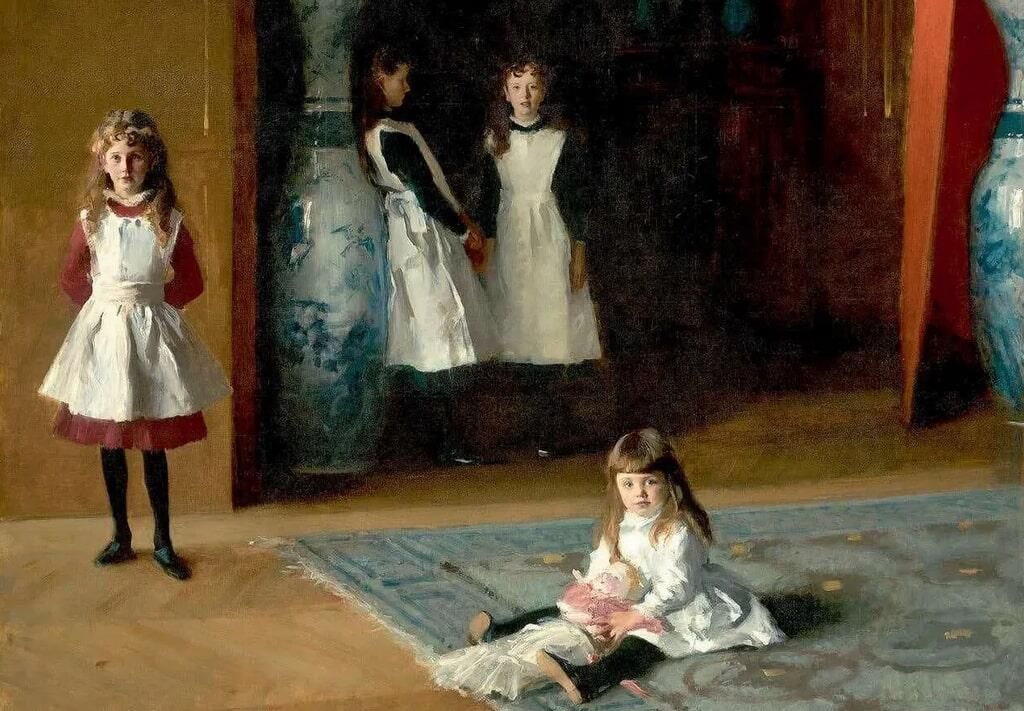
Throughout his outings and meetings in Paris, the young painter built up a network of artistic and social friendships. The idea of portraying them imposed itself on him. “His works are imbued with a subtle outlook, nourished by references to Ingres, Titian, Veronese and the masters of the Italian Renaissance,” analyzes Paul Perrin. This is how in 1882, he painted children: the four daughters of his friend Edward Darley Boit, in the privacy of the family apartment.
His paintings met with immediate success at the Salon (Painting and Sculpture Salon), which attracted crowds every year to the Palais de l’Industrie, on the Champs-Élysées. “It’s the place where reputations are made,” emphasizes Paul Perrin. Sargent impresses with the size and ambition of his portraits.” Until 1884, when he presented the Portrait of Mrs *** . Her model is Virginie Gautreau, a young expatriate from Louisiana, wife of a Parisian banker. She appears in a black sheath dress with a plunging neckline, a strap sliding over her shoulder. Paris is outraged by this sensuality deemed indecent. Hurt by the criticism, Sargent took the work with him to London.
He retouches the painting, replaces the strap and renames it Madame X . “I guess it was the best thing I ever did,” he later confided. Paradoxically, the scandal marks its glory. In Great Britain, orders are pouring in. In New York, people praise his genius. In 1916, the Metropolitan Museum of Art acquired Madame X consecrating a portrait that has become so legendary that it is nicknamed “the Mona Lisa American. Oblivion in France, Sargent died in London in 1925, a book by Voltaire in his hand, as a sign of his attachment to the country which saw the birth of his talent.
Today, a century after his death, the American artist finds the light again in Paris, the very place where his talent was revealed. “In the age of selfies, the portrait is once again becoming a fascinating genre, a mirror of society and relationships,” notes Paul Perrin. From then on, with Sargent, not only are we rediscovering an entire era, but also, who knows, our own relationship to images?