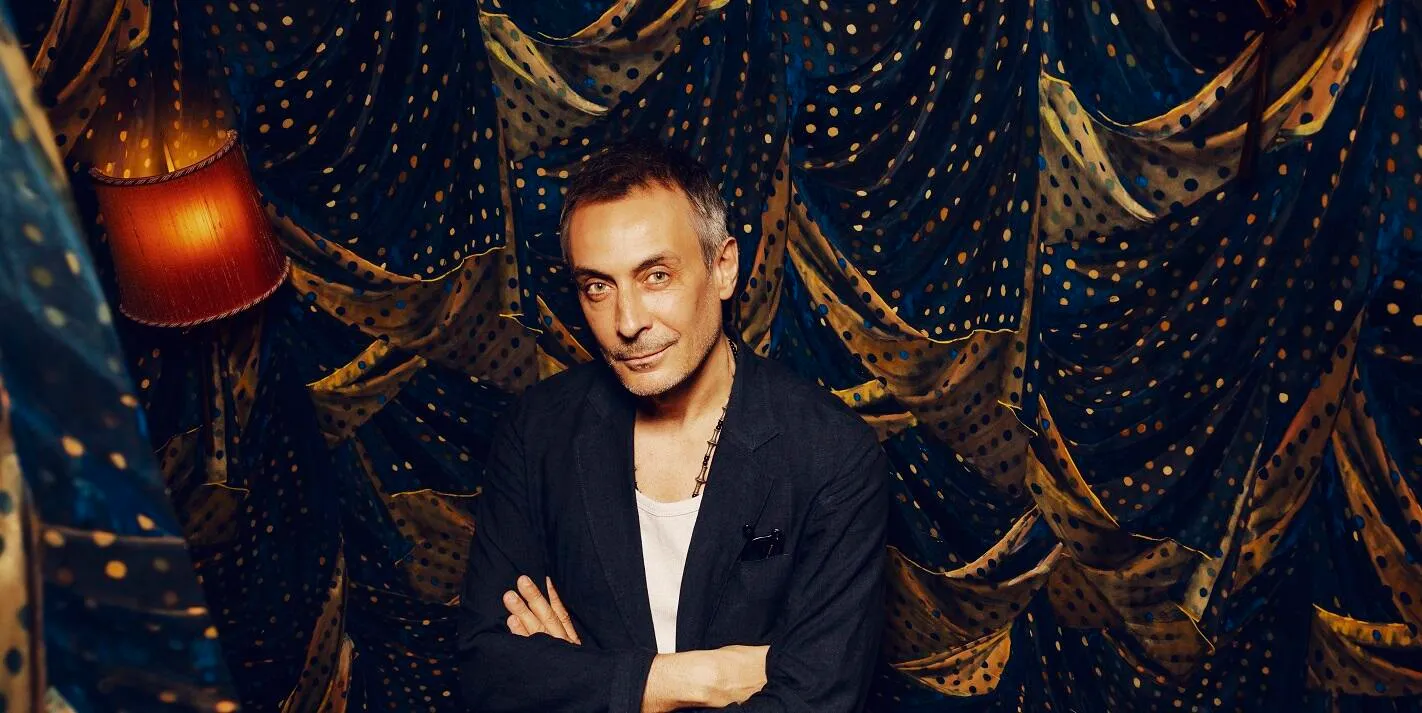
Benoit Solès, actor: “In Avignon, you have to convince every day. »
Why did you choose to bring this forty-five year old true story to the stage?
The fate of Mehmet Ali Agca, author of an attempted assassination of the Pope in May 1981, ticks all the boxes of a great sensitive story, where we try to decipher the mechanisms of the human soul. This event belongs to the past, of course, but unfortunately resonates with our contemporary issues. Some mysteries and gray areas also reinforce its narrative interest: what really pushed Ali Agca to commit such an act?
The hypotheses were almost as numerous as for the assassination of President Kennedy in 1963… Why did he not follow through with his action? And what did they say to each other with John Paul II, two years later, during those famous twenty-two minutes when the Pope went to meet his attacker in prison? The subjects immediately impose themselves on me, as if obvious. As an author, I look for its theatrical potential in a story: that it interests as much as it moves.
Were you not afraid that this religious subject would put off the public?
He is indeed a far-right Muslim terrorist (member of the Gray Wolves, a Turkish ultranationalist organization, editor’s note) who receives forgiveness from a Catholic pope. But I tried to make it a piece that was more human than religious, also so that the spectators could, on a certain scale, identify with the characters. Ali Agca’s trajectory returns each of us to the position of wanting to be forgiven or to grant forgiveness.
For the writer Georges Bernanos, “understanding is already loving”. Do you have to like these characters a little to play them?
I asked myself this question a lot last year when I played Killer Joe, a rapist and hitman, in Tracy Letts’ play. It is not a question of excusing this type of character, but of entering into his logic, otherwise we remain on the surface. Yes, Ali Agca killed (a Turkish journalist in 1979, editor’s note) and tried to kill a second time. It remained to be understood why. Failing to love, we must seek empathy.
The word comes from the Greek: “to suffer with”. I tried to enter into the suffering of Ali Agca, which requires a certain rapprochement. We see it in ancient theater, it is often a tragic mechanism which leads to murder.
In January 2015, you were right next to the Charlie Hebdo offices during the attack…
I was rehearsing a play at the Comédie Bastille, right opposite the editorial office. When we heard the gunshots, people who had escaped the bullets began to take refuge in the theater, panicked. The street was cordoned off and we spent the whole day with them, trying as best we could to appease them.
Could this drama have led you on the path of Ali Agca?
Consciously, no. But it is true that we arrive ten years after this dark period (Charlie the Bataclan, Father Hamel, Nice…), and that the artists, after a sacred time to be respected, took up these subjects – often in the name of the victims or with their agreement. I don’t know if 22 Minutes is part of it, but it seems to me that in our time, the story of this forgiveness granted by a man raised by religion to another man blinded by religion can be a stone of reflection to bring to this great collective trauma.
Behind these great ambitions, is there a childhood dream?
More like a teenager! I have always loved literature, theater and theaters. It happened to me in college, where I was enrolled, almost without anyone asking my opinion, in the end-of-year show of a third grade class. When I go on stage to play Creon in Antigone d’Anouilh, I feel that my life, my job, is here: on stage.
I don’t know if I will succeed, but I know that I will do everything to get there. I then put aside my preparatory class and political science projects to go to Paris to take theater classes. As in Aznavour’s song: “At 18, I left my province / Determined to take hold of life…”
In 2018, you write The Turing machinewhich has been performed more than 1,200 times since. Has this immense success changed your life?
At the time, a famous reading committee to whom I had sent the text, to receive a little money because I didn’t have any, replied to me verbatim: “A play about a homosexual mathematician who commits suicide, you can’t find a worse subject, it will never work!” » So, on the one hand, yes, being recognized by the public and by one’s peers provides immense happiness. The piece is performed and studied all over the world, it’s extraordinary. On the other hand, no. No one remembers the “Molierized” actors two or three years ago.
You have to stay humble. Far from being a star, I am an artisan. Behind the gilt and red velvet of the theaters, there is a lot of dust, sweat and work. This is the paradox of this profession. I like golden statuettes, but above all I prefer companionship, collective work, tours…
I am fortunate to approach this edition with an encouraging booking rate, but I am thinking of many friends who are putting themselves in financial danger, without knowing whether the spectators or the programmers will be there. In the theater, uncertainty is daily. A performance is never the same as the day before. Every evening, everything has to be done again. Nothing is ever acquired. It is precisely this fragility, this constant challenge that fuels this passion.
This uncertainty illustrates quite well this strange profession, glorious and precarious…
Precarious, yes. I’ve seen companies leave halfway through the festival when they had already paid for theater and accommodation, just to save on food, because they realized their show wouldn’t work. We are acrobats, clowns, who put on costumes and masks to tell stories to people who may or may not believe them.
It’s both big, the theater, it’s immense, it’s my reason for being and living, and at the same time, it’s the kingdom of artifice. When the lights go out, there’s nothing left. In Avignon, you perform your play and, twenty minutes later, another is performed on the same stage… And you find yourself towing under the sun to find the spectators the next day. It can only confront you with a form of humility.
At the end of your play, the character of Ali Agca offers a stone to a spectator…
This means that the public can choose to stone Ali, as well as to see in the pardon granted by the pope, this magnificent and Christian gesture in the noblest and most universal sense of the term, the opportunity to transform a story of violence into a message of peace.
His bio
September 5, 1972. Born in Agen (Lot-et-Garonne).
1991. Made his stage debut with Roger Louret in musical shows.
1995. First roles on French television.
2011. Wrote his first play, in which he played the title role: Call me Tennessee.
2018. Creation of The Turing machine at the Avignon Off.
2019. The Turing machine obtains four Molières.