Brexit, ten years later: Immigration and violence… in Belfast, promises betrayed
The streets are deserted. Only emptiness and boredom remain. Only the barking of dogs holed up behind the garden gates breaks the monotony. A mother rushes to her window and watches, behind her curtain, for the slightest movement in her driveway.
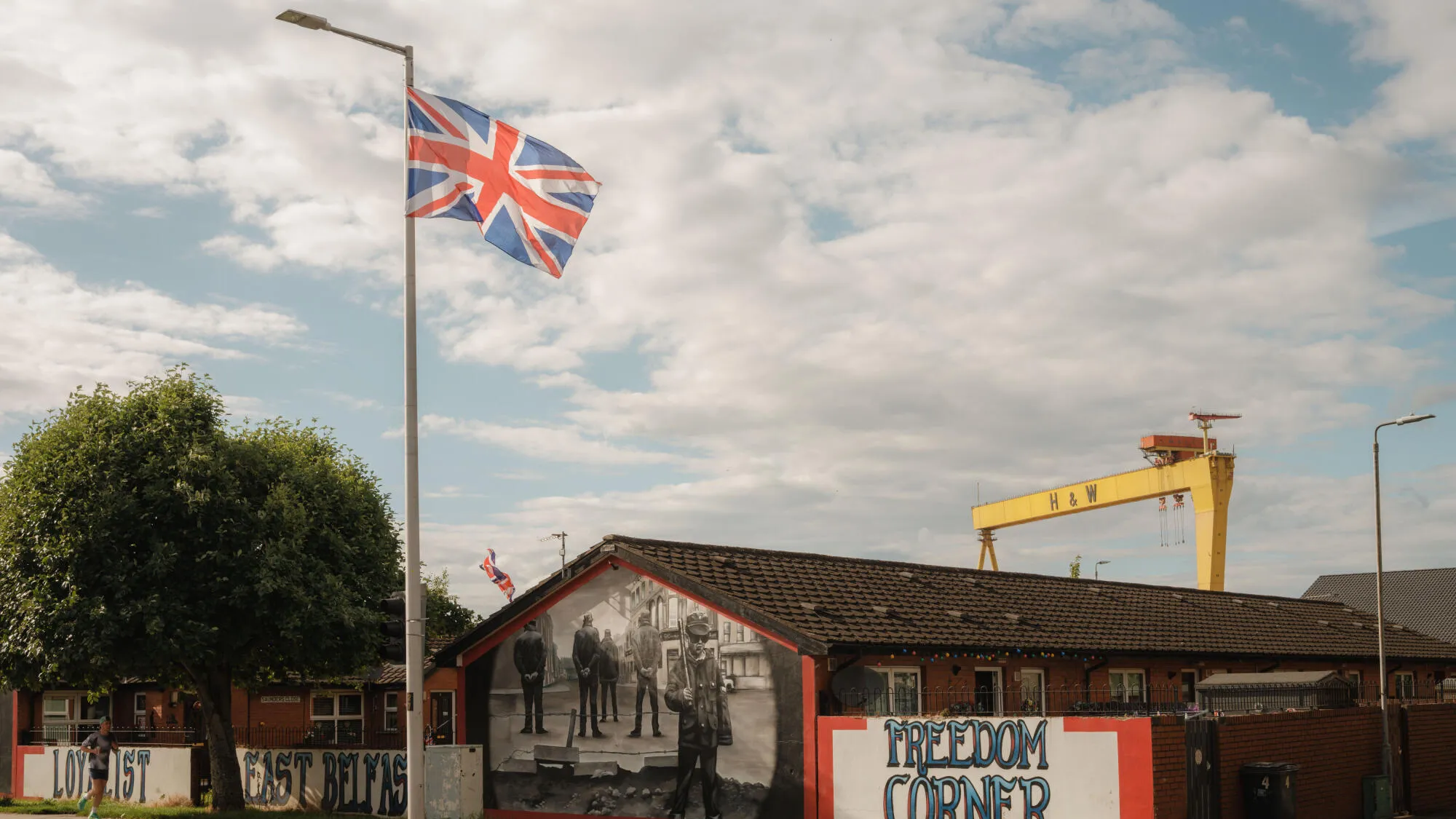
Here, in the suburbs of Belfast, suspicion is a reflex. Each neighborhood is guarded by bales of barbed wire. The Peace Walls – these walls of peace erected after the Troubles, the fever which bloodied Northern Ireland and left more than 3,500 dead for almost thirty years – maintain a fragile harmony.
More than twenty-five years after the Good Friday Agreement of 1998 which put an end to this inter-community violence, nationalist Catholics and unionist Protestants live separately. At the top of the buildings, the flags provide information on the obedience of the end of the sidewalk. The frescoes painted on the walls remind us, like a stubborn prayer, of the price of peace.
Wind of riots
But on June 9 and 10, the city plunged back into violence. On Newtownards Road, residents compare the traces left by the riots: a burned car here, a smashed window there. This time, the anger did not target the neighbor on the boulevard next door, but the foreigner, who had become the explanation for all evils and accused of “invading” and “disturbing” an island which had painfully regained its calm.
After the brutal stabbing of an ordinary resident by a Sudanese asylum seeker on June 8, hundreds of hooded faces spread terror, calling for migrants to be “kicked out” and setting fire to community businesses. Corrupted public debate How was Belfast, long shaped by its own fractures and little affected by immigration, able to give in to this wind of riots which has been blowing across the United Kingdom for several years?
Across the Channel, society has become accustomed to living to the rhythm of these sudden conflagrations. Triggered after the murder of three girls during a dance class by a British teenager born to Rwandan parents, in the summer of 2024, the riots in Southport, a town located in the west of England, opened a sequence from which the country is still struggling to emerge. Thanks to a news item, crowd movements arise, spread and further corrode public debate.
Post-Brexit reality
However, the British thought they had finished with this undermined debate. Ten years earlier, on June 23, 2016, they voted by 51.89% to leave the European Union, with the promise of a drastic reduction in immigration and a return to full employment. By breaking with the principle of European free movement, the most fervent supporters of leave – of leaving the EU – dreamed of making the United Kingdom a fortress, protected by its insular character.
If not all British people shared the enthusiasm aroused by this bet, the referendum should settle the question and ratify a shift in the fight against immigration. Ten years later, the reality is quite different. After a historic peak of nearly 1.5 million immigrants in 2023, the United Kingdom still welcomed nearly 900,000 in 2025.
That day, I did not vote. What’s the point if politicians then do the opposite of what the majority demands?
Lya house painter
Enough to maintain, among some British people, the feeling of not having been listened to. Lya shares this frustration. This Wednesday afternoon, the house painter is enjoying his day off with his niece, whom he gently pushes on the swing. Politics? He no longer “believes” in it. The parties? “Good only to promise the moon. »Brexit finally convinced him. “That day, I did not vote. What’s the point if politicians then do the opposite of what the majority demands? »
“Today, frustration has released racist speech”
The feeling of dispossession floods the speeches and unleashes comments hitherto confined to the margins of the extreme right. “Today, frustration has unleashed racist speech,” worries Manus Maguire, of the Regeneration Forum, an organization committed to reconciliation in Belfast. Those most neglected by society find a new outlet in the fight against immigration.
During the riots, the premises of this social worker appeared on lists of places to be set on fire broadcast on WhatsApp. “But above all, Brexit has changed the face of immigration,” insists Cathal McManus, researcher specializing in the study of extremism at the University of Belfast. By breaking with Europe, the United Kingdom has seen immigration from Poland, Slovakia and Romania dry up.
898,000
898,000 immigrants arrived in the UK in 2025. Source: Office for National Statistics, 2026.
These posted workers, directly targeted during the 2016 debates, have been replaced by migrants from India, Sudan or Nigeria, whose cultural references, further removed from British society, fuel the rejection.
It is on this soil that Reform UK – a resolutely anti-migrant and anti-elite party – thrives. Long marginal, the movement emerged from the shadows during the 2016 campaign, actively supporting Brexit. Led by Nigel Farage, a vociferous and skillful tribune, it became the country’s leading protest force.
Populist crusade
Taking advantage of the collapse of the traditional parties, Labor (labour) and the Tories (conservatives), deemed incapable of curbing immigration. The resignation of Labor Prime Minister Keir Starmer on June 22 illustrates the extent of the political crisis. Reform UK imposes its populist grid on regions, like Northern Ireland, which had nevertheless voted in favor of remaining.
To the point of creating a shift? There are signs of rapprochement between the far right and the Northern Irish unionists. The hardest wing of the loyalist camp, Jim Allister’s Traditional Unionist Voice, has struck an election deal with Reform UK. Relations with the Democratic Unionist Party, the main unionist party, have also warmed.
Within the most extremist factions, a barely veiled dream now brews: to overcome the historic divide between Catholics and Protestants to unite them around the same anti-migrant crusade. Convergence remains a pipe dream: the constitutional question still structures local political life, and Sinn Féin, the main force in the nationalist camp, remains largely in favor of welcoming it.
Away from the politicized crowds, the line of conduct remains: no collusion with the rioters. Everyone knows in their flesh what a rainy afternoon is like when we bury a neighbor murdered by another.