
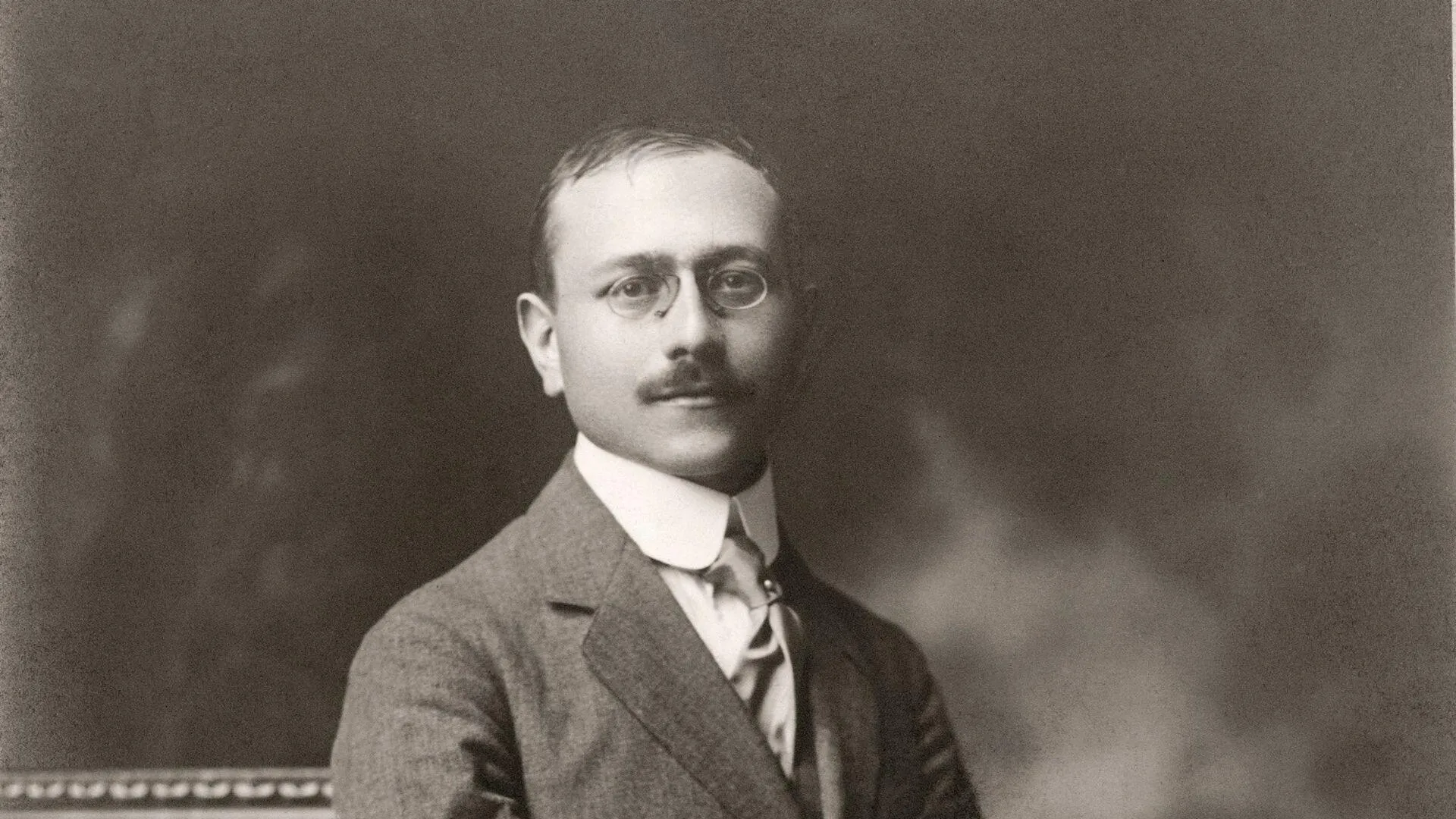
Pantheonization of Marc Bloch: “He remains the boss”
“Marc Bloch (1886-1944) quite simply remains “the boss”, even today! », summarizes the specialist journalist from France Culture, Emmanuel Laurentin. “Nearly a century after Jules Michelet (1798-1874), we consider that he is the founder of contemporary historical science,” agrees professor of medieval history Florian Mazel, one of the coordinators of a collective work devoted to this major academic of the 20th century. In fact, starting from the milestones that it has set, we see the major areas, methods and tools that continue to stimulate researchers.
Immediate history, long time
Marc Bloch’s best-known work, The strange defeatwas written “on the fly” during the Occupation and published posthumously in 1946. The man who is now a citizen threatened because he is Jewish and, soon, a resistance fighter lucidly analyzes the defeat of the French army. He then inaugurated the idea of “immediate history” or “history of present times”, which had become a field in its own right. With this particularity of using direct testimonies as sources. This principle guides, for example, historians of the Shoah who have used the stories of survivors or their recordings.
Likewise, concerning the Algerian War, even closer to us, the historian Raphaëlle Branche collected the memories of French conscripts for twenty years. “The difficulty then consists of maintaining distance from one’s sources and not becoming a memoirist rather than a historian,” warns his colleague Claire L’Hoër. Especially when immediate history questions tragedies and reconstructs them from the point of view of the victims.
Previously, when in 1931, Marc Bloch published The original characters of French rural historyhe painted a broad picture of the landscapes shaped by farmers between Prehistory… and the 19th century! He, the specialist in the Middle Ages, freed himself from the temporal barriers which sequence his discipline and opened a vast field still plowed today: History seen through the prism of “the long term”. This concept makes it possible to understand economic, social and cultural phenomena that evolve slowly.
With his friend Lucien Febvre, he notably founded, in 1929, the magazine Annalswhich still exists, where some of the recent research is published. “In recent years,” observes Emmanuel Laurentin, “the history of the environment has developed in this way. » History of town planning, pollution, forests or climate… These themes also require crossing the ages. “Whereas, with the development of our discipline, we have often become hyper-specialists in a specific field and a well-defined period,” regrets Florian Mazel.
Free yourself from frames
Crossing perspectives and going beyond borders: this is a constant at Marc Bloch who brings together geographers, economists, sociologists, anthropologists, linguists… in his journal. The idea is to arrive at a “global history” which takes into account all the dimensions of the phenomenon we want to study. “Moreover, for him, the history of France only has meaning in a comparison of the same practices – agriculture or the exercise of royalty – with other countries,” insists Peter Schöttler who has also just written a biography of the historian.
Two directions which have been reflected, for around thirty years, in numerous collective publications: encyclopedias, books resulting from conferences or even exhibition catalogs are now champions of interdisciplinarity. So, in Mirror of a city. The Lyon History Museum (Ed. Libel), notes on geography, sociology and archeology complement those on history and art history to tell the story of the capital of the Gauls. Translations of foreign works on France also decenter our view of our own past, such as the biography of the British Julian Jackson, in 2019, De Gaulle. A certain idea of France (Ed. du Seuil) which inspired the film The Battle of Gaulle, currently in theaters.
Fire from all sources
Interested in rural life, and the status of serfs in particular, Marc Bloch opens the way to restore “the life of Mr. Everyman”, as Claire L’Hoër nicely summarizes. Emblematic work of this movement: Montaillou, Occitan village from 1294 to 1324 by Emmanuel Le Roy-Ladurie, published in 1975, reconstructs the daily life of the inhabitants of this Ariège village at the time of the Cathar heresy. Since then, countless studies have continued to highlight the most diverse social groups.
“Today, there are a lot of women and minorities,” notes historian Dominique Missika. Which is logical, because the historian responds to the concerns of his time. » Claire L’Hoër also points out the growing interest in tracing the history of cultural notions – such as death, beauty, etc. –, that of emotions, senses and sensitivities… Thus Alain Corbin who published in 2016 a history of silence, while Michel Pastoureau is interested in that of colors.
Among their young heirs: Sarah Rey explores the power of crying in Antiquity, while Clémentine Vidal-Naquet examines conjugal love in the correspondence of the poilus. Far from official archives, these historians delve into private correspondence, diaries and even novels. Big change over the past twenty years: “With the digital revolution, we can now consult manuscripts on the other side of the world,” notes Florian Mazel.
To make those who did not write speak, Marc Bloch did not hesitate to analyze illuminations, aerial photos, artistic or archaeological objects: “For him, any witness of the past can be questioned, any vestige makes history,” insists Professor Mazel. A path, abundantly cleared by his successors. It allows you to read, for example, The thief of paradise by Christiane Klapisch-Zuber (Ed. Alma) who examines, in 2015, what the representations of the Good Thief in the Gospel of Luke reveal about Renaissance society.
Rigor and taste for storytelling
Ultimately, nothing is forbidden to the historian, explains Marc Bloch in Apology for history or the profession of historian published in 1949, after his assassination by the Nazis: “He is not there to discover, once and for all, a forgotten truth,” summarizes Florian Mazel, “but to ask questions and propose an answer. Knowing that it will be re-examined, nuanced later by others who will have access to new sources or will reread them differently. »Resounding example: in 2017, under the direction of Patrick Boucheron, a World History of France (Ed. du Seuil).
From 146 dates, often unexpected, almost as many specialists communicate the latest status of their research. This calls into question, for example, the classic reading of the founding of Marseille by the Greeks or of the battle of Poitiers, led by Charles Martel in 732… A lively debate then pitted them against certain colleagues who accused them of destroying the traditional national narrative inherited from the programs of the school of Jules Ferry. “However,” analyzes Emmanuel Laurentin, “I like History when it surprises me, shakes me up, makes me see the time of the Crusades, for example – according to one of my recent readings – not from the point of view of the warriors, but from that of the anonymous guides who, in the Balkans, accompanied the pilgrims. »
If the method is scientific, the story must be entertaining, wrote Marc Bloch who was aware that, to appreciate History, “you need curiosity and appetite”. A great program for today.
Marc Bloch in 10 dates
July 6, 1886. Born in Lyon (Rhône). His father is a professor of ancient history.
1914-1918. A young high school teacher, he was drafted into the infantry.
1919. Wife Simonne Vidal. Teaches the Middle Ages at the University of Strasbourg.
1920. Publishes his medieval history thesis, Kings and serfs.
1929. Founded the magazine es Annals of economic and social history with his friend Lucien Febvre.
1937. Holder of a chair of economic history at the Sorbonne, in Paris.
1939-1940. A volunteer, he participated in the Battle of the North, then taught in the southern zone. His book Feudal society is published.
1940. Write The strange defeat.
1943. Joins the Franc-Tireur resistance movement.
June 16, 1944. Shot by the Gestapo in Ain. He was arrested on March 8 and tortured.
To go further
→ An exhibition: “Marc Bloch, the spirit of History”, at the Panthéon, in Paris, from June 25.
→ A comic strip: Marc Bloch, the fighting historianby Jean-David Morvan, advised by Suzette Bloch, drawings by Laurent Bidot, Ed. Tallandier, 104 p.; €23.
→ A documentary: Marc Bloch. In the name of France, on France 2, June 23, 2026.


