
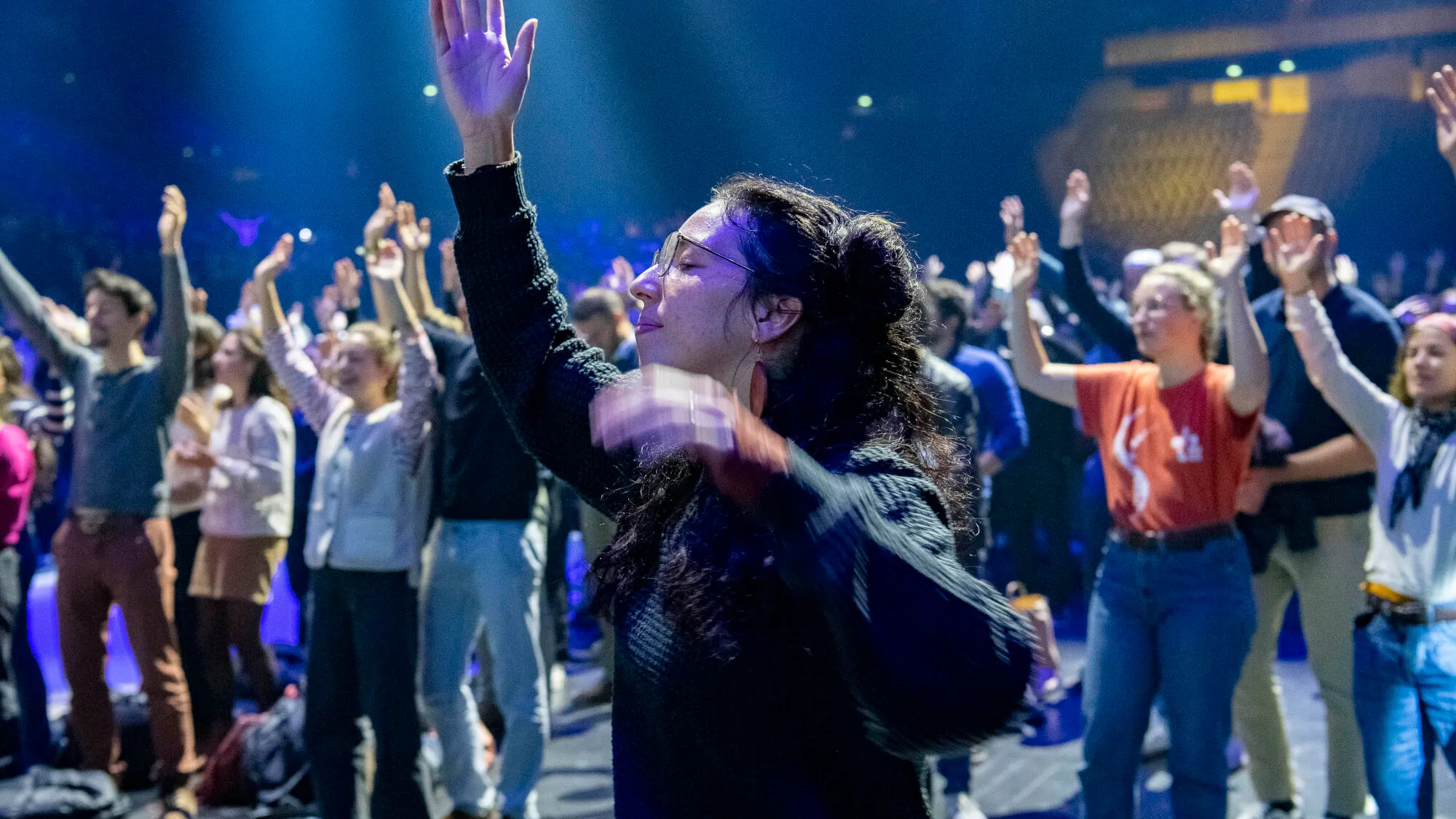
Charismatic renewal in French parishes
Last Sunday at mass, you sang Let my mouth sing your praise Or Stand up, shine ? Each month, your diocese organizes praise evenings or times of street evangelization? Perhaps you have even participated in a “prayer of the brothers” during which two faithful placed their hand on your shoulder to pray for you? Without knowing it, you sometimes practice your faith like a charismatic.
Nearly sixty years after the emergence of the first new communities, such as the Beatitudes, the Chemin neuf or the Emmanuel, the prayer habits of the charismatics have spread well beyond their ranks, to become integrated into the parishes. To the point of now offering the Church a new form of vitality.
In their early days, however, they aroused astonishment. The movement was built from the end of the 1960s among American evangelicals, emphasizing the action of the Holy Spirit, evangelization and especially “charisms”, these gifts of the Spirit cited by Saint Paul (1 Cor, 12), including healing, prophecy or the gift of tongues (see glossary at the bottom of the article). “During a family prayer, a friend of my parents, who knew nothing about my professional situation, gave me what we call “a word of knowledge”: he invited me to become a private teacher, something I had been working on for a long time,” says Aymeric, 30 years old.
In 2017, the International Office of Charismatic Renewal – which became Charis in 2019 – estimated that the movement brought together more than 120 million Catholics around the world.
If various crises have since diminished their influence, many faithful report strong spiritual experiences lived within them, which they then transmitted within their parish. In 2017, Pope Francis presented the Renewal as a “current of grace” for “the whole Church”, and not as a distinct movement. “After a period of distrust, charismatic forms such as the prayer of the brothers, the testimony of faith or praise are much better accepted,” analyzes Valérie Aubourg, professor of anthropology-ethnology at the Catholic University of Lyon.
A new culture
The movement, however, clashed with other ecclesial sensitivities. “The militant Catholic movement, the majority after the Second Vatican Council, took a dim view of these Catholics who put forward the Eucharist, confession and practices of piety,” recalls Valérie Aubourg. Even today, when parishes are entrusted to them (around thirty in France just for Emmanuel, editor’s note), these communities can quickly change their uses, at the risk of annoying them.
“Their repertoire of songs, in particular, can scare away parishioners who don’t understand them,” explains Olivier Landron, historian of Christianity. Where the songs of the 1970s present a very community dimension, emphasizing the liberation offered to all, those of the Renewal emphasize more the individual relationship of the faithful with God, more readily employing informality. The charismatic songs quickly spread. “Even among more traditional sensibilities, like the Saint-Martin community, who willingly draw from Emmanuel’s “green notebook,” notes Olivier Landron.
Certain markers are now spreading without even being identified as such. Valérie Aubourg cites the success of “Alpha courses”, to train in spiritual life, or even “mothers’ prayer” groups. Born in England, they use charismatic codes without claiming to do so. In Nîmes, Mgr Brouwet, responsible for Renewal for the Conference of Bishops of France (CEF) from 2019 to 2025, shares the same observation: “We see prayers from the brothers in the parishes, without it being stamped “Renewal”. Songs of Emmanuel are sung, without the audience raising their hands. » It is therefore a new culture which permeates the Church and its faithful. In a pastoral letter dedicated to the prayers of the brothers, for healing and deliverance, the Archbishop of Lyon, Olivier de Germay, mentioned them as practices which “are no longer confined to new communities”.
Help for ordinary life
However, not all Catholics begin to speak in tongues or perform healings. “Many charisms are less extraordinary but important: welcome, preaching, authority in the Church… We must invoke the Holy Spirit more in ordinary ecclesial life,” underlines Mgr Brouwet.
This aspiration affects the faithful of all stripes today. In circles of traditional sensibility, the mixture of genres gave birth to the adjective “tradismatic”. In the working-class suburbs, the influence of evangelicals spreads the attraction for large charismatic prayer assemblies and healing prayers. Valentine Latapy, 32, grew up in an Ignatian spirituality. This Ile-de-France biologist experienced a personal conversion at the age of 22. She feels a “burning fire” in her heart, which she understands today as an “outpouring of the Holy Spirit”.
She does not frequent charismatic circles, uncomfortable with their great expressiveness. However, in 2025, she joined the French School of Life in the Spirit (EFVE), a one-year training launched by the diocese of Paris to renew her spiritual life and train in charisms.
In parishes, these practices transform community life. At Notre-Dame-de-Bonne-Nouvelle, in Rennes, the brothers’ prayer is offered after Sunday mass, since volunteers received an outpouring during a retreat, and wanted to share it with everyone. “Each time, several faithful request it. I am very touched to see the peace they get from it,” confides Carole Fouillet, 50, who notes a strengthening of fraternity in the parish. Several communities, however, have been marked by spiritual, physical abuse or governance abuses. The Beatitudes were placed under supervision by the Vatican between 2010 and 2015 to carry out refoundation work, the Word of Life was thus dissolved in 2023. The Chemin neuf community is today the subject of criticism from former members, to the point of having mandated an independent commission last March to respond to these situations. Finally, for almost a year, Emmanuel has been accompanied by a bishop appointed by Rome to verify its management and its integration into the dioceses.
Reinforced supervision
Today, faced with the growth of initiatives, the Church is taking care to better supervise them to avoid abuses, such as personal power grabs and spiritual influence. In 2017, the CEF published a booklet Protection, deliverance, healingto help parishes accompany prayer requests. In his pastoral letter, Mgr de Germay recalls in particular the importance of the training of companions, the agreement of the priest and community discernment.
Same caution at the EFVE: “We must check that those who grow in their charisma evolve in a balanced manner: that they do not act alone in their corner, that they remain attentive to comments, and that they are detached from their charisma,” underlines Father Grenet. Taking stock after three years of existence of the EFVE, the priest is enthusiastic: “Pope Francis told the charismatics to be a river before joining the sea. Being a small diocesan body which trains in the charism, we have the feeling of witnessing this meeting of confluences. »
Six dates for a renewal
- May 5, 1895. Letter Provida matris caritateby Leo XIII, calling on the Church to make a novena to the Holy Spirit.
- 1962-1965. Vatican Council II, which reopens the door to the exercise of charisms in the Church.
- February 1967. Outpouring of the Spirit experienced by Pennsylvania students with Pentecostals. Beginning of the Catholic Charismatic Renewal.
- 1972-1978. Birth of the first French charismatic communities (Emmanuel, Fondacio, Puits de Jacob, etc.)
- Pentecost 1998. John Paul II receives, for the first time, and encourages, new movements and communities in the Vatican.
- 2019. Creation of Charis, the international service desired by Francis to coordinate the Charismatic Renewal.
Small glossary
- Prayer of the brothers. Several Christians surround a person and intercede for them, saying words received in prayer.
- Word of knowledge. Truth received in prayer over the life of a person, who thus recognizes himself.
- Prophecy. Word spoken in the name of God and received in prayer (and not prediction of the future).


