
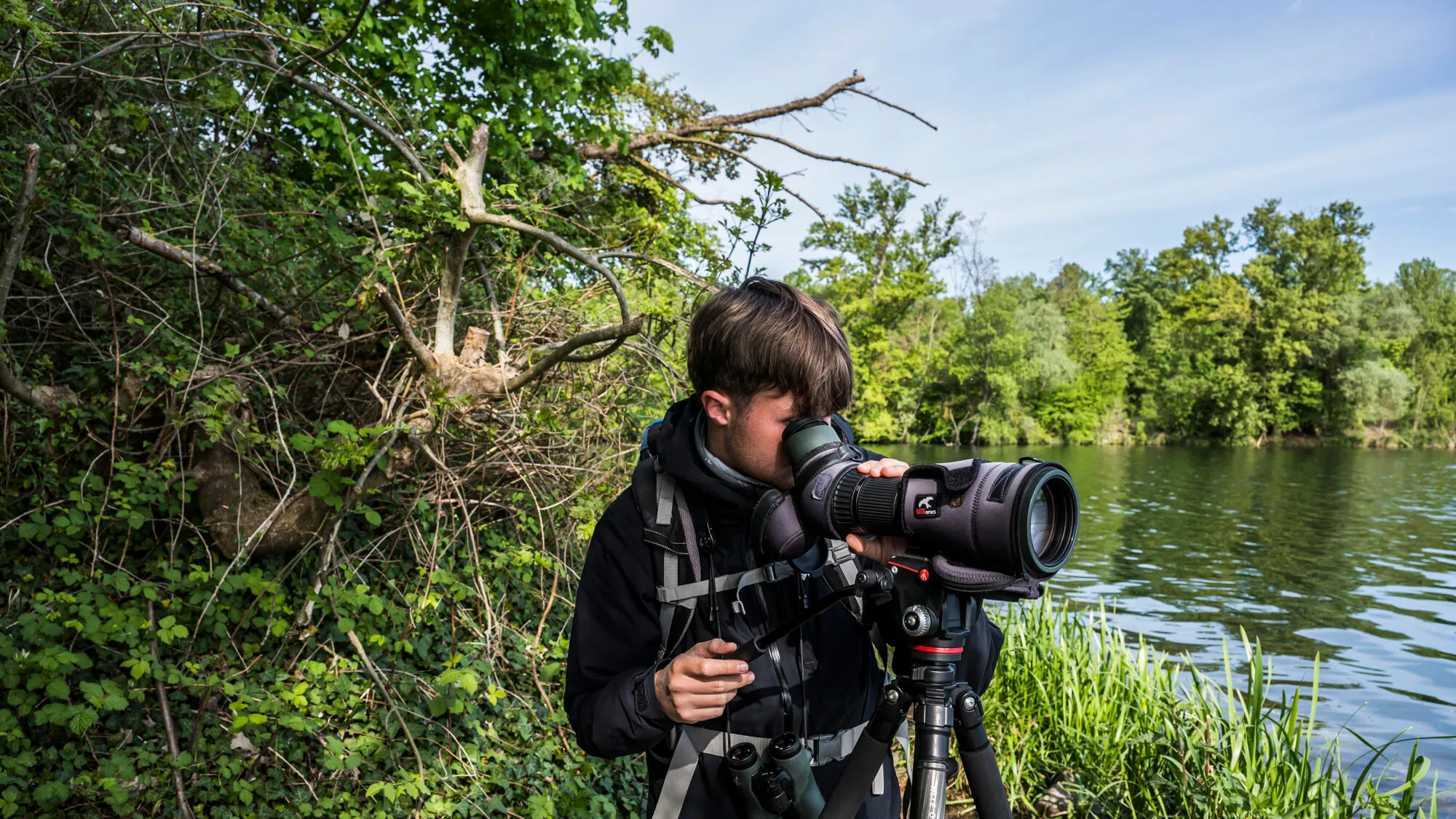
who are the hunters, in search of the rare bird?
The place seems calm, peaceful. Trees line a large expanse of water, barely stirred by a light morning breeze. The Erstein alluvial forest nature reserve (Bas-Rhin), in the former major bed of the Rhine, is nevertheless full of activity, for those who know how to listen. “We hear a cuckoo, nightingales and a swift. It really is the beautiful season. » Luca Fétique may only be 21 years old, but he has experience spotting birds. With his optical telescope, he points out a red-backed shrike. This amateur ornithologist, project manager at the League for the Protection of Birds (LPO) of Bas-Rhin, is a member of the community of anglers.
These several thousand enthusiasts note, online, each new bird seen, specifying the species, location and date. All their observations can be viewed on the website cocheurs.fr, and a ranking separates the most frequent participants. “Some cheat a little,” notes Luca. They tick even when all they have done is hear the birds. » If these animals are the most popular, the checkmark can concern all fauna, from grasshoppers to amphibians, including butterflies.
An addictive pleasure
In France alone, Luca checked off 363 species of birds. A great accomplishment, which explains the calm and perspective that animate him today. “When we haven’t seen any specimens, we always want to discover more. But I like not knowing what I’m going to encounter during the day. In this reserve alone, we could check around sixty birds on the site. I know what I saw and where I saw it in one click: it’s modernity. »
This modernity rhymes with accessibility. Some amateur ornithologists can avoid the usual hours of tracking: via groups on online messaging services such as WhatsApp or Telegram, they are informed in real time of the presence of certain specimens.
The supposed patient zero of the hantavirus epidemic which affected the cruise ship MV Handius, Leo Schilperoord, had observed 5,998 species of birds, according to his profile on the Ebird platform.
His sad story embodies the involuntary excesses that this very captivating passion can generate. Practitioners have gotten so caught up in the game that they go on for miles with the sole aim of ticking off the rare bird. Quentin Guibert has just returned from Camargue. For this 32-year-old from Lyon, these seven hours of round-trip driving were an easy journey. “It has already happened to me to go as far as Brittany or Normandy,” he explains.
Leaving on a Monday morning at 9 a.m., he was finally able to look at the coveted leucoptera lark, very rarely observed in France, around 5:30 p.m., after a day full of uncertainties. “It was a relief to see her. We were happy, we took the time to observe it carefully, to enjoy the species. It’s a hard feeling to describe. » For these few moments of pleasure, he still had to take an emergency RTT day, the evening before, and hold a professional video meeting from the car. The bird was worth it. “We have little chance of seeing this species in our lifetime,” assures the thirty-year-old, who works in a consulting company. Looking for the bird is an activity that takes you back to childhood: it’s like a game. We detach ourselves from our daily life, from our urban world. »
The risk of frenzy
This game can have an impact on social life. Quentin has already had to cancel long-planned weekends with friends. But he spares his family. On a weekend with his grandparents in Évian (Haute-Savoie), Quentin managed not to leave them stranded to go see an attractive Camargue lark. “There are wedges who would be capable of giving up everything. I haven’t done it yet. But if I know there’s a rare bird and I can’t go there, it makes me tense. » This racing fever can have its excesses.
On the LPO side, some tense up, off-screen, at the mention of the practice, citing examples of groves surrounded by dozens of frenzied wedgers. “Sometimes, the brains become disconnected,” recognizes Quentin Guibert, who regrets the shift towards a form of “consumption” of birds. “When I started, around fifteen years ago, we were accompanied by a mentor, there was a learning phase. Today, we see a lot more self-taught people coming here because of the craze on social networks. »
Isolated overflows
From now on, some are only attracted by the spectacular photo which will be widely “liked”, even if it means disturbing the birds or not respecting the environments in which they live. A skirmish pitted the community against entomologists at the end of 2025. In an article in the specialized online journal Martinia*, insect specialists returned to the recent disappearance of a microdragonfly called Nehalennia speciosa. Among the causes, the site cocheurs.fr is expressly named, guilty, according to the authors, of having encouraged overcrowding in a fragile environment.
These excesses remain rare, attributable to a minority intoxicated by the euphoria of the beginnings. Because experienced drivers are also keen observers of the evolution of the fauna. Their reports feed participatory science platforms, such as Faune France, which work in collaboration with an entire network of associations. At the water’s edge, in Erstein, the cuckoo song continues to resonate, indifferent to rankings and notifications. No score here. Only the long life of life.
* “Chronicle of a disappearance: the case of Nehalennia speciosa in Franche-Comté, the only contemporary French station”.


